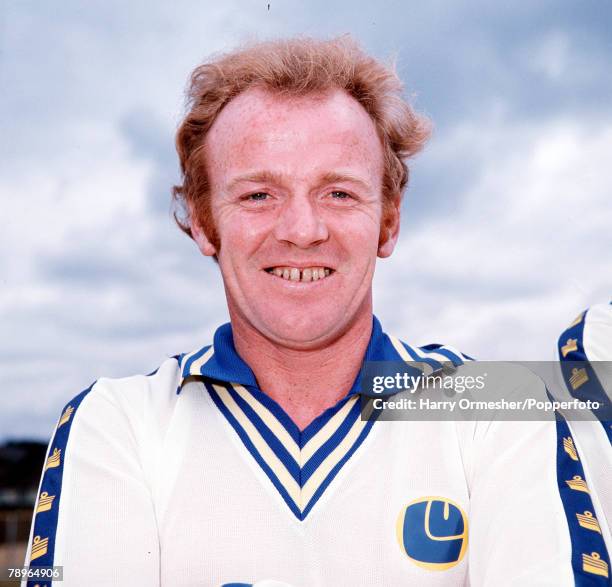
Billy Bremner
 United Kingdom
association football player•association football coach
Also known as: William John Bremner, Billy
Birthday
December 9, 1942
Birth Sign
Sagittarius
Birthplace
Stirling, Scotland
Age
Died at 54
Height
5 ft 5 in (165 cm)
About
Billy Bremner was a Scottish footballer and manager, widely regarded as the heart of the great Leeds United side of the 1960s and 1970s. Standing only 5 foot 5, he combined precise passing and creativity with ferocious tackling, boundless stamina, and a fiery competitive streak that made him a born leader. As captain, he drove Leeds through the most successful period in the club's history, winning two First Division titles, an FA Cup, a League Cup, and the Inter-Cities Fairs Cup. The team also became famous for an agonizing series of near-misses, finishing runners-up in multiple major competitions, including the 1975 European Cup final. That blend of triumph and heartbreak defined the era, and Bremner was at the center of it all, named the Football Writers' Association Footballer of the Year in 1973. He also captained Scotland at the 1974 World Cup, where the side went unbeaten but failed to advance on goal difference. After retiring, he managed Hull City, Doncaster Rovers, Leeds United, and Partick Thistle, with mixed success. Voted Leeds United's greatest-ever player in multiple fan polls, he was honored with a bronze statue outside Elland Road. Billy Bremner is remembered as a fearless leader and a legend of Leeds United and Scottish football.
Early Life & Background
Born in the Raploch area of Stirling, a working-class district, Bremner grew up in a council house with his family. His father was a coal miner, and money was tight. From a young age, he was obsessed with football, playing relentlessly in the streets and local parks. His small stature was offset by immense energy and natural talent. He attended St. Mary's Primary School and later St. Modan's High School. His first step toward professional football came with a local juvenile side, Gowanhill United, where his performances caught the eye of scouts. He initially had a trial with Chelsea but was rejected. In 1959, he joined Leeds United as an apprentice, signing professional terms in January 1960. A pivotal moment came when Don Revie took over as manager in 1961. Revie saw in the young, fiery midfielder the perfect prototype for the hard-working, technically gifted team he was building. Bremner made his first-team debut on 23 January 1960 against Chelsea, but it was under Revie that his career truly ignited.
Career Growth
Bremner established himself in the Leeds first team and was part of the side that won the Second Division title in 1963-64, earning promotion to the First Division. He became a permanent fixture in midfield and was appointed club captain in 1966, a role he held for a decade. Under his leadership, Leeds won the League Cup in 1968, beating Arsenal 1-0. The following season, they won the First Division title with a record 67 points, conceding just 26 goals. In 1971, Bremner lifted the Inter-Cities Fairs Cup after a two-leg victory over Juventus. The 1972 FA Cup final saw Leeds beat Arsenal 1-0, with Bremner raising the trophy. He was named Footballer of the Year in 1973, the same year Leeds lost the FA Cup final to Sunderland and the European Cup Winners' Cup final to AC Milan. The 1973-74 season brought a second league title, with Leeds going 29 games unbeaten from the start. At the 1974 World Cup, Bremner captained Scotland, who went undefeated but were eliminated on goal difference. In 1975, he led Leeds to the European Cup final, where they lost 2-0 to Bayern Munich in a controversial match. He left Leeds in 1976 after 773 appearances, a club record at the time, and moved to Hull City as player-manager. Later, he managed Doncaster Rovers to the Fourth Division title in 1980-81, then returned to Leeds as manager in 1981, but was unable to replicate his playing success and was sacked in 1985.
Career Timeline
Public Image & Style
Bremner was the embodiment of the "hard man", stocky, barrel-chested, red-haired, and perpetually scowling on the pitch. He was also a supremely gifted passer and a born leader. The media portrayed him as a fierce competitor, the heart of Leeds United, and a symbol of an era of football that was less sanitized. Fans still sing "There's only one Billy Bremner" at Elland Road, and his statue outside the stadium is a pilgrimage site. His legacy is treated with reverence on official club channels, often using the hashtag #BillyBremner.
Fame & Fandom (iFAMOUS Rankings)
Billy Bremner, the fiery Scottish midfielder who captained Leeds United to their greatest triumphs, has been evaluated by iFANN's Global Fame Engine but is not currently ranked in its published lists. As of August 2026, he does not hold a placement in the Global Top 1,000 or any Top-100 scope list. This absence from the rankings reflects the engine's focus on contemporary fame metrics, not a diminishment of his historical stature.
His fanbase, though devoted, has no formal name, no equivalent of 'Swifties' or 'Beatlemania.' Instead, his supporters are woven into the fabric of Leeds United and Scotland national team fandom. They honor him through annual tributes on his birthday and the anniversary of his death, and in 2026, a gala dinner at Elland Road celebrated 'the greatest captain we've ever had.' His motto, 'Side before self,' became a rallying cry for Scotland during the 2026 World Cup, a reflection of his enduring influence. Grassroots efforts in his hometown of Stirling further cement his memory, ensuring that the legend of Billy Bremner remains a living part of football culture.
Interesting Facts and Legends
Bremner was sent off multiple times, most famously in the 1975 European Cup final, contributing to Leeds' 'Dirty Leeds' reputation. His energetic, bouncy running style was nicknamed 'The Bremner Bounce' by fans. In the 1970 FA Cup final replay against Chelsea, he was involved in a famous on-pitch scuffle with Ron Harris. Despite his hard-man image, he was a gifted passer and had a surprisingly gentle touch. He always referred to Leeds United as 'we' even after leaving the club, and remained a passionate supporter until his death. The number 4 shirt he wore became iconic for his midfield role.
One of the most retold stories from his career is his captaincy of Scotland at the 1974 World Cup, where he earned praise from Pelé himself, a moment that underscored the respect he commanded from the game's greatest. Standing just 5'5", he was widely regarded as the most feared midfielder in English football, a reputation built on relentless tenacity and fierce tackling. His death on 7 December 1997, two days short of his 55th birthday, prompted an outpouring of grief, and fans still tell stories of his leadership and indomitable spirit.
Notable Quotes
“I wasn't a dirty player. I was a competitive player. There's a difference.”
“Leeds United is in my blood. It's not just a club; it's a way of life.”
“The only thing that matters is winning. Not playing well, not entertaining. Winning.”
“I'd have run through a brick wall for Don Revie. And I think I did a few times.”
Family & Personal Life
Bremner married Vicky in 1967, and she was a constant support throughout his career. They had three children: a son, Billy Jr., and two daughters, Susan and Deborah. The family lived a private life, a counterpoint to his ferocious public persona. After his death, his estate has been managed by his widow and children. The Billy Bremner Foundation, run by the family, raises funds for youth football in Stirling and Leeds.
Notable Connections
Bremner's closest collaborator was manager Don Revie, whom he revered as a father figure. On the pitch, he formed a legendary midfield partnership with Johnny Giles, combining Bremner's energy and tackling with Giles's creativity. He also played alongside defensive stalwarts Jack Charlton and Norman Hunter, and attacking threats Allan Clarke, Eddie Gray, and Peter Lorimer. For Scotland, he shared the pitch with Kenny Dalglish.
Relationships & Dating History
Bremner had a single known romantic relationship. He married Vicky in 1967, and they remained together until his death in 1997. The couple met in Stirling before his professional career took off. They had three children: a son, Billy Jr., and two daughters, Susan and Deborah. There are no credible public records of any other relationships. As of 2026, he is deceased and was married to Vicky at the time of his death.
- MarriedVicky Bremner1967 - 1997Met in Stirling before his career; married for 30 years until his death; three children together.
Death & Aftermath
Died
December 7, 1997 (aged 54)
Death Place
Leeds, West Yorkshire, England
Cause of Death
Heart attack
The campaign to erect a statue in his honor remains active, with progress reports issued as recently as April 2026, while limited-edition memorabilia such as the Billy Bremner whisky have been produced by fans to mark his enduring status. Tributes from peers and institutions followed immediately, with Pele recalling his belief in Scotland's tournament potential during the 1974 World Cup and the National Football Museum later inducting him into its Hall of Fame alongside the Scottish Football Museum. Fans continue to gather annually on December 7 for vigils, honoring the man universally regarded as Mr.
Leeds United for his fiery leadership and tireless energy under Don Revie. William John Bremner passed away on December 7, 1997, at St James's University Hospital in Leeds, West Yorkshire, just two days before his fifty-fifth birthday. He was fifty-four years old at the time of his death, which occurred following a bout of unspecified illness or flu-like symptoms that escalated into a sudden cardiac event. Specific details regarding the funeral service or burial location remain unrecorded in public sources.
Net Worth (Estate Value)
$4 Million
iFANN Editorial Team estimate
iFANN currently estimates Billy Bremner's estate at $4 million. The bulk of his wealth came from his playing and managerial career, with his peak earnings in the 1970s when he was one of the top-paid footballers in England. Posthumously, the estate generates revenue through royalties from his autobiography Billy Bremner: The Autobiography, image rights used in video games such as FIFA and Pro Evolution Soccer, and sales of memorabilia like signed shirts and boots. The Billy Bremner Foundation also raises funds for youth football. A major restoration of his statue outside Elland Road in 2024-2025 was funded by the club and the foundation. A documentary titled The Heart of Leeds: Billy Bremner is scheduled for release in 2026, which will bring additional licensing income to the estate.
Awards Won (6)
Bremner won the Football Writers' Association Footballer of the Year award in 1973, the highest individual honor in English football at the time. He also won the Scottish Footballer of the Year award in 1973 and was named Leeds United Player of the Year four times between 1970 and 1973.
1973 · Player of the Year
Leeds United and Scotland
1973 · Player of the Year
Leeds United and Scotland
Known For
Leeds United captain and midfielder
1966 · Captain
First Division title wins
1969 · Midfielder
FA Cup victory
1972 · Captain
Footballer of the Year
1973 · Player
Scotland captain at World Cup
1974 · Captain
Keywords
Quick Facts
- Profession
- association football player, association football coach
- Born
- +1942-12-09
- Birthplace
- Stirling
- Died
- +1997-12-07
- Death Place
- Doncaster
- Gender
- Male
- Birth Sign
- Sagittarius
Personal Details
- Full Name
- William John Bremner
- Height
- 5 ft 5 in (165 cm)
- Spouse
- Vicky Bremner
- Children
- Billy Jr., Susan, Deborah
- Education
- St. Modan's High School, Stirling
Frequently Asked Questions
How old was Billy Bremner when he died?
What is Billy Bremner's net worth in 2026?
Where is Billy Bremner's statue located?
How many children did Billy Bremner have?
What is Billy Bremner best known for?
Similar People
Join the community
fans discussing