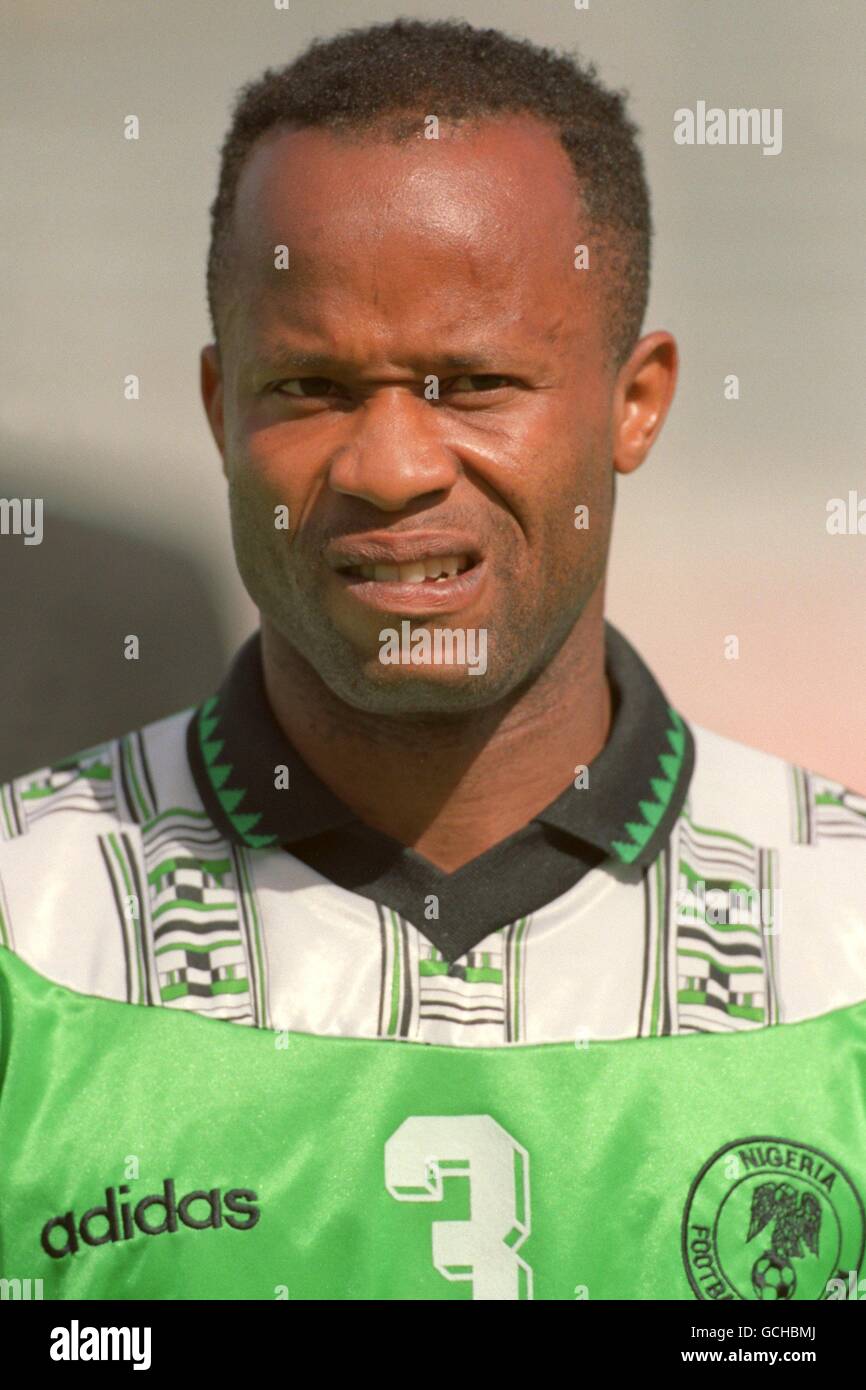
Benedict Iroha
 Nigeria
Former professional footballer•coach
Also known as: Ben Iroha
Birthday
November 29, 1969
Birth Sign
Sagittarius
Birthplace
Aba, Abia State, Nigeria
Age
56 years old
Height
5 ft 8 in (173 cm)
About
Benedict "Ben" Iroha is a Nigerian former professional footballer who starred as a left-back and left midfielder during the golden era of Nigerian football. He earned 41 caps for the Super Eagles and was a key member of the squad that won the 1994 Africa Cup of Nations and reached the Round of 16 at the 1994 FIFA World Cup, Nigeria's first appearance on that stage. Iroha also played at the 1998 World Cup in France, making him a two-time World Cup participant.
At club level, Iroha competed in Nigeria, Belgium, and Switzerland, with his most successful spell coming at Swiss side FC Sion, where he won the Swiss Cup in 1995 and 1996. After retiring, he transitioned into coaching, working with Nigeria's Olympic side, and later founded a football academy in Lagos. He remains a respected voice in Nigerian football, frequently offering commentary on the national team's fortunes.
Fans remember Iroha for his explosive pace, overlapping runs, and pinpoint crosses, qualities that made him a nightmare for defenders. His legacy as one of Nigeria's finest left-backs endures, and he is often cited in discussions about the country's best-ever defensive talent.
Early Life & Background
Benedict Iroha grew up in Aba, a bustling commercial city in Abia State, Nigeria. Like many Nigerian kids of his generation, he played football in the streets and on dusty pitches, developing the raw skills that would later define his career. He started as a midfielder, using his energy and technical ability to dictate play from the center of the park. But it was a positional switch that changed everything, moving to left-back unlocked his true potential, allowing him to bomb forward at will while still fulfilling his defensive duties.
Iroha honed his craft in the Nigerian domestic league, which in the late 1980s and early 1990s was a hotbed of talent. The competition was fierce, and he quickly stood out with his athleticism and attacking instincts from the back. His performances in the domestic league caught the attention of national team selectors, and he earned his first call-up to the Super Eagles setup. This was the era that produced a golden generation of Nigerian footballers, and Iroha was determined to be part of it.
His early career was marked by a relentless work ethic and a willingness to learn. Coaches noted his professionalism and his ability to adapt to different tactical demands. By the early 1990s, Iroha had established himself as one of the most promising left-backs in the country, setting the stage for his breakthrough on the international stage.
Career Growth
Iroha's career reached its peak in 1994, a landmark year for Nigerian football. He was a starting left-back for the Super Eagles at the Africa Cup of Nations in Tunisia, where Nigeria lifted the trophy for the second time. That summer, he played every minute of Nigeria's run at the FIFA World Cup in the United States, helping the team advance to the Round of 16 in their debut appearance. The squad's performances captivated the world, and Iroha's marauding runs down the left flank became a signature of that team.
After the World Cup, Iroha moved to Europe, joining FC Sion in Switzerland. He quickly became a fan favorite, and his contributions helped the club win the Swiss Cup in 1995 and again in 1996. These were the first major trophies of his club career, and they cemented his reputation as a top-level defender. He also had stints in Belgium, where he continued to play at a high level.
Iroha returned to the World Cup stage in 1998, earning a spot in Nigeria's squad for France '98. Although the team exited in the Round of 16 again, Iroha's experience and leadership were vital. After retiring from playing, he moved into coaching, working with Nigeria's Olympic team and later founding a football academy in Lagos to nurture young talent. He has remained an active commentator on Nigerian football, often drawing on his own experiences to advocate for the national team's improvement.
Career Timeline
Public Image & Style
In Nigerian football circles, Iroha is remembered as one of the greatest left-backs the country has ever produced. Fans often describe him as a "super left full back," and many struggle to name a better Nigerian player in that position since his era. His public persona is that of a nostalgic figure from the golden age of Nigerian football, someone who embodies the flair and attacking spirit of the 1994 generation. He is frequently called upon by the media for commentary on the national team, and his opinions carry weight because of his World Cup experience. Iroha's social media presence is modest, but his appearances in fan tributes and retrospective posts keep his legacy alive.
Fame & Fandom (iFAMOUS Rankings)
Benedict Iroha does not command a formalized fandom with a distinct name or organized digital infrastructure, as his legacy resides within the historical memory of Nigerian football rather than modern celebrity culture. His supporters are primarily purists who revere the 1994 Super Eagles generation, viewing him through the lens of nostalgia for a golden era that predates the social media campaigns and fan clubs typical of contemporary stars. While interactions occur on social platforms where fans label him a legend, there are no official hashtags, charter drives, or ritualistic gatherings dedicated solely to his person. In August 2026, the iFANN Global Fame Engine evaluated Benedict Iroha and determined he currently holds no placement in the published rankings, including the Global Top 1,000 or any Top-100 scope list. This absence of a rank reflects his status as a historical figure whose fame is anchored in specific athletic achievements rather than ongoing global consumption metrics. The evaluation confirms that while he remains a respected voice in sports commentary, he does not generate the volume of search traffic or media coverage required for a current numerical position in the worldwide hierarchy. Consequently, his influence is measured by enduring cultural respect among football enthusiasts rather than quantifiable popularity scores.
Interesting Facts and Legends
Originally a midfielder before converting to left-back, Iroha earned the moniker "super left full back" from admirers who consider him one of Nigeria's finest defenders in that position. He stands among the few Nigerians to feature in two FIFA World Cups, appearing in both USA '94 and France '98. His son, Ben Iroha Jnr, surprised many by pursuing basketball instead of football despite his father's illustrious career. In 2021, thirty years after their triumph, Iroha received presidential housing allocations alongside the rest of the 1994 squad from President Muhammadu Buhari. A notable piece of folklore involves an incident where Iroha claimed the media had pushed him into a narrative regarding his exclusion from coaching roles, highlighting a clash between public expectation and federation administration. His most iconic moment remains leading the left flank during Nigeria's historic debut at the 1994 World Cup, an event fans frequently cite as unmatched by subsequent generations. He also cemented his legendary status by participating in the 1998 tournament in France, becoming a rare two-time World Cup participant for his nation.
Notable Quotes
“No set of Eagles can match USA '94 squad.”
“Nigeria's absence at the World Cup is being strongly felt.”
Family & Personal Life
Iroha is a father to Ben Iroha Jnr, who has carved his own path in sports. Unlike his father, the younger Iroha chose basketball, and in a 2021 interview he expressed his ambition to represent Nigeria in that sport. The elder Iroha has spoken proudly of his son's independence, noting that he never pressured him to follow in his football footsteps. Details about Iroha's parents, siblings, and current household are not publicly documented, as he has kept his personal life largely private.
Notable Connections
Iroha's career is closely linked with his 1994 Super Eagles teammates, including Stephen Keshi, Uche Okafor, Thompson Oliha, and Rashidi Yekini, several of whom have since passed away. He has also been associated with fellow Nigerian legend Segun Odegbami, who has paid tribute to the 1994 generation. More recently, Iroha has interacted with NPFL Chairman Elegbeleye, whom he praised in 2024 for transforming the league.
Relationships & Dating History
Public records do not document any romantic relationships, marriages, or divorces for Benedict Iroha. He has kept his personal life out of the spotlight, and no credible sources have reported on his dating history or current marital status. As of 2026, his relationship status remains unknown, and he appears to prioritize privacy regarding his family life.
Salary, Net Worth In 2026
$1 Million
iFANN Editorial Team estimate
Benedict Iroha's net worth is not publicly tracked by major celebrity wealth outlets, so exact figures remain elusive. Per iFANN's editorial analysis, his total assets are estimated at $1 Million as of 2026. Club salaries in the 1990s were modest compared to today's standards, yet Iroha sustained a professional career spanning over a decade. His post-retirement work with Nigeria's Olympic team and his academy have provided additional income streams distinct from his playing days. Unlike modern stars with massive endorsement deals, Iroha's wealth reflects the economic realities of the era he played in. Still, his contributions to Nigerian football have earned him recognition, including a presidential housing allocation in 2021 which added to his asset base.
Awards Won (3)
Iroha's trophy cabinet includes the 1994 Africa Cup of Nations title with Nigeria and two Swiss Cup victories with FC Sion in 1995 and 1996. These are team honours, but they highlight his role in successful sides. He did not receive individual awards during his career, but his contributions were vital to these triumphs.
1994 · Winner
Nigeria national team
1996 · Winner
FC Sion
1995 · Winner
FC Sion
Known For
Africa Cup of Nations
1994 · Left-back for Nigeria
FIFA World Cup
1994 · Left-back for Nigeria
Swiss Cup
1995 · Player for FC Sion
Swiss Cup
1996 · Player for FC Sion
Keywords
Sources
Quick Facts
- Profession
- Former professional footballer, coach
- Born
- November 29, 1969
- Birthplace
- Aba, Abia State, Nigeria
- Gender
- Male
- Birth Sign
- Sagittarius
- Height
- 5 ft 8 in (173 cm)
- National Team Caps
- 41
Personal Details
- Full Name
- Benedict Iroha
- Height
- 5 ft 8 in (173 cm)
- Children
- 1 son (Ben Iroha Jnr)
Frequently Asked Questions
How old is Benedict Iroha?
Did Benedict Iroha play in the World Cup?
What is Benedict Iroha's height?
Does Benedict Iroha have children who play football?
What is Benedict Iroha doing now?
Similar People
Join the community
fans discussing