“It's a movie that knows its audience and delivers exactly what they want: a good time with some serious stuff thrown in.”
Roger Ebert
Chicago Sun-Times
 United States
"Everyone's gettin' lined up."
Part of a Collection
Barbershop Collection
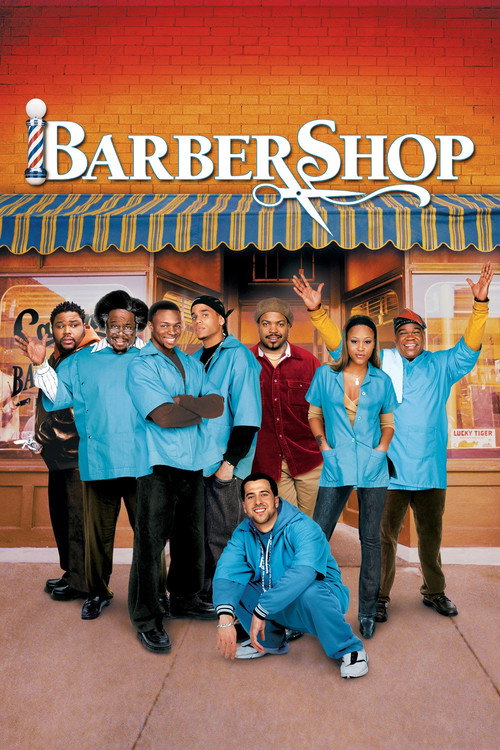
Set against the sweltering backdrop of a single July day in 2001, Barbershop transforms a South Side Chicago shop into a vibrant stage for community life. Ice Cube steps into the role of Calvin Palmer, a young man who inherited his late father's business but sees it merely as a financial burden rather than a legacy. The narrative unfolds as Calvin navigates the volatile mix of regulars and staff while facing pressure from a local loan shark to sell the property.
The film captures the unique rhythm of neighborhood life where conversations drift effortlessly from politics and crime to personal struggles. Inside these four walls, characters like J.D., Jimmy James, and Ricky Nash represent various facets of African American experience. Their interactions reveal deep-seated frustrations with gentrification and police brutality while highlighting the resilience that binds them together.
Stream
Availability and pricing can change. Confirm on the provider's site before purchasing.
The story begins on a humid afternoon in July 2001 when Calvin Palmer inherits a struggling barbershop on the South Side of Chicago. He views the establishment not as a cherished family heirloom but as an asset he needs to liquidate to pay off debts left by his father. A slick real estate developer named Isaac Rosenberg represents a chain of modern salons eager to buy the building and displace the neighborhood's traditional culture. Calvin's primary goal is to secure enough money to leave the area, treating the shop as nothing more than bricks and mortar.
Inside the shop, Calvin must manage a chaotic environment filled with colorful personalities. J.D. serves as a charismatic but immature barber who constantly clashes with Calvin's serious demeanor. Jimmy James, a gentle soul and former teacher, finds solace in the routine of cutting hair. Ricky Nash, a smooth-talking musician, struggles with his identity while flirting with Terri Jones, the sharp-witted beautician running the adjacent salon. Terri shares a complex romantic history with Calvin, adding personal tension to the professional chaos.
The central conflict intensifies when Eddie, the loan shark who owns the building, makes it clear that Calvin must pay off the debt by the end of the week or lose the shop permanently. Simultaneously, a large sum of cash goes missing from the safe belonging to one of the customers. This theft forces the disparate group of patrons and staff to band together to find the culprit before the police arrive or the situation spirals out of control.
As the day progresses, the shop becomes a forum for heated debates about race, politics, and the changing landscape of Chicago. Conversations range from the aftermath of the O.J. Simpson trial to local issues of police brutality. These discussions reveal the deep-seated hopes and frustrations of the residents. The investigation into the stolen money brings hidden secrets and rivalries to light, forcing characters to confront their vulnerabilities.
Tensions rise as the deadline approaches. Calvin struggles with the decision to sell, torn between his desire for financial freedom and the growing realization that the shop serves as a vital institution for the community. He witnesses how the space provides a safe haven for men to express themselves and resolve conflicts. The arrival of the police and the looming threat from Eddie create a ticking clock that pushes everyone toward a breaking point.
The narrative builds towards a climax where the true nature of the community is tested. Calvin must decide whether to succumb to external pressures or fight to preserve the legacy his father left behind. The story explores themes of brotherhood, responsibility, and the enduring power of a place that acts as a sanctuary for the marginalized. Through these interactions, Calvin begins to see the value of the shop beyond its monetary worth.
Official Trailer
Critical Consensus
While Barbershop benefits from a strong ensemble cast and genuine heart, its reliance on formulaic comedy and occasional heavy-handed social commentary prevents it from reaching its full potential. Nevertheless, the film succeeds in capturing the vibrant spirit of a Chicago neighborhood and the unique camaraderie found within a barbershop, making it an enjoyable watch for fans of urban dramas and comedies.
“It's a movie that knows its audience and delivers exactly what they want: a good time with some serious stuff thrown in.”
Roger Ebert
Chicago Sun-Times
“Tim Story's direction is competent, and the cast chemistry is undeniable, though the script occasionally stumbles under the weight of its own ambitions.”
Todd McCarthy
Variety
“A lively, funny, and surprisingly poignant look at a slice of life that feels both specific and universal.”
Todd Brown
The Hollywood Reporter
“The film's greatest strength lies in its ability to balance humor and drama, creating a portrait of a community that feels authentic and lived-in.”
A.O. Scott
New York Times
Ice Cube
Calvin Palmer
Anthony Anderson
J.D.
Cedric the Entertainer
Eddie
Sean Patrick Thomas
Jimmy James
Eve
Terri Jones
Troy Garity
Isaac Rosenberg
Michael Ealy
Ricky Nash
Keith David
Lester Wallace
Jazsmin Lewis
Jennifer Palmer
Leonard Earl Howze
Dinka
Director
Tim Story
Writers
Mark Brown, Don D. Scott, Marshall Todd
Composer
Terence Blanchard
Cinematographer
Tom Priestley Jr.
Producers
Mark Brown, Robert Teitel, George Tillman Jr., Ice Cube
NAACP Image Awards (2003)
Outstanding Motion Picture: Won
NAACP Image Awards (2003)
Outstanding Actor in a Motion Picture: Nominated
BET Awards (2003)
Best Movie: Nominated
Black Reel Awards (2003)
Best Film: Nominated
MTV Movie Awards (2003)
Best Breakthrough Performance: Nominated
Join the community
fans discussing