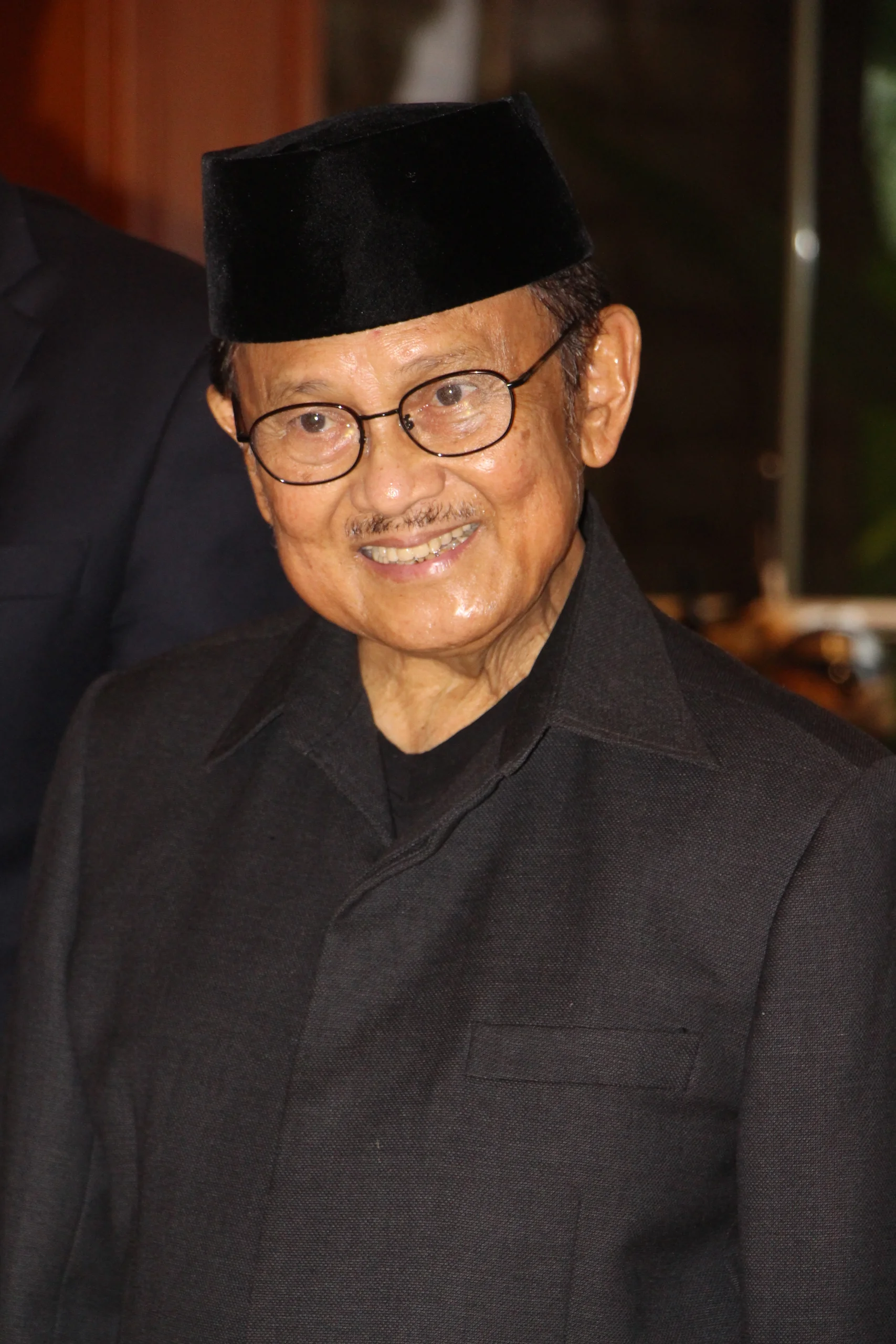
B. J. Habibie
 Indonesia
Also known as: Bacharuddin Jusuf Habibie, Pak Habibie, The Flying Engineer
Birthday
June 25, 1936
Birth Sign
Sagittarius
Birthplace
Parepare, South Sulawesi, Indonesia
Age
Died at 83
Height
5 ft 7 in (1.70 m)
About
Bacharuddin Jusuf Habibie, universally known as B.J. Habibie, was an Indonesian statesman, aerospace engineer, and inventor who served as the third president of Indonesia from May 1998 to October 1999. Born on June 25, 1936, in Parepare, South Sulawesi, he is revered as the "Father of Reformasi" for his pivotal role in transitioning Indonesia from the authoritarian New Order under Suharto to a democratic era. His life story is defined by a unique duality: a brilliant technical mind that designed aircraft in Germany and a visionary political leader who dismantled decades of dictatorship in just over a year.
As president, Habibie initiated radical reforms that legalized new political parties, freed thousands of political prisoners, and lifted press censorship. Despite the controversy surrounding this decision, his peaceful transition of power after the 1999 elections remains a unique event in Indonesian history. He died on September 11, 2019, leaving behind a legacy as a scientist-politician who steered Indonesia through a turbulent but successful transition.
Early Life & Background
Bacharuddin Jusuf Habibie was born into a family of mixed Bugis-Gorontalese and Javanese ancestry. His father, R. Abdul Djalil Habibie, worked as an agricultural official, while his mother, R.A. Tuti Marini Puspowardojo, came from a respected local family. The family moved frequently during his childhood, living in various parts of Indonesia including Jakarta before settling in Surabaya. Even as a young boy, Habibie displayed a precocious interest in mechanics and mathematics. He often dismantled household appliances to understand their inner workings, a habit that foreshadowed his future career.
His formal education began at the State Elementary School in Surabaya and continued at the State Junior High School. In 1949, he moved to Bandung to attend high school, completing his studies there after the Dutch transfer of sovereignty. In 1955, at the age of 19, Habibie received a scholarship to study engineering in Germany. This marked the beginning of a long separation from his homeland and his future wife, Hasri Ainun Besari, whom he had met in high school. He initially studied mechanical engineering at RWTH Aachen University but switched to aircraft construction due to his specific passion for aviation.
Upon graduation, he earned his Diplom-Ingenieur degree in 1960 and his doctorate, Dr.-Ing., in 1965. His doctoral thesis, titled "Stress Analysis of Sandwich Shells," was so significant that it was published as a book by Springer-Verlag, a rare honor for a student. Upon graduation, he joined Messerschmitt-Bölkow-Blohm (MBB), a major German aerospace firm. Over the next two decades, he rose rapidly through the ranks, eventually becoming a Vice President of MBB and heading its research department. During this period, he worked on advanced projects involving supersonic flight and composite materials. He became a key figure in the development of the Transall C-160 transport aircraft and the F-104 Starfighter. His technical expertise and leadership earned him the nickname "The Flying Engineer." Despite offers to stay in Europe, Habibie felt a strong pull to contribute to his nation's development. In 1974, responding to an invitation from President Suharto, he returned to Indonesia.
Career Growth
His return to Indonesia marked the start of a meteoric political ascent. He was appointed Minister of Research and Technology in 1978, a position he held until 1998. In this role, he founded the National Institute of Aeronautics and Space (LAPAN) and the Indonesian Aerospace (IPTN) company. Under his direction, IPTN developed the N-250 Gatotkaca, Indonesia's first indigenous turboprop aircraft, which made its maiden flight in 1995. This achievement cemented his reputation as the "Father of Technology" in Indonesia.
His political trajectory accelerated in 1998 when he was elected Vice President alongside Suharto. However, his tenure as vice president was short-lived. Following the Asian Financial Crisis and massive student protests, Suharto resigned on May 21, 1998. As per the constitution, Habibie immediately assumed the presidency, becoming the first vice president to take office mid-term. As president, Habibie initiated a series of radical reforms known as Reformasi. His administration legalized new political parties, freed thousands of political prisoners, and lifted censorship on the press. He called for early general elections, which were held in June 1999. Although his party won the most seats, the coalition he formed did not secure enough votes to elect him president again, and he stepped down peacefully in October 1999, succeeded by Abdurrahman Wahid. This peaceful transition remains a unique event in Indonesian history.
Career Timeline
Public Image & Style
Habibie was known for his distinctive mustache and formal attire, often wearing suits even during informal gatherings. He projected an image of intellectual rigor combined with deep humility. Media portraits often highlighted his dual identity as a brilliant engineer and a compassionate statesman. His public speeches were characterized by precise language and a focus on rational solutions to complex problems. He was affectionately addressed as "Pak Habibie" by citizens, a term denoting deep respect rather than fanatical devotion. His presence was always dignified, reflecting his background as a scientist and his role as a head of state.
Fame & Fandom
B. J. Habibie commanded a global attention that extended far beyond the borders of his native archipelago, a resonance measured by the iFANN Global Fame Rankings as of September 2026. His enduring legacy places him as the 11th most famous person in Indonesia, down from 10th last cycle. Within the specific scope of national origin, he ranks as the 8th most famous person from Indonesia, holding steady from the previous cycle. On the broader regional stage, his influence secures him the position of the 22nd most famous person in Southeast Asia, holding steady from the previous cycle. These placements track his presence across media coverage, search activity, and cultural consumption signals worldwide without requiring further elaboration on the underlying metrics.
Despite this significant visibility, no formal or organized fandom exists for B. J. Habibie. Unlike entertainment figures who cultivate fan clubs or dedicated online communities, the public relationship with him is defined by national reverence and academic respect rather than traditional fandom structures. He is addressed affectionately as Pak Habibie by citizens, a term denoting deep respect rather than fanatical devotion. There are no organized campaigns, birthday billboards, or fan-funded projects associated with his name; instead, his memory is preserved through state-organized commemorations and the continued operation of Wisma Habibie & Ainun as a cultural landmark where citizens visit to honor his history.
Interesting Facts and Legends
Habibie was the first Indonesian to earn a doctorate in aircraft construction from a German university. He was a skilled musician and played the piano, often composing music inspired by his love for Ainun. His nickname "The Flying Engineer" came from his ability to fly planes he helped design. He was known for his meticulous attention to detail, often correcting blueprints with a red pen. The minor planet 10134 Habibie was named in his honor. His decision to call for early elections and step down after losing the presidential vote in 1999 is a global case study in democratic maturity. Unlike many leaders who cling to power, Habibie left office voluntarily, setting a precedent for Indonesia. The story of his childhood promise and lifelong commitment to Ainun is a cultural touchstone, often cited as a model of devotion in Indonesia.
Notable Quotes
“I am not a politician; I am an engineer. I build things.”
“Democracy is not a gift from above; it is a struggle from below.”
“If you want to go fast, go alone. If you want to go far, go together.”
Family & Personal Life
Bacharuddin Jusuf Habibie was married only once, to Hasri Ainun Habibie (née Hasri Ainun Besari). Their relationship is legendary in Indonesia, often described as a fairy tale that spanned nearly six decades. They met in 1952 while attending high school in Bandung. The couple was engaged before Habibie left for Germany in 1955. Despite the distance and the temptation of other opportunities, they remained devoted to one another. Ainun accompanied him to Germany in 1962, where she pursued her own medical degree. They married in 1962 and had three children: Thareq Kemal Habibie, Puan Maharani Habibie, and Ilham Akbar Habibie.
The couple remained together until Ainun's death in September 2010. After her passing, Habibie lived as a widower until his own death in 2019. Their love story was immortalized in the popular film trilogy Habibie & Ainun, which dramatized their courtship, separation, and enduring bond. The couple's home, Wisma Habibie & Ainun, serves as a museum today. There are no records of any other romantic relationships, dating history, or marriages prior to or following his union with Ainun.
Notable Connections
Relationships & Dating History
B.J. Habibie was married only once, to Hasri Ainun Habibie (née Hasri Ainun Besari). Their relationship is legendary in Indonesia, often described as a fairy tale that spanned nearly six decades. They met in 1952 while attending high school in Bandung. The couple was engaged before Habibie left for Germany in 1955. Despite the distance and the temptation of other opportunities, they remained devoted to one another. Ainun accompanied him to Germany in 1962, where she pursued her own medical degree. They married in 1962 and had three children: Thareq Kemal Habibie, Puan Maharani Habibie, and Ilham Akbar Habibie.
There are no records of any other romantic relationships, dating history, or marriages prior to or following his union with Ainun. The couple remained together until Ainun's death in September 2010. After her passing, Habibie lived as a widower until his own death in 2019. Their love story was immortalized in the popular film trilogy Habibie & Ainun, which dramatized their courtship, separation, and enduring bond.
- MarriedHasri Ainun Habibie1962 - 2010Met in high school in 1952; married in 1962; she died in 2010.
Death & Aftermath
Died
September 11, 2019 (aged 83)
Death Place
Jakarta, Indonesia
Cause of Death
Cardiac arrest from multi-organ failure
Bacharuddin Jusuf Habibie passed away on September 11, 2019, at the Cipto Mangunkusumo National General Hospital in Jakarta. The former president had been hospitalized for several days due to complications stemming from a long-standing heart condition. Medical officials confirmed that his death resulted from cardiac arrest triggered by multi-organ failure. His passing sent shockwaves through Indonesia and drew tributes from around the globe.
President Joko Widodo immediately declared three days of national mourning. Dignitaries from nations including Australia, where he maintained close ties with former Prime Minister John Howard, expressed their grief. International organizations like International IDEA honored his pivotal role in transitioning Indonesia to democracy. A state funeral was held on September 14, 2019, featuring full military honors. Thousands of mourners lined the streets of Jakarta as his casket was transported to the Kalibata Heroes' Cemetery, where he was laid to rest alongside other national heroes.
In the years following his death, his legacy has been actively preserved. The Wisma Habibie & Ainun residence in Jakarta continues to serve as a museum and cultural landmark. Educational partnerships between Indonesian universities and RWTH Aachen in Germany remain strong. In July 2026, a biographical musical titled Sayap Cinta Habibie & Ainun premiered, celebrating his life and romance. Later that year, in August 2026, a new gamelan installation was unveiled at the Wisma, further cementing his place in Indonesian cultural heritage.
Net Worth (Estate Value)
$3 Million
iFANN Editorial Team estimate
As a deceased former head of state and a civil servant, B. J. Habibie did not accumulate wealth through commercial ventures in the manner of celebrities. His net worth is estimated to be modest compared to modern business tycoons, reflecting his life of public service. Estimates for his estate value range between $1 million and $5 million USD, primarily derived from government pensions, savings, and the management of his intellectual property rights regarding his engineering patents, which are now owned by the Indonesian state. The estate is managed by his children, who oversee the Wisma Habibie & Ainun museum and educational foundations. There are no major ongoing revenue streams from posthumous releases or licensing deals comparable to entertainment estates, though the museum generates tourism revenue. iFANN currently estimates B. J. Habibie's net worth at approximately $3 Million.
Awards Won (3)
Habibie received numerous high-level national and international distinctions. He was awarded the Grand Cross of the Star of the Republic of Indonesia, the highest civilian honor. He also received the Federal Cross of Merit, First Class, from Germany. Various honorary doctorates were bestowed upon him by universities worldwide, including his alma mater RWTH Aachen. The minor planet 10134 Habibie was named in his honor.
1998 · Civilian Honor
Presidency
1994 · Science and Technology
Engineering Contributions
Known For
President of Indonesia
1998 · 3rd President
N-250 Gatotkaca
1995 · Lead Developer
Reformasi Era
1998 · Initiator
Keywords
Sources
Quick Facts
- Profession
- politician, engineer
- Born
- June 25, 1936
- Birthplace
- Parepare
- Died
- September 11, 2019
- Death Place
- Jakarta, Indonesia
- Gender
- Male
- Spouse
- Hasri Ainun Habibie
- Birth Sign
- Sagittarius
Personal Details
- Full Name
- Bacharuddin Jusuf Habibie
- Height
- 5 ft 7 in (1.70 m)
- Spouse
- Hasri Ainun Habibie
- Children
- Thareq Kemal Habibie, Puan Maharani Habibie, Ilham Akbar Habibie
- Education
- RWTH Aachen University, Bandung Institute of Technology
Frequently Asked Questions
Who was B.J. Habibie?
When did B.J. Habibie die?
What was B.J. Habibie's profession?
Did B.J. Habibie have a wife?
What is the most famous project B.J. Habibie worked on?
Similar People

Join the community
fans discussing