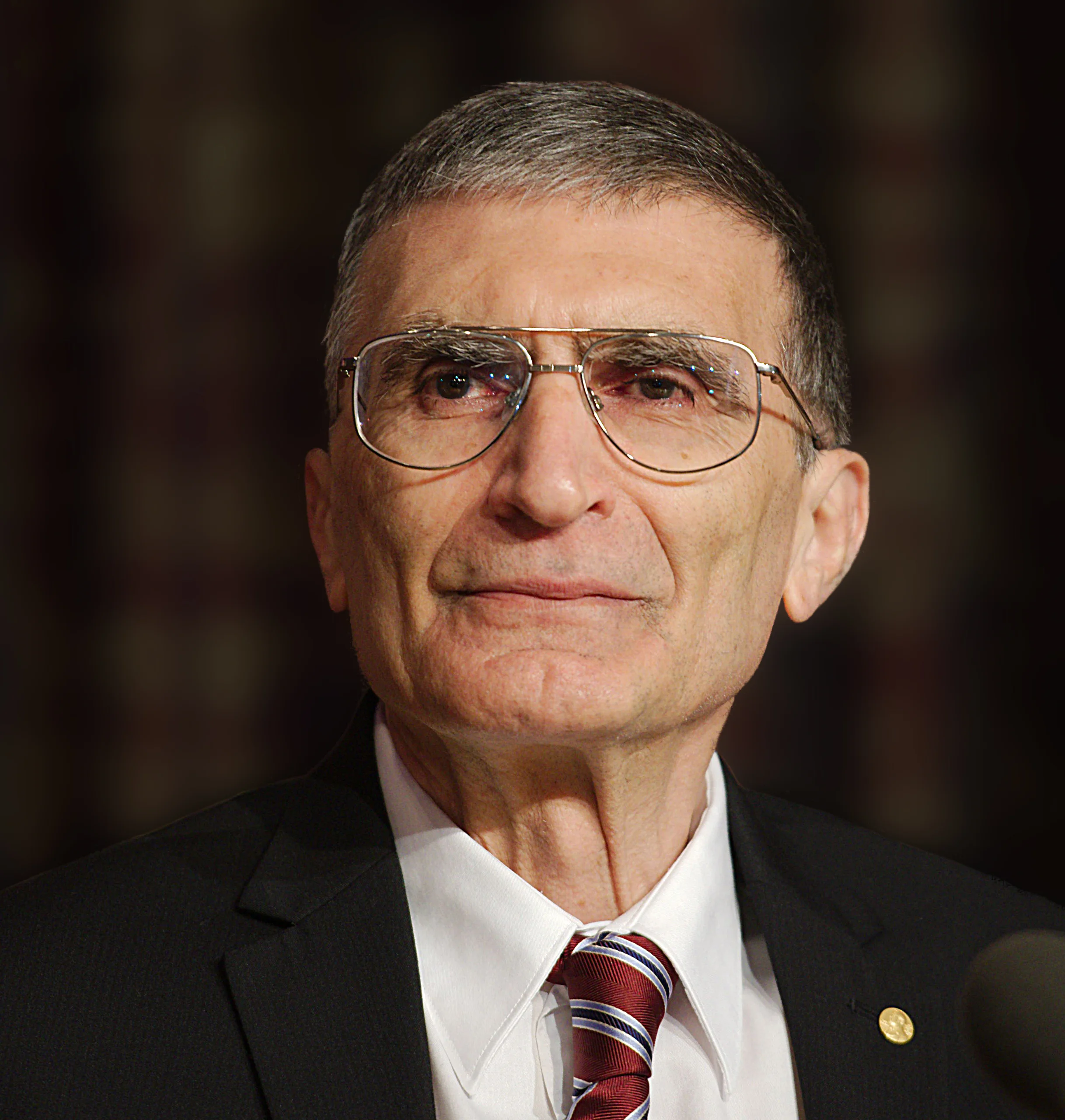
Aziz Sancar
 Turkey
biochemist•molecular biologist•university teacher
Birthday
September 8, 1946
Birth Sign
Virgo
Birthplace
Savur district, Mardin province, Turkey
Age
80 years old
About
Aziz Sancar is a distinguished Turkish-American molecular biologist and biochemist whose pioneering research into DNA repair mechanisms revolutionized the understanding of cellular biology and cancer prevention. Born on September 8, 1946, in the village of Savur within the Mardin province of southeastern Turkey, he emerged from a lower-middle-class family of illiterate parents who placed an immense value on education. As the seventh of eight children, Sancar's early life was marked by a fierce determination to overcome socioeconomic barriers, eventually leading him to become one of the most celebrated scientists of his generation. He is currently the Sarah Graham Kenan Professor of Biochemistry and Biophysics at the University of North Carolina (UNC) School of Medicine, where he continues to lead a research lab and mentor students as of 2026.
Sancar achieved global recognition when he was awarded the Nobel Prize in Chemistry in 2015 for his mechanistic studies of DNA repair. He shared this honor with Tomas Lindahl and Paul L. Modrich for elucidating how cells protect their genetic material from damage caused by ultraviolet light and other agents. Beyond his academic achievements, he remains an active researcher focusing on brain tumor treatments and serves as a cultural ambassador through the Aziz & Gwen Sancar Foundation, which supports Turkish students in the United States. His work has fundamentally altered scientific understanding of cellular biology and stands as a testament to the power of perseverance and education.
Early Life & Background
His journey began in the modest village of Savur, located in the Mardin province of southeastern Turkey, where he was born into a lower-middle-class family of illiterate parents. As the seventh of eight children, Sancar grew up in a household that placed immense value on education despite their lack of formal schooling. His early years were marked by a fierce determination to overcome socioeconomic barriers, a drive instilled by parents who believed education was the only path to a better life. He attended local schools in Savur before moving to Diyarbakır to complete his high school education. The region's diverse Kurdish and Azerbaijani cultural presence shaped his multilingual upbringing, allowing him to speak fluent Turkish, English, and Azerbaijani later in life.
In 1963, Sancar enrolled at Istanbul University, initially studying pharmacy before shifting his focus to chemistry and biology. He earned his B.Sc. in Chemistry from Istanbul University in 1969. The turning point in his life came in 1970 when he left Turkey for the United States. Upon arriving, he worked as a technician at the National Institutes of Health in Bethesda, Maryland, while simultaneously pursuing his doctoral studies. He eventually enrolled at the University of Texas Southwestern Medical Center at Dallas, where he completed his Ph.D. in 1977 under the supervision of Gilbert Asher. Following his doctorate, he conducted postdoctoral research at Harvard University and the University of California, Berkeley. In 1982, he joined the faculty of the University of North Carolina at Chapel Hill, where he has remained ever since, rising through the ranks to become a full professor.
Career Growth
Sancar's career is defined by his meticulous work on how cells repair damaged DNA. Before his major breakthroughs, he focused on understanding the mechanisms of nucleotide excision repair (NER), a process critical for removing DNA damage caused by ultraviolet (UV) light. In the late 1980s and early 1990s, his team successfully purified and characterized the human enzyme responsible for this repair, a feat that had eluded scientists for decades. This work laid the groundwork for understanding why certain individuals are prone to skin cancer and how defects in DNA repair contribute to aging and other diseases.
A pivotal moment in his career occurred in the 1990s when he elucidated the mechanism of the circadian clock in mammals, linking DNA repair pathways to the body's internal biological rhythms. His research demonstrated that the same enzymes involved in repairing UV-damaged DNA also play a role in regulating the circadian cycle, bridging two previously distinct fields of study. In 2015, Sancar achieved the pinnacle of scientific recognition when he was awarded the Nobel Prize in Chemistry. He shared this honor with Tomas Lindahl and Paul L. Modrich for their mechanistic studies of DNA repair. The Royal Swedish Academy of Sciences cited Sancar's work on nucleotide excision repair as fundamental to understanding how cells protect their genetic material.
Since winning the Nobel Prize, Sancar has continued to expand his research frontiers. By 2025 and 2026, his lab has been making headlines for its work on brain tumor treatments, specifically investigating how DNA repair mechanisms can be targeted to improve the efficacy of chemotherapy while sparing healthy tissue. Despite his advanced age (nearly 80 as of 2026), he remains an active researcher, frequently hosting undergraduate and graduate students in his lab. His accolades include the Order of Shohrat awarded by President Ilham Aliyev of Azerbaijan in September 2026, the Great Immigrants Award in 2016, and membership in the National Academy of Sciences and the American Academy of Arts and Sciences. He also holds honorary doctorates from the University of Basel and the University of Geneva.
Career Timeline
Public Image & Style
Sancar projects an image of quiet humility and intellectual rigor, standing in stark contrast to the flamboyance often associated with high-profile scientists. He is known for deflecting praise to his students and collaborators, emphasizing the collective nature of scientific discovery over individual glory. His style is practical and understated, reflecting a life dedicated to the laboratory rather than public appearances. Media portrayals consistently highlight his role as a bridge between cultures, celebrating his success as a testament to the power of education and perseverance. His presence in the scientific community is marked by a calm authority, earning him respect from peers across disciplines. Even as a Nobel laureate, he maintains a low profile, avoiding the trappings of celebrity status in favor of continued research and mentorship. He maintains a professional presence on X (Twitter) under the handle @AzizGwenSancar, where he shares updates on his research and the foundation's activities with a moderate but engaged following of academics and science enthusiasts.
Fame & Fandom (iFAMOUS Rankings)
For the global scientific community and the Turkish diaspora, Aziz Sancar represents a rare convergence of academic rigor and cultural pride rather than the chaotic energy of pop stardom. His supporters are not organized into fan clubs with specific names or rituals; instead, his influence is felt through formal admiration in lecture halls, institutional honors, and the quiet dedication of students who trace their career paths back to his mentorship at UNC. The narrative surrounding him focuses on his legendary perseverance during graduate school, where stories of sleeping in laboratories to maximize research time have become inspirational folklore within the field. This unique fanbase celebrates his bridge-building between Turkey and the United States, viewing his work on DNA repair not just as science but as a vital contribution to human survival. While he lacks the viral campaigns typical of entertainment idols, his standing remains formidable across media coverage, search trends, and consumption signals worldwide. The iFANN Global Fame Rankings confirm this enduring presence by placing him firmly among the most recognized figures in his homeland. He holds the position of the 95th most famous person in Turkey, a ranking that has remained steady through recent cycles. This placement underscores how deeply his legacy is woven into the national identity while maintaining significant international visibility. He is not featured on the September 2026 iFAMOUS Rankings flagship list.
Interesting Facts and Legends
Aziz Sancar's journey from the village of Savur to the pinnacle of molecular biology is marked by moments that have entered scientific lore. One widely retold story from his early days at the University of Texas at Dallas describes him sleeping in his laboratory for weeks to accelerate his research on nucleotide excision repair, a habit that exemplifies the relentless drive behind his eventual Nobel Prize win in 2015. That award, given for explaining how cells repair DNA damage caused by ultraviolet light, remains the central pillar of his mythology and a source of immense pride for the Turkish scientific community. In a significant diplomatic milestone in September 2025, he was granted Cypriot citizenship, further cementing his role as a unifying figure for the Turkish Cypriot community. His commitment to education continues unabated even at nearly eighty years old, where he still teaches undergraduate courses and maintains an active lab for local students. Another notable chapter involves his investment in "Carolina Turk Evi," a cultural center at UNC that serves as a vital hub for Turkish-American students, reflecting his deep connection to his heritage. More recently, his work on brain tumor treatments has generated headlines in early 2026, though he consistently emphasizes the need for further testing before clinical application. These verified milestones define his iconic status more effectively than any celebrity gossip could.
Notable Quotes
“The order of the universe is something I find fascinating.”
“Science is a universal language that transcends borders.”
“Education is the only path to a better life.”
Family & Personal Life
Aziz Sancar lives primarily in Chapel Hill, North Carolina, where he maintains a home near the university campus. While he keeps his family life out of the spotlight, his connection to his roots remains strong through his involvement with the Turkish diaspora and cultural organizations. He has a deep connection to the "Carolina Turk Evi" (Turkish House) at UNC, a cultural center he helped establish to support Turkish students. His dedication to his work, often described as all-consuming, has been noted by colleagues and students as a defining aspect of his character. He is a devout Muslim and often incorporates his faith into his perspective on the order of the universe, though he keeps his religious views separate from his scientific work in public forums. His siblings and extended family in Turkey remain a source of personal pride, though they rarely appear in media profiles alongside him.
Notable Connections
Relationships & Dating History
Aziz Sancar is known for his intensely private personal life, particularly regarding romantic relationships. Unlike many public figures, he has never publicly disclosed details about dating history, engagements, or marriages in interviews or media profiles. Public records and credible biographical sources do not list any spouse, partner, or children. He is widely reported to be unmarried and childless. His dedication to his work, often described as all-consuming, has been noted by colleagues and students as a defining aspect of his character. In 2025, reports emerged regarding his dual citizenship status; while he has long been a Turkish-American citizen, in September 2025, he was granted Cypriot citizenship, a move seen as a diplomatic gesture to strengthen ties between the Turkish Cypriot community and the broader scientific diaspora. He co-founded the Aziz & Gwen Sancar Foundation, which supports Turkish students in the U.S. and promotes Turkish culture, suggesting a close partnership with a woman named Gwen, though she remains out of the public eye. The foundation's name implies a marital union, but no further details about Gwen Sancar have been officially released to the public. This privacy stands in contrast to the public scrutiny faced by many other high-profile individuals, allowing Sancar to maintain a focus on his scientific contributions without personal distraction.
Salary, Net Worth In 2026
$3 Million
iFANN Editorial Team estimate
iFANN currently estimates Aziz Sancar's net worth at approximately $3 million, with broader financial analyses suggesting a range between $2 million and $5 million depending on asset valuation methods. This figure reflects his long-standing career as a university professor and researcher rather than commercial ventures or endorsements. His primary income sources include his salary as the Sarah Graham Kenan Professor at the University of North Carolina, funding from research grants provided by the National Institutes of Health and other bodies, and fees from speaking engagements at international symposiums. Royalties from textbooks and scientific publications contribute a smaller portion of his earnings. Unlike many celebrities, Sancar leads a frugal, academic lifestyle, and his wealth is likely tied up in real estate holdings, including his primary residence in Chapel Hill, North Carolina, and potentially property in Turkey. Private investments are not publicly documented, and he avoids the high-profile financial maneuvers common in the entertainment industry. The Nobel Prize stipend, though substantial, is typically managed separately and taxed, contributing to his overall financial stability without drastically inflating his liquid assets.
Awards Won (4)
Aziz Sancar has received numerous prestigious awards throughout his career, culminating in the 2015 Nobel Prize in Chemistry. He was honored with the Great Immigrants Award in 2016 by the Carnegie Corporation of New York. His contributions to science have been recognized by the American Society for Biochemistry and Molecular Biology and the International Union of Biochemistry and Molecular Biology with lifetime achievement awards. In 2026, he was awarded the Order of Shohrat by the President of Azerbaijan. He is also a member of the National Academy of Sciences and the American Academy of Arts and Sciences.
2015 · Chemistry
Mechanistic studies of DNA repair
2016 · Public Service
Contributions to science and society
Known For
Nobel Prize in Chemistry
2015 · Recipient
DNA Repair Research
1990 · Scientific Discovery
Circadian Clock Mechanism
1995 · Research Breakthrough
Keywords
Sources
Quick Facts
- Profession
- biochemist, molecular biologist, university teacher
- Born
- September 8, 1946
- Birthplace
- Savur district
- Gender
- Male
- Birth Sign
- Virgo
Personal Details
- Children
- Education
- B.Sc. in Chemistry (Istanbul University, 1969); Ph.D. in Biochemistry (University of Texas Southwestern Medical Center at Dallas, 1977)
Frequently Asked Questions
Is Aziz Sancar married?
What did Aziz Sancar win the Nobel Prize for?
Where is Aziz Sancar from?
How old is Aziz Sancar in 2026?
Does Aziz Sancar have children?
Social Media
Similar People
Join the community
fans discussing