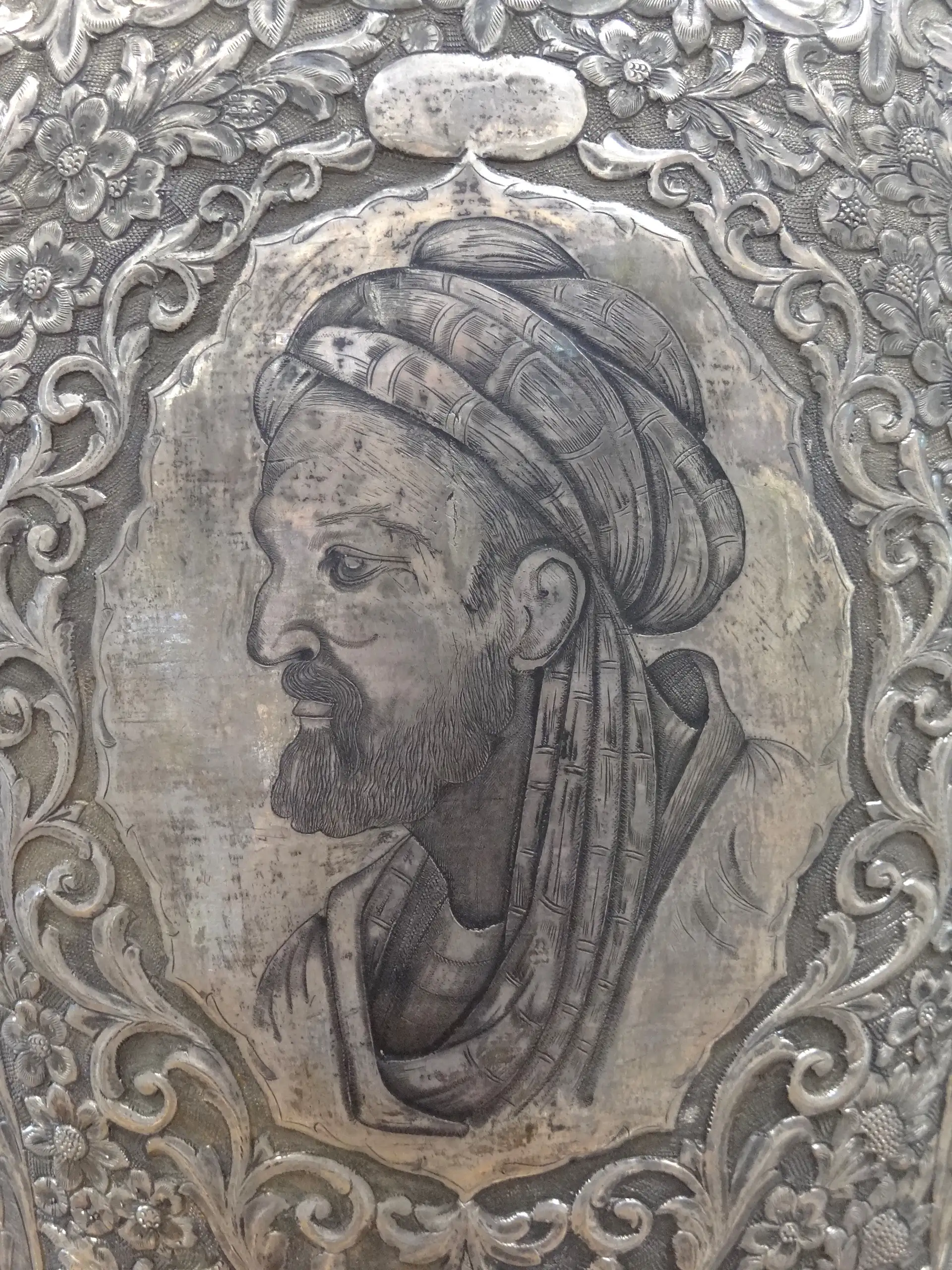
Avicenna
 Uzbekistan
Philosopher•physician•astronomer•poet
Also known as: Ibn Sina, Abu Ali al-Husayn ibn Abdallah ibn Sina, Prince of Physicians
Birthday
January 1, 980
Birth Sign
Capricorn
Birthplace
Afshona, near Bukhara, present-day Uzbekistan
Age
Died at 57
About
Avicenna was a Persian philosopher, physician, astronomer, and poet of the Islamic Golden Age, born around 980 and known in the West by the Latinized form of his Arabic name, Ibn Sina. He is the author of The Canon of Medicine, a five-book medical encyclopedia that served as a standard text in European universities for roughly six hundred years, and of The Book of Healing, a vast philosophical and scientific summa. Of the roughly 450 works attributed to him, about 240 survive, including some 150 on philosophy and 40 on medicine.
His standing rests on a method that joined empirical observation to Aristotelian logic, a combination that made him a reference point for medieval Scholasticism and for medical teaching across the Islamic world and Latin Europe. He is traditionally called the father of early modern medicine. He died in 1037 at about 57, at Hamadan, and his mausoleum there remains a site of commemoration.
Early Life & Background
He was born around 980 in the village of Afshona, near Bukhara, in a region then part of the Samanid Persian empire and now in Uzbekistan. His father was a local official in the Samanid administration, and the household was Persian-speaking. By his own account, preserved through his student al-Jūzjānī, he had memorized the Qur'an by the age of ten and had worked through logic, the natural sciences, and much of the available philosophical curriculum before he was a teenager.
His tutors included a teacher of logic named al-Nātili, whom he famously outgrew, correcting his instructor's reading of Aristotle's Isagoge. He read Aristotle's Metaphysics forty times, again by his own reckoning, before the commentary of al-Fārābī finally unlocked the text for him. Medicine he began at about sixteen and, he claimed, surpassed his teachers within a year or two.
The decisive break came through royal patronage. The Samanid prince Nūḥ ibn Manṣūr fell ill, and the young Ibn Sina was brought in to treat him. The cure earned him access to the Samanid royal library, the khizānat al-kutub, where he reportedly worked through holdings that no other reader of his generation had seen. The collapse of the Samanid state around 999 ended that chapter and pushed him toward the peripatetic career of court service that defined his adult life.
Career Growth
Court service took him through a succession of Iranian dynasties: the Samanids, then the Ziyarids at Gorgan under Qābūs ibn Vushmgīr, then the Buyid courts at Rayy and Hamadan, and finally the court of ʿAlāʾ al-Dawla at Isfahan. At Gorgan, around the 1010s, he began al-Qānūn fī al-Ṭibb, the Canon, completing it around 1025. The five books systematized Greek, Arabic, and Indian medical knowledge and were still in use at European universities as late as 1650.
At Hamadan in the 1020s he finished Kitāb al-Shifāʾ, the Book of Healing, an encyclopedia spanning logic, natural science, psychology, geometry, astronomy, arithmetic, and metaphysics. Later came al-Ishārāt wa-l-tanbīhāt, a more mystical-tinged philosophical summa, and the Dānish-nāma-yi ʿAlāʾī, a philosophical encyclopedia written in Persian for his patron. Companion medical treatises on the pulse, urine, drugs, and hygiene followed.
Career Timeline
Public Image & Style
To later centuries he was the Prince of Physicians, a title that attached to the Canon and to the tradition of learned medicine it represented. Medieval European writers knew him through Latin translations and placed him alongside Galen and Hippocrates; Islamic scholarship placed him at the summit of the Peripatetic school. The image is that of the archetypal polymath, invoked in medical commentary, in histories of ophthalmology, and in essays on the breadth of Islamic learning. There is no personality cult around him and no modern media persona, only the durable authority of the texts.
Fame & Fandom (iFAMOUS Rankings)
Fame data for Avicenna has not yet been gathered by iFANN, so no placement in the Global Fame Rankings is claimed here. He is not on the September 2026 iFAMOUS Rankings flagship list. His reputation runs on a different currency from that of living celebrities: citations, curricula, and the survival of manuscripts rather than search traffic or follower counts.
There is no fandom in the modern sense, no fan name, no organized campaigns, and no documented fan culture. The audience is scholarly and clinical. Physicians read the Canon for centuries as a working text; historians of philosophy read the Shifāʾ; and general readers encounter him through surveys of Islamic thought. The nearest thing to a fanbase is the long line of commentators and translators, from Latin Scholastics to modern medical historians, who kept his name in circulation.
Interesting Facts and Legends
His Latin name, Avicenna, is a medieval European rendering of Ibn Sina that stuck in the scholarly literature. He wrote in both Arabic and Persian, and composed poetry in both. Some traditions credit him with early observations linking diseases to contagion.
Two stories about him circulate widely. One is the royal library episode: brought in to treat the ailing Samanid prince, he gained access to the palace collection and reportedly read books no one else had encountered. The other is the reading of Aristotle's Metaphysics forty times before al-Fārābī's commentary made it intelligible. Both come from his own autobiographical account as transmitted by al-Jūzjānī, and both are retold with embellishment.
His most cited thought experiment, the floating man, argues that the soul is aware of itself even when every sensory input is removed. It appears in every survey of his philosophy.
Family & Personal Life
He was born into a Persian-speaking family in the Bukhara region; his father held a local post in the Samanid administration. Beyond that, the record is thin. Al-Jūzjānī, who lived with him for roughly the last twenty-five years of his life and edited several of his works, left the fullest account, and it says little about domestic arrangements. No marriage and no children are documented in any credible source. He is not known to have had a spouse or offspring, and the household details that survive concern his student and companion rather than a family.
Notable Connections
His student and biographer al-Jūzjānī, who lived with him for about twenty-five years and edited several of his works, is the source for most of what is known about his life. Among earlier thinkers, al-Fārābī's commentary on Aristotle's Metaphysics was the decisive intellectual influence. His patrons included Nūḥ ibn Manṣūr, Qābūs ibn Vushmgīr, and ʿAlāʾ al-Dawla.
Relationships & Dating History
No romantic relationships, marriages, or children are documented in any credible source. The biographical tradition transmitted by al-Jūzjānī concerns his studies, his patrons, and his writings, and it records nothing about a spouse or household of his own. Any account of a partner should be treated as unattested. At the time of his death in 1037 he is not known to have been married.
Death & Aftermath
Died
June 18, 1037 (aged 57)
Death Place
Hamadan, Iran
Cause of Death
Severe intestinal illness (colic), as reported by traditional sources
He died in June 1037 at roughly 57 years of age. The date most often given is 22 June, though the existing profile record uses 18 June; the exact day within the month is not settled. Hamadan, in present-day western Iran, is the traditional place of death, where he had been serving the Buyid prince ʿAlāʾ al-Dawla. A minority of accounts place his final illness at Isfahan instead. He fell ill while on campaign with the prince.
The cause handed down by his student and biographer al-Jūzjānī is a severe intestinal illness, a colic complicated by seizures and by his own drastic self-treatment with enemas and bleeding. That description belongs to the biographical tradition, not to any autopsy or contemporaneous medical record, and it should be read as reported rather than confirmed. A mausoleum at Hamadan marks the traditional burial site.
The Canon of Medicine carried his name through six centuries of European and Islamic medical teaching after his death, and Latin translations secured his standing among European scholars. His manuscripts and effects moved through court patronage networks; no formal estate or will is documented. Modern commemoration has been institutional: Uzbekistan announced in October 2026 that it will mark the 1,050th anniversary of his birth in 2030, with a research center to open at Bukhara, and Tajikistan established the Abu Ali Ibn Sina International Prize in Medicine. A 1987 film, Avicenna, dramatized his life.
Net Worth (Estate Value)
$1.2 Million
iFANN Editorial Team estimate
No estate, will, or property record survives. His manuscripts and effects passed through the patronage networks of the courts he served, and the Canon and the Shifāʾ have long since entered the public domain. The iFANN Editorial Team's reading of the available material places the notional value of his surviving manuscript corpus and commemorative rights at roughly $1.2 Million as of 2026, a figure that reflects the market for medieval Islamic manuscripts and the licensing of his name for academic and commemorative purposes rather than any documented fortune. Revenue streams are indirect: rare-book and manuscript sales, scholarly editions, the 1987 film and similar dramatizations, and institutional commemoration such as the planned Bukhara research center tied to the 1,050th anniversary in 2030. No posthumous royalties accrue in the modern sense.
Awards & Accolades
View 4 records, honours and achievementsKnown For
The Canon of Medicine
1025 · Author
The Book of Healing
1020s · Author
Pointers and Reminders
1030s · Author
The Book of Knowledge for ʿAlāʾ al-Dawla
1030s · Author
Keywords
Sources
Quick Facts
- Profession
- Philosopher, physician, astronomer, poet
- Born
- c. 980
- Birthplace
- Afshona, near Bukhara
- Died
- June 18, 1037
- Death Place
- Hamadan, Iran
- Gender
- Male
- Works attributed
- About 450, of which roughly 240 survive
Personal Details
- Full Name
- Abū ʿAlī al-Ḥusayn ibn ʿAbdallāh ibn Sīnā
- Education
- Tutored in Bukhara; studied logic, natural science, philosophy, and medicine; used the Samanid royal library
Frequently Asked Questions
What is Avicenna best known for?
Was Avicenna Persian?
Why is Ibn Sina called Avicenna?
How did Avicenna die?
What did Avicenna believe about God?
Similar People
Join the community
fans discussing