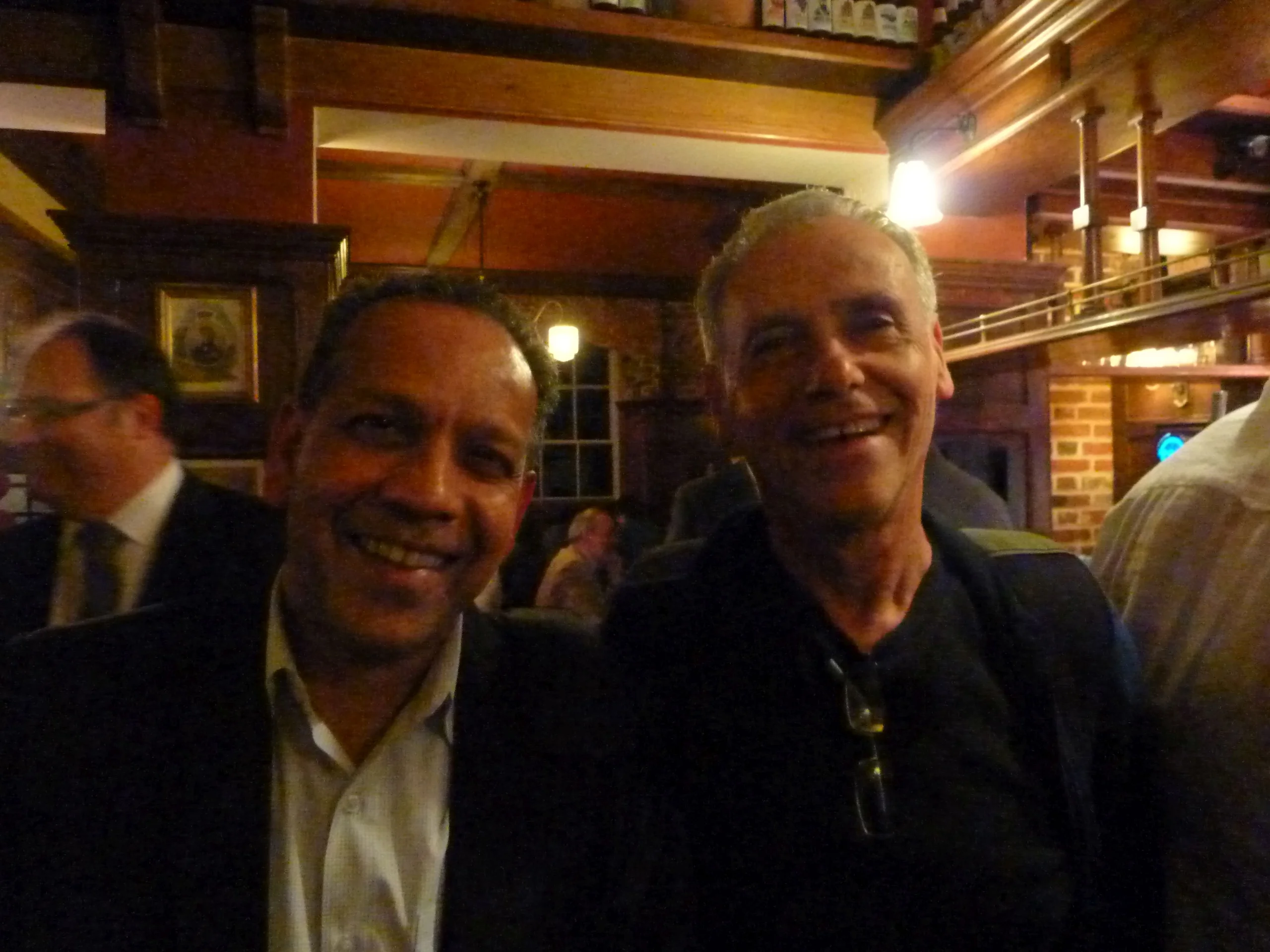
Ariel Rubinstein
 Israel
Birthday
April 13, 1951
Birth Sign
Aries
Birthplace
Jerusalem, Israel
Age
75 years old
About
Ariel Rubinstein is an Israeli economist and Professor Emeritus at Tel Aviv University who also serves as a Professor of Economics at New York University. Born in Jerusalem on April 13, 1951, he has spent decades reshaping how economists understand human decision-making through rigorous work in game theory, bounded rationality, and choice theory. His influence extends far beyond the classroom, with over 51,500 academic citations tracking his impact on global economic thought.
Rubinstein stands out for his sharp critiques of abstract models that ignore real-world constraints and his unique commitment to open knowledge. He makes eight of his textbooks available for free download on his personal website, a rare move in the publishing industry. In 2002, he received the Israel Prize, the nation's highest honor, for his contributions to economics. He remains an active voice in the field, balancing theoretical innovation with practical insights into how people actually behave under time pressure and cognitive limits.
Early Life & Background
Growing up in Jerusalem during the early years of the State of Israel, Ariel Rubinstein displayed a natural aptitude for mathematics and logic that would define his future career. He pursued his higher education at the Hebrew University of Jerusalem, where he built a strong foundation in formal sciences. Between 1972 and 1974, he completed a B.Sc. in Mathematics, Economics, and Statistics. His academic trajectory accelerated quickly, leading to an M.A. in Economics in 1975 under the supervision of Menahem Yaari.
His doctoral studies continued at the same institution, culminating in a Ph.D. in 1979. During these formative years, Rubinstein began moving away from purely abstract assumptions about economic behavior. Instead, he focused on formalizing how actual agents make choices when faced with complex information and cognitive limitations. This early research laid the groundwork for his later pioneering work in bounded rationality. Before gaining international fame, he served as a lecturer at the Hebrew University and held positions at other prestigious institutions like Northwestern University and the University of Pennsylvania. These years were dedicated to developing the mathematical frameworks that would eventually become standard texts for graduate students worldwide.
Career Growth
Rubinstein's professional breakthrough arrived with his seminal work in game theory during the late 1980s and 1990s. His research on repeated games and bargaining established him as a leading theorist in the field. A defining moment came with the publication of Course in Game Theory, co-authored with Martin Osborne. This book became a standard text for graduate students globally, cementing his reputation as a master of the subject.
In the 1990s and 2000s, he pioneered the study of bounded rationality, challenging the neoclassical assumption of perfect rationality. He developed models showing how agents make decisions under time pressure and cognitive limits, offering a more realistic view of human behavior than traditional economics allowed. His recent work continues to push boundaries. In November 2025, he published "Noise Bargaining: A New Perspective on Single Proposers, Negotiation and Delays" in the Federal Reserve Bank of Richmond Economic Brief. Earlier experimental studies in 2023 explored response time and decision-making, further refining his theories on how speed affects economic outcomes.
Beyond pure theory, Rubinstein gained significant media attention in October 2019 when he was tipped for the Nobel Prize following his public critique that "economics lacks common sense." This sentiment highlighted his role not just as a theorist but as a critic of the profession's realism. He currently holds dual appointments at Tel Aviv University and New York University, where he mentors new generations of economists while continuing his own impactful research.
Career Timeline
Public Image & Style
Rubinstein projects an image of a rigorous, sometimes critical thinker who values common sense over complex abstraction. He is respected for his integrity and his willingness to challenge the establishment, particularly when economic models detach from reality. His online presence on X (formerly Twitter) under the handle @ArielRubinstein reflects this persona, where he shares mottos for economists and updates on his research. Unlike pop culture figures, he does not cultivate a celebrity aesthetic; his appearance is generally described as unassuming, fitting for a man whose authority comes from his ideas rather than his style.
Fame & Fandom (iFAMOUS Rankings)
The iFANN Global Fame Engine evaluated Ariel Rubinstein in September 2026 and determined that he does not currently hold a placement in the published rankings, including the Global Top 1,000 or any Top-100 scope list. This absence of a numeric rank is a factual statement of his position outside the metrics designed for mass-market celebrities. His fame operates on a different scale, measured by over 51,500 academic citations and his profound influence on how economists model human decision-making. There is no documented fandom name associated with him; his audience consists entirely of fellow economists, graduate students, and researchers who engage with his ideas rather than worship his persona.
Unlike entertainers who cultivate dedicated tribes, Rubinstein's community is dispersed across lecture halls and digital archives, united by a shared pursuit of economic rigor. There are no organized fan clubs, birthday billboards, or viral campaigns driving his visibility. Instead, his legacy is built on initiatives like his free distribution of eight books and his curated directory of cafes for deep thought. These acts serve the academic community directly, reinforcing a relationship based on utility and intellectual exchange rather than fandom rituals. In the rare instances where his name appears in broader news, it often stems from Nobel Prize speculation or his sharp critiques of economic common sense, further cementing his role as a serious thinker rather than a celebrity icon.
Interesting Facts and Legends
Rubinstein is widely known for making eight of his major textbooks available for free download on his personal website, including Economic Fables and Lecture Notes in Game Theory. This initiative reflects his deep belief that knowledge should be accessible to all rather than locked behind paywalls. In March 2015, he compiled a unique directory of cafes around the world deemed suitable for thinking, based on criteria like quietness and coffee quality. This list revealed his personal interest in environments conducive to deep intellectual work.
Despite his prominence in economics, he is often confused with Arthur Rubinstein, the legendary classical pianist. The two are distinct individuals, though the similarity in names occasionally leads to mix-ups regarding the International Piano Competition. Another notable fact is his background in pure mathematics; his training is deeply rooted in formal math and statistics, which gives his economic models a unique rigor. He is also known for his left-wing Zionist perspectives, which he frequently expresses in his publicistic writing and op-eds.
Notable Quotes
“Economics lacks common sense.”
“The goal of science is to explain the world, not to create a fantasy.”
Family & Personal Life
Ariel Rubinstein maintains a very private personal life, keeping details about his family and relationships out of the public eye. There are no publicly documented records of marriages, engagements, or high-profile romantic partnerships in credible biographical sources. He resides primarily between Tel Aviv and New York, splitting his time between his academic duties at Tel Aviv University and New York University. While he does not share family stories publicly, his dedication to his academic community and his mentorship of students serve as a testament to his values.
Notable Connections
Relationships & Dating History
Ariel Rubinstein keeps his personal life strictly private. There are no publicly documented records of marriages, engagements, divorces, or high-profile relationships in credible biographical sources or news archives. He is known to be unmarried or his relationship status is kept confidential; no partner names, children, or family details have been released to the public. Consequently, there is no chronological dating history to report. As of 2026, his relationship status remains officially unconfirmed or private, with no public statements indicating he is married, divorced, or widowed. He resides primarily between Tel Aviv and New York, focusing on his academic duties and writing.
Salary, Net Worth In 2026
$1 Million
iFANN Editorial Team estimate
iFANN Editorial Team analysis of Ariel Rubinstein's earnings, ventures and assets points to roughly $1 million. This estimate reflects his income as a university professor at Tel Aviv University and New York University, along with occasional consulting fees and speaking engagements. Unlike commercial celebrities, his wealth does not stem from box office returns or music sales. Notably, he often waives royalties for his textbooks by making them freely available online, which limits potential revenue from his most famous works. Specific details regarding his real estate holdings or investment portfolio are not publicly disclosed. As of 2026, his financial status remains stable and consistent with that of a distinguished academic in the United States and Israel.
Awards Won (1)
Rubinstein's accolades reflect his stature in the global academic community. He received the Israel Prize in 2002, the most prestigious award in Israel, for his contributions to economics. He is a member of the Israel Academy of Sciences and Humanities, a Foreign Member of the American Academy of Arts and Sciences, and a Foreign Member of the British Academy. Although frequently cited as a top contender for the Nobel Memorial Prize in Economic Sciences, particularly in 2019, he has never won the prize itself.
2002 · Economics
Contributions to Economic Theory
Known For
Course in Game Theory
1994 · Co-author
Models of Microeconomic Theory
1991 · Author
Economic Fables
2006 · Author
Keywords
Sources
Quick Facts
- Profession
- economist, university teacher
- Born
- April 13, 1951
- Birthplace
- Jerusalem
- Gender
- Male
- Birth Sign
- Aries
Personal Details
- Full Name
- Ariel Rubinstein
- Children
- Education
- Ph.D. in Economics, Hebrew University of Jerusalem (1979)
Frequently Asked Questions
How old is Ariel Rubinstein?
What is Ariel Rubinstein famous for?
Did Ariel Rubinstein win a Nobel Prize?
Where does Ariel Rubinstein teach?
Is Ariel Rubinstein married?
Social Media
Similar People
Join the community
fans discussing