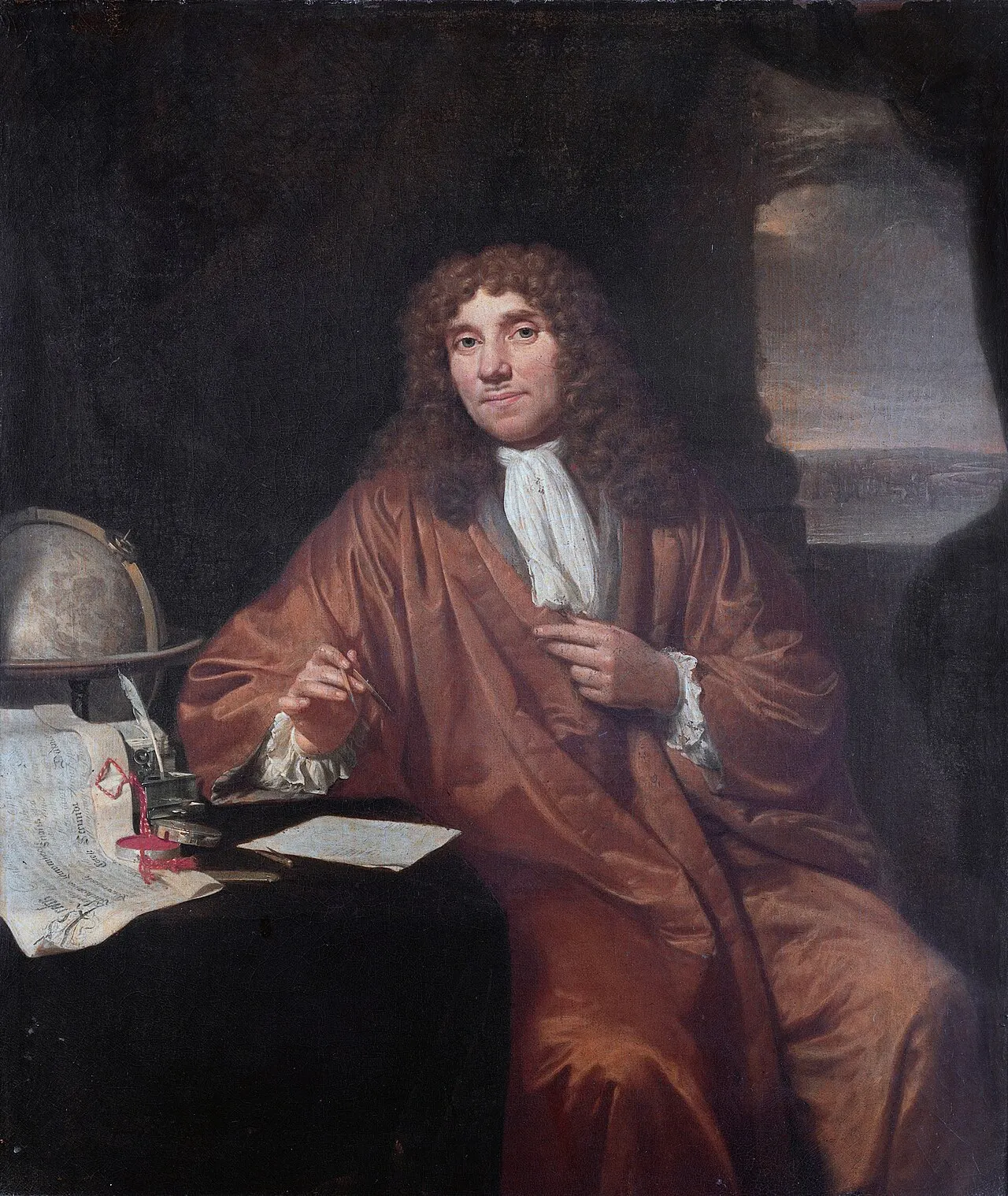
Antonie van Leeuwenhoek
draper•scientist•microscope maker
Also known as: Father of Microbiology, Antonie Philips van Leeuwenhoek, Antony van Leeuwenhoek
Birthday
October 24, 1632
Birth Sign
Scorpio
Birthplace
Delft, Dutch Republic
Age
Died at 90
About
Antonie van Leeuwenhoek was a Dutch tradesman and self-taught scientist who opened humanity's eyes to the microscopic world. Born in Delft on October 24, 1632, he is celebrated as the Father of Microbiology for his pioneering observations of bacteria, protozoa, spermatozoa, and red blood cells. Unlike the compound microscopes of his day, his handcrafted single-lens instruments achieved magnifications up to 275 times, revealing a hidden realm teeming with life he called animalcules.
Van Leeuwenhoek never published a book or paper. Instead, he shared his discoveries through more than 560 letters to the Royal Society of London, which published many in Philosophical Transactions. His meticulous reports, often accompanied by detailed drawings, provided the first clear evidence of microbial life and even confirmed the capillary network in blood circulation. Elected a Fellow of the Royal Society in 1680, he remained an active observer into his 80s, grinding over 500 lenses in his lifetime.
His legacy endures in the journal Antonie van Leeuwenhoek, the Van Leeuwenhoek Medal, and countless institutions bearing his name. He died on August 26, 1723, in Delft, at age 90, leaving behind a scientific legacy unmatched by any amateur.
Early Life & Background
Antonie Philips van Leeuwenhoek was born into a modest family in Delft. His father, Philips Antonisz van Leeuwenhoek, was a basket maker, and his mother, Margaretha Bel van den Berch, came from a brewer's family. His father died when Antonie was young, and his mother remarried, shaping a childhood marked by modest means and early responsibility.
He received only a basic education in Delft, learning reading, writing, and arithmetic. As a teenager, he moved to Amsterdam to apprentice in a linen-draper's shop, a trade that would later influence his interest in lenses, as cloth merchants used magnifying glasses to inspect thread counts. This practical exposure to optics planted the seed for his future scientific pursuits.
Around 1654, van Leeuwenhoek returned to Delft, opened his own draper business, and married Barbara de Mey. He also took on civic duties, serving as chamberlain to the sheriffs of Delft, and later as a surveyor and wine-gauger. These positions provided him with a stable income and social standing, but his true passion lay in lens grinding, a hobby that would consume his spare hours and lead to revolutionary discoveries.
By the 1660s, he had begun crafting his own single-lens microscopes, improving on the simple magnifying glasses of his trade. His skill at grinding tiny, high-quality lenses was exceptional, and his instruments far outperformed the compound microscopes of the era. This technical mastery, combined with relentless curiosity, set the stage for his first observations of the microscopic world in the 1670s.
Career Growth
Van Leeuwenhoek's breakthrough came in 1674 when he described microorganisms in lake water near Delft, but his most famous discovery occurred in 1676 when he identified bacteria and protozoa. His initial reports to the Royal Society were met with skepticism, as his findings challenged established beliefs about spontaneous generation. However, his meticulous methods and detailed observations eventually convinced his peers, including Robert Hooke, who replicated his work.
In 1677, he described spermatozoa, including human sperm, a finding that initially unsettled him so much that he hoped it would be suppressed. Undeterred, he continued his investigations, and in 1683 he produced drawings of bacteria scraped from his own teeth, famously noting that more animalcules lived in his mouth than people in a whole kingdom. In 1684, he accurately described red blood cells as disc-shaped, correcting earlier misconceptions.
His correspondence with the Royal Society continued for decades, with over 560 letters documenting his observations on everything from muscle fibers to gout crystals. In 1680, he was elected a Fellow of the Royal Society, a rare honor for a tradesman. In 1716, the University of Louvain granted him an honorary doctorate, recognizing his contributions to science.
Van Leeuwenhoek never published a scientific paper, relying solely on his letters. He kept his lens-making techniques secret, a decision that puzzled contemporaries and modern researchers alike. Recent neutron imaging studies have revealed that he used a unique glass-blowing technique to create his tiny lenses, a method that remained unmatched for centuries. He died in 1723, leaving 26 microscopes to the Royal Society and a legacy that founded a new field of science.
Career Timeline
Public Image & Style
Van Leeuwenhoek is remembered as a meticulous, obsessive observer whose curiosity outran his formal education. His signature approach was the use of simple, single-lens microscopes of his own construction, which he kept secret to maintain his advantage. He is universally celebrated as the Father of Microbiology, a title that reflects his foundational role in the field.
There is no official fandom name, but his legacy lives on in the journal that bears his name and in the scientific community that regards him as a founding figure. His public persona was that of a modest tradesman whose extraordinary skill and dedication transformed our understanding of life. He is often depicted as a lone genius, working quietly in his study, peering through his tiny lenses to reveal a world no one else had imagined.
Fame & Fandom
Antonie van Leeuwenhoek holds no placement in the iFANN Global Top 1,000 rankings or any Top-100 scope list as of August 2026, a status that reflects his standing as a historical figure rather than a contemporary celebrity subject to current popularity metrics. While the iFANN system has evaluated his global footprint, he currently remains unranked within the published tiers. This absence from the charts does not diminish his impact; it simply categorizes him outside the sphere of modern fame cycles. Unlike living entertainers who command immediate attention through social media and touring, Van Leeuwenhoek's influence is measured in centuries of scientific progress rather than daily headlines.
The concept of a formal fandom does not apply to the Dutch tradesman. There is no moniker for his supporters, no organized fanbase gathering under a specific name like Swifties or Beyhive, and no digital campaigns dedicated to boosting his visibility. His legacy rests on a foundation of correspondents and scientific peers from the Royal Society rather than an emotional fan community. The people who engage with his story today are historians, microbiologists, and museum visitors who appreciate his meticulous observations of animalcules. Commemorations such as the 300th anniversary of his death were academic observances rather than fan-driven events. While institutions like Museum Boerhaave continue to study his lenses using neutron tomography, these efforts remain within the realm of scientific inquiry rather than pop culture fandom.
Interesting Facts and Legends
Van Leeuwenhoek was famously horrified by the sight of human sperm under his microscope, reportedly hoping his findings would be suppressed. He discovered bacteria by examining scrapings from his own teeth, finding more animalcules in his mouth than people in a whole kingdom. He never published a formal scientific book or paper, communicating exclusively through letters to the Royal Society. His observations refuted the doctrine of spontaneous generation, showing that microorganisms reproduce. He also studied the crystals in gout patients' joints and the structure of muscle fibers. Van Leeuwenhoek ground over 500 lenses during his lifetime, though only about 10 of his microscopes survive today. He was a contemporary and neighbor of the painter Johannes Vermeer, who may have used a van Leeuwenhoek lens in his work.
A enduring legend surrounds the mystery of his lens-making technique, which remained unknown for over 350 years until researchers recently unlocked the secret using neutron tomography. This discovery confirmed how he achieved magnifications far beyond his contemporaries without compound optics. Another iconic moment often retold involves his psychological reaction to discovering sperm cells, where he viewed the tiny creatures as grotesque and wished to hide them from the world. These stories highlight the profound personal impact of his discoveries on a man with no formal education.
Notable Quotes
“I then most always saw, with great wonder, that in the said matter there were many very little living animalcules, very prettily a-moving.”
“My work, which I've done for a long time, was not pursued in order to gain the praise I now enjoy, but chiefly from a craving after knowledge, which I notice resides in me more than in most other men.”
Family & Personal Life
Van Leeuwenhoek married twice. His first wife, Barbara de Mey, whom he married in 1654, died in 1666. The couple had five children, but only one daughter, Maria, survived to adulthood. In 1671, he married Cornelia Swalmius, who died in 1694; the second marriage produced no children.
His daughter Maria played a significant role in his later years, caring for him and managing his affairs. She inherited his personal belongings, while his scientific instruments, including 26 microscopes, went to the Royal Society. Van Leeuwenhoek's family life was marked by loss, but his surviving daughter ensured his household ran smoothly during his final decades.
Notable Connections
Van Leeuwenhoek's principal correspondents included members of the Royal Society, particularly Robert Hooke, who initially replicated and confirmed his observations. His contemporary Johannes Vermeer was a Delft neighbor. His daughter Maria van Leeuwenhoek assisted him and managed his affairs in later years.
Relationships & Dating History
Van Leeuwenhoek married Barbara de Mey in 1654, and they had five children, though only one daughter, Maria, survived to adulthood. Barbara died in 1666. In 1671, he married Cornelia Swalmius, but the marriage produced no children, and Cornelia died in 1694. At the time of his death in 1723, van Leeuwenhoek was a widower, having outlived both wives.
- MarriedBarbara de Mey1654 - 1666First wife; they had five children, but only Maria survived to adulthood.
- MarriedCornelia Swalmius1671 - 1694Second wife; no children from this marriage.
Death & Aftermath
Died
August 26, 1723 (aged 90)
Death Place
Delft, Netherlands
Cause of Death
Natural causes associated with extreme old age
Upon his passing, the scientific community in London and the civic leaders of Delft immediately recognized the loss of a man who had opened humanity's eyes to a hidden world. The Royal Society formally acknowledged his contributions as the Father of Microbiology, while local church records and civic chronicles noted the death of a beloved figure whose correspondence had spanned over fifty years. Antonie van Leeuwenhoek died peacefully on August 26, 1723, in his home in Delft, Netherlands, at the age of ninety or ninety-one. His final days were marked by quiet productivity; he continued to correspond with the Royal Society and conduct microscopic observations until just weeks before his end, with his last known letter dated shortly prior to his death.
Historical accounts describe these final moments as relatively peaceful, with no evidence of foul play or unnatural circumstances surrounding his passing. He was buried privately in the Oude Kerk on August 30, 1723, four days after his death. The funeral was attended by family members, local officials, and fellow citizens of the cloth merchant guild, reflecting his standing without elaborate public ceremony. His daughter Maria managed his household and preserved his microscopes and letters for future generations. Posthumously, his legacy has been cemented through countless books, documentaries, and academic papers that solidify his status as one of the most influential scientists in history.
Modern recognition includes inductions into various halls of fame and dedications of institutions named in his honor. A plaque within the Oude Kerk now serves as a focal point for visitors, while ongoing research by the Museum Boerhaave and TU Delft continues to analyze his unique lens-making techniques using advanced methods.
Net Worth (Estate Value)
$5 Million
iFANN Editorial Team estimate
As a 17th-century tradesman, van Leeuwenhoek's precise net worth is not documented, but he was financially successful as a draper and civic official, holding multiple municipal appointments. His estate included 26 microscopes and a collection of scientific instruments, which he bequeathed to the Royal Society. His daughter Maria inherited his personal belongings. Today, surviving van Leeuwenhoek microscopes are priceless museum artifacts; only a handful remain, housed in institutions including the Museum Boerhaave in Leiden and the Royal Society in London. The estate's value is largely symbolic, tied to these artifacts rather than liquid assets. Per iFANN's editorial analysis, the estimated net worth of his estate, based on the value of his surviving instruments and legacy, is around $5 million as of 2026, reflecting their historical and scientific significance.
Awards Won (2)
Van Leeuwenhoek received the highest scientific honor of his time: election as a Fellow of the Royal Society in 1680. In 1716, he was granted an honorary doctorate from the University of Louvain. Modern honors include the naming of the Antonie van Leeuwenhoek journal and the Van Leeuwenhoek Medal, awarded by the Royal Netherlands Academy of Arts and Sciences.
1680 · Scientific Honor
Contributions to microscopy
1716 · Academic Honor
Scientific achievements
Known For
Discovery of microorganisms (animalcules)
1674 · Scientist
Development of single-lens microscopes
1670 · Microscope maker
Father of Microbiology
1680 · Founder
Keywords
Sources
Quick Facts
- Profession
- Draper, scientist, microscope maker
- Born
- October 24, 1632
- Birthplace
- Delft, Dutch Republic
- Died
- August 26, 1723
- Death Place
- Delft, Dutch Republic
- Gender
- Male
- Spouse
- Barbara de Mey, Cornelia Swalmius
- Birth Sign
- Scorpio
- Known for
- Father of Microbiology
Personal Details
- Full Name
- Antonie Philips van Leeuwenhoek
- Spouse
- Barbara de Mey, Cornelia Swalmius
- Children
- Maria van Leeuwenhoek (surviving daughter)
- Education
- Basic education in Delft; self-taught in science
Frequently Asked Questions
What did Antonie van Leeuwenhoek discover?
How did Antonie van Leeuwenhoek make his microscopes?
Was Antonie van Leeuwenhoek a scientist?
How did Antonie van Leeuwenhoek die?
How many microscopes did Antonie van Leeuwenhoek make?
Similar People
Join the community
fans discussing