 France
About
André Robert Breton stands as the principal theorist, co-founder, and undisputed leader of the Surrealist movement, a revolutionary force that reshaped 20th-century art and literature. Born on February 19, 1896, in Tinchebray, Normandy, he dedicated his life to unlocking the creative potential of the unconscious mind, famously defining this pursuit in his 1924 Surrealist Manifesto as "pure psychic automatism." His influence extends far beyond France, anchoring his name in the collective consciousness of global art history and modernist thought. As a charismatic intellectual with a distinctive aesthetic featuring a beard and beret, Breton attracted a constellation of major artists including Salvador Dalí, Joan Miró, Max Ernst, and René Magritte.
Breton's legacy is defined by his relentless challenge to rational conventions and his belief that the irrational holds deeper truths about human existence. Even after the movement fragmented due to internal political and artistic disagreements, he remained its guiding spirit until his death in 1966. His ideas on automatism, the marvelous, and the power of dreams remain essential to understanding modern creativity. Today, he is universally recognized not merely as a writer but as a philosopher of the subconscious whose work continues to inspire scholars, artists, and writers worldwide.
Early Life & Background
André Robert Breton was born into a middle-class family in Tinchebray, a small town in the Normandy region of France. His early education laid the groundwork for a career that would eventually reject the rigid structures of conventional society. Before achieving fame as an artist, Breton studied medicine and psychiatry at the University of Paris, where he developed a clinical framework to observe the human psyche under extreme stress. This academic background proved pivotal, providing him with the scientific vocabulary to later describe the workings of the unconscious.
During World War I, Breton served as a medical orderly where he worked extensively with soldiers suffering from shell shock, a condition now known as post-traumatic stress disorder. This direct exposure to the fractured psyche profoundly shaped his later theories on the irrational and the subconscious. Witnessing how trauma could bypass rational thought moved him away from strict rationalism toward the exploration of dreams and automatic writing. These experiences formed the bedrock of his belief that the mind holds truths inaccessible to logical analysis.
Breton's career began within the Dada movement, a chaotic anti-art group active during and immediately after the war. He helped organize public readings that often devolved into riots, establishing a precedent for disrupting social norms through art. However, by 1919, Breton grew disillusioned with Dada's nihilism and sought a more constructive approach to revolutionary art. He began developing the theoretical framework that would soon become surrealism, moving from destruction to creation while retaining the movement's rebellious spirit.
Career Growth
In 1924, Breton published the First Manifesto of Surrealism, formally launching the movement. This document became the foundational text for surrealism, defining it not just as an artistic style but as a way of life. His leadership attracted a constellation of major artists, including Salvador Dalí, Joan Miró, Max Ernst, and René Magritte, who were drawn to his charismatic vision and theoretical rigor. Throughout the 1920s and 1930s, Breton produced a series of seminal works that solidified his status as a literary giant.
In 1924, he published Nadja, a semi-autobiographical novel blending photography, prose, and poetry that chronicled his chance encounters with a mysterious woman named Nadja. The book is considered a masterpiece of surrealist literature. In 1928, he released The Magnetic Fields, a collection of automatic writings created with Philippe Soupault, which predated the manifesto but established the technique of automatic writing. His political engagement also intensified; he joined the Communist Party in 1927, believing surrealism and Marxism could be synthesized, though this alliance eventually fractured due to ideological differences regarding Stalinism and the autonomy of art.
In 1938, Breton organized the International Surrealist Exhibition in Paris, a massive show featuring over 300 works by artists from around the world. As World War II approached, Breton fled Europe, settling first in Marseille and then emigrating to New York City in 1941. In the United States, he continued to lead the surrealist community in exile, organizing exhibitions and publishing the journal VVV. After the war, Breton returned to Paris in 1946 and re-established the surrealist movement, though internal schisms had already begun to fragment the group. Despite these divisions, he remained the spiritual leader of surrealism until his death.
Career Timeline
Public Image & Style
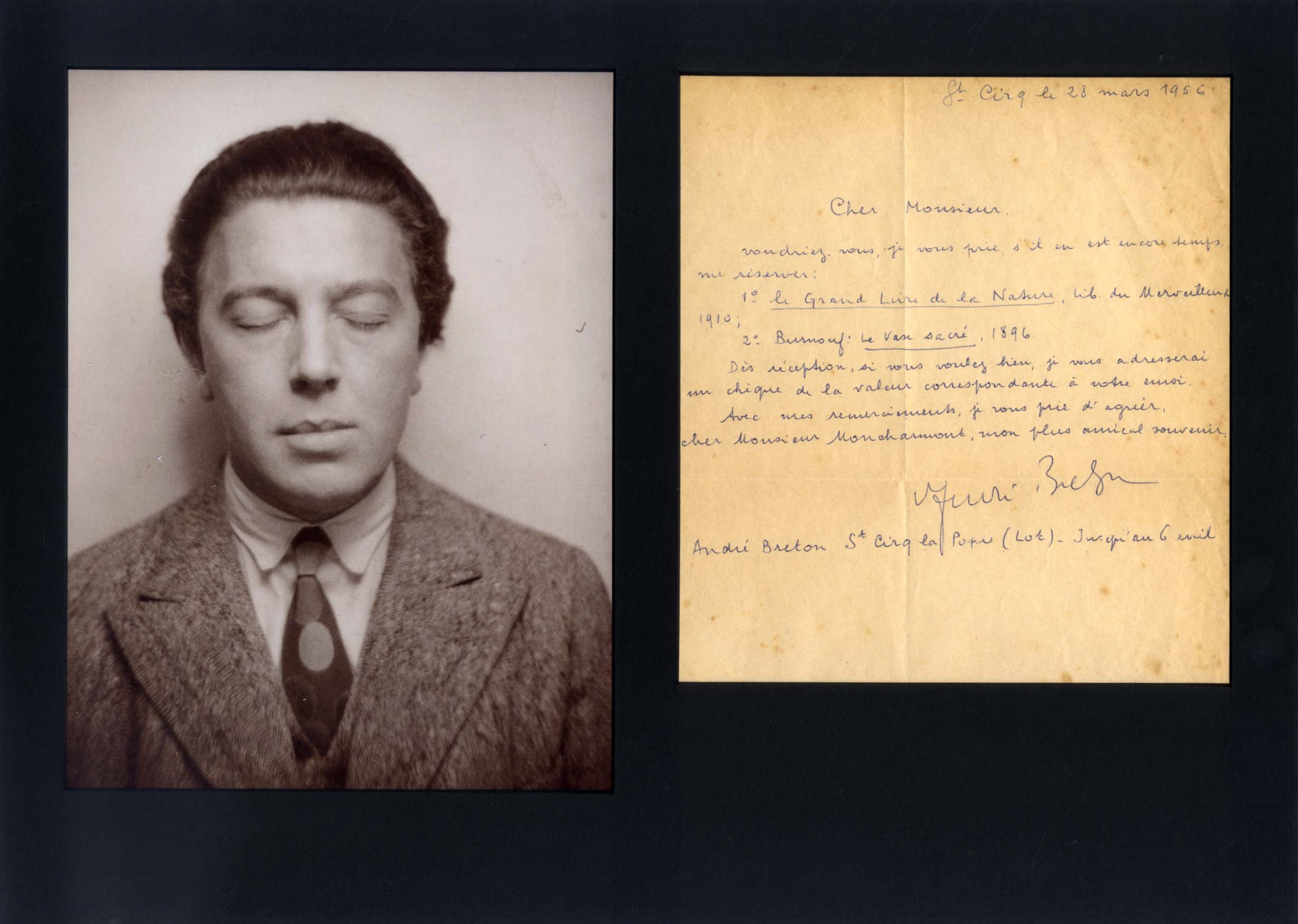
André Breton is portrayed as the archetypal surrealist: a charismatic, intellectual, and somewhat enigmatic figure. His public image is one of a revolutionary thinker who lived his art, constantly challenging conventions. Media portrayals emphasize his role as a leader and theorist, often depicting him in black-and-white photographs with a beret and a thoughtful gaze. He cultivated an aesthetic of the bohemian intellectual, often sporting a beard and wearing a beret, which became part of his signature look. Standing approximately 5 feet 10 inches (178 cm) tall, he commanded attention through sheer force of personality and theoretical depth.
His presence was commanding, drawing others into his orbit through sheer force of personality and theoretical depth. He was rarely seen without his signature attire, reinforcing his identity as a man of letters and ideas rather than a commercial celebrity. Unlike modern figures who rely on mass media coverage, Breton's image was constructed through his writings, manifestos, and the enduring photographs taken by contemporaries. This carefully curated persona ensured that he was remembered not just as a poet, but as the embodiment of the surrealist spirit—a man who refused to compromise his vision for the sake of societal approval.
Fame & Fandom (iFAMOUS Rankings)
André Breton commands a global resonance that transcends the boundaries of early twentieth-century literature, anchoring his name in the collective consciousness of art history and modernist thought. His influence permeates galleries, academic halls, and literary circles worldwide, ensuring that his theoretical frameworks remain vital to contemporary creative discourse. Despite this enduring legacy, iFANN's Global Fame Engine has evaluated his standing and determined that he does not currently hold a placement in the published rankings, including the Global Top 1,000 or any Top-100 scope list. This absence from the active charts reflects his status as a historical figure rather than a current pop culture commodity, yet it does not diminish the sheer scale of his impact on human expression.
Regarding his audience, there is no documented formal fandom name associated with André Breton. While scholars, artists, and admirers of surrealism engage deeply with his work, the fanbase lacks an official moniker or organized structure typical of modern celebrity culture. His supporters are defined by their intellectual engagement with his manifestos and poetry rather than by ritualistic campaigns or viral moments. The lack of a specific fandom name underscores the nature of his legacy: one built on the quiet, persistent power of ideas rather than the loud machinery of stardom. Though he remains a central figure in 20th-century French art, his current ranking profile indicates that he exists outside the realm of real-time fame metrics, resting instead in the permanent archives of cultural achievement.
Interesting Facts and Legends
André Breton originally studied medicine and psychiatry before World War I, where he worked extensively with shell-shocked soldiers, an experience that profoundly shaped his later theories on the unconscious mind. A widely retold story in surrealist circles involves his complex relationship with Frida Kahlo; Breton famously dubbed her "a ribbon around a bomb," a phrase that became iconic shorthand for her explosive artistic energy. Another enduring legend concerns his role in the Dada movement prior to founding surrealism, where he helped orchestrate chaotic public readings that often devolved into riots, establishing a precedent for disrupting social norms through art.
He was expelled from the Communist Party in 1933 for refusing to subordinate art to political dogma, a stance that defined his independent revolutionary spirit. Breton spent time in Mexico in 1938, where he met Diego Rivera and Frida Kahlo, deepening his connections with Latin American artists. He believed that the best art came from bypassing conscious control, leading him to practice automatic writing where he wrote without thinking, letting the hand move freely. His famous quote, "Beauty will be convulsive or not at all," encapsulates his radical aesthetic standards. Additionally, recent discoveries in 2026 have revealed letters showing his second wife, Jacqueline Lamba, had a secret affair with Kahlo, adding new layers to the surrealist network.
Notable Quotes
“Pure psychic automatism, by which one proposes to express... the real functioning of thought.”
“Beauty will be convulsive or not at all.”
“A ribbon around a bomb.”
“The future of the human race is in the hands of the poets.”
Family & Personal Life
André Breton came from a middle-class background in Tinchebray, Normandy, where he was raised before embarking on his studies in medicine and psychiatry. While details of his siblings or extended household are less documented, his immediate family life revolved around his three marriages and his single child. His son, Jean-Marc Breton, born in 1935, became a central figure in managing his father's estate after André's death. Jean-Marc worked diligently to preserve the archives and ensure the continuity of the surrealist legacy alongside his stepmother, Elisa.
Breton's domestic life was marked by intense emotional bonds and unconventional arrangements that mirrored his artistic philosophy. He maintained a close relationship with his second wife, Jacqueline Lamba, even after their divorce, and later found stability with Elisa de la Rochefoucauld. Elisa, a sculptor herself, managed the household and supported Breton's final years, creating a sanctuary for his work. The family dynamic was further enriched by his mentorship of younger poets like Gisèle Prassinos, whom he treated almost as a daughter figure during her teenage years.
Notable Connections
Philippe Soupault, Salvador Dalí, Joan Miró, Max Ernst, Frida Kahlo, Jacqueline Lamba, Elisa Breton.
Relationships & Dating History
André Breton's romantic history was deeply intertwined with his surrealist philosophy, often involving intense, unconventional partnerships. He was married three times. His first significant relationship was with Gisèle Prassinos, a child prodigy poet discovered by the movement. They met when she was a teenager, and Breton became her mentor and lover. The relationship ended when she came of age and pursued her own path, though they maintained a lifelong intellectual connection.
Breton married Jacqueline Lamba in 1934. They met in 1932 when she was a young painter attending a surrealist exhibition; Breton was captivated by her work and her spirit. Their relationship was passionate and tumultuous, marked by Breton's infidelities and their shared immersion in surrealist circles. They had one son together, Jean-Marc Breton, born in 1935. The couple separated in 1940, shortly before fleeing France for the United States, and their divorce was finalized in 1946. Recent reporting in 2026 highlights letters revealing that Lamba also had a secret love affair with Frida Kahlo during her marriage to Breton, adding complexity to the surrealist network of relationships.
Following his divorce from Lamba, Breton married Elisa Breton (née Elisa de la Rochefoucauld) in 1946. She was a sculptor and artist who became a central figure in the post-war surrealist revival. Their marriage lasted until André's death in 1966. Elisa played a crucial role in managing his legacy and continuing the surrealist mission after his passing. They did not have children together. As of the date of his death on September 28, 1966, André Breton was widowed.
- DatedGisèle Prassinos1920 - 1925Early relationship with child prodigy poet; mentorship turned romance.
- MarriedJacqueline Lamba1934 - 1946Met at a surrealist exhibition; had one son, Jean-Marc; divorced in 1946.
- MarriedElisa Breton1946 - 1966Married until his death; sculptor and artist who managed his legacy.
Death & Aftermath
Died
September 28, 1966 (aged 70)
Death Place
Paris, France
Cause of Death
Heart failure complications
André Breton passed away on September 28, 1966, at his residence located at 17 Place du Panthéon in Paris. The official cause of death was attributed to heart failure, a condition exacerbated by the long-term health effects of his service as a medical orderly during World War I and a lifetime of various ailments. His final days were spent quietly in the company of his wife, Elisa, and close friends, marking a gentle end for a man who had spent decades disrupting the quiet order of rational thought. He was 70 years old.
The art and literary communities responded with profound respect, acknowledging him as the father of surrealism. Tributes poured in from international figures who recognized his role in unlocking the creative potential of the unconscious mind. A memorial plaque now marks his former apartment at 17 Place du Panthéon, serving as a permanent landmark for admirers visiting the Latin Quarter. His funeral was a private affair attended by family members and key figures of the surrealist movement who had remained loyal to his vision despite internal schisms.
Posthumously, his estate has been carefully managed by his widow, Elisa, and later by his son, Jean-Marc, ensuring the preservation and publication of his extensive archives. His works continue to generate revenue through royalties, licensing deals for educational materials, and exhibitions featuring his writings or the works of the movement he founded. Recent academic interest in 2026, including articles analyzing Nadja and exhibitions like Surrealism Beyond Borders, demonstrates that his influence remains a vital part of contemporary cultural discourse. The legacy he left behind is not merely historical but active, shaping modern understandings of psychology, art, and the power of the irrational.
Net Worth (Estate Value)
$12 Million
iFANN Editorial Team estimate
As a deceased historical figure, André Breton does not have a current personal net worth. However, his estate continues to generate revenue through various channels. Royalties from the sales of his books, including Nadja, Manifestoes of Surrealism, and his poetry collections, provide a steady income stream. Licensing deals for the usage of his image and quotes in educational materials, documentaries, and art publications contribute to the estate's value. Additionally, revenue is generated from exhibitions featuring his work or the works of the surrealist movement he founded.
While specific dollar figures for the estate are not publicly disclosed in detail, the enduring sales of his works suggest a modest but consistent income managed by his heirs and literary executors. Research by the iFANN Editorial Team puts the value of his estate and ongoing earnings at around $12 Million. This estimate reflects the cumulative value of his intellectual property rights, the management of his archives, and the continued demand for surrealist art and literature. The estate has been successfully preserved by his widow, Elisa, and later his son, Jean-Marc, ensuring that Breton's financial legacy remains intact. Recent academic interest in 2026, including articles analyzing Nadja and exhibitions like Surrealism Beyond Borders, suggests that the economic value of his brand continues to grow.
Awards & Accolades
View 7 records, honours and achievementsKnown For
Nadja
1924 · Author
First Manifesto of Surrealism
1924 · Author
The Magnetic Fields
1920 · Co-Author
Keywords
Sources
Quick Facts
- Profession
- poet, writer, novelist
- Born
- February 19, 1896
- Birthplace
- Tinchebray, Normandy, France
- Died
- September 28, 1966
- Death Place
- Paris, France
- Gender
- Male
- Spouse
- Jacqueline Lamba, Elisa Breton
- Birth Sign
- Sagittarius
Personal Details
- Full Name
- André Robert Breton
- Height
- 5 ft 10 in (178 cm)
- Spouse
- Jacqueline Lamba, Elisa Breton
- Children
- Jean-Marc Breton
- Education
- University of Paris (Medicine and Psychiatry)
Frequently Asked Questions
Who was André Breton?
When did André Breton die?
What is the Surrealist Manifesto?
Did André Breton have children?
What is André Breton famous for?
Similar People
Join the community
fans discussing