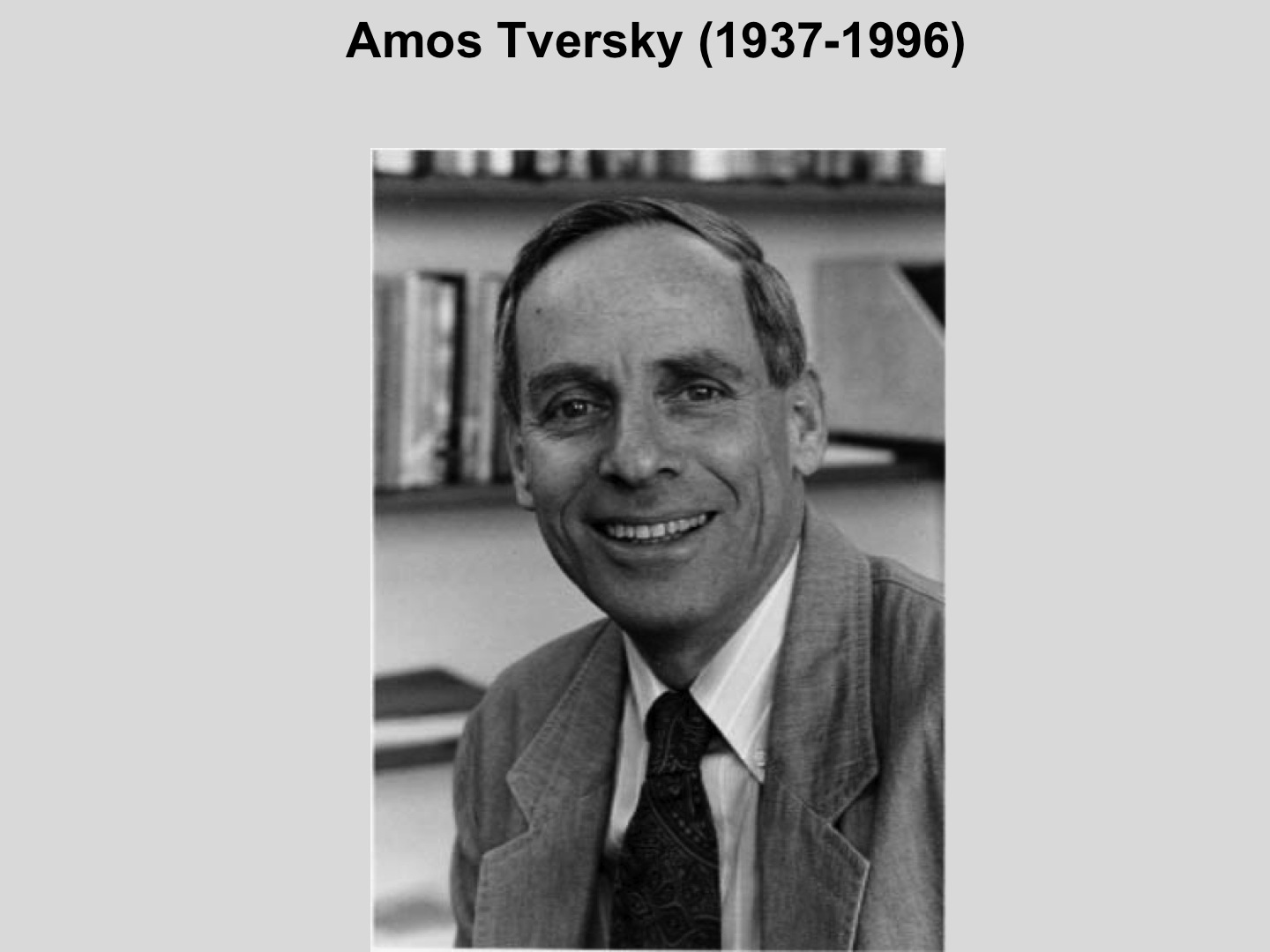
Amos Tversky
 Israel
psychologist•economist•university teacher
Also known as: Amos Nathan Tversky
Birthday
March 16, 1937
Birth Sign
Pisces
Birthplace
Haifa, Israel
Age
Died at 59
About
Amos Tversky was an Israeli cognitive and mathematical psychologist who, alongside Daniel Kahneman, exposed the hidden flaws in human reasoning. Their collaboration produced prospect theory, a framework that explains why people make decisions that defy simple logic, and it became a cornerstone of behavioral economics. Tversky's work extended beyond that, covering everything from measurement theory to the psychology of prediction.
His research with Kahneman uncovered systematic biases in how people think and handle risk, reshaping fields from economics to medicine. A 2002 survey ranked him among the most cited psychologists of the 20th century. He passed away in 1996, but his ideas continue to shape how experts understand human choice.
Early Life & Background
Amos Tversky was born on March 16, 1937, in Haifa, then part of British Mandate Palestine. His father, a veterinarian, and his mother, a social worker, raised him in a secular Jewish household. He served in the Israeli Defense Forces as a paratrooper, reaching the rank of captain, and was wounded in action during the 1956 Suez Crisis.
After his military service, Tversky studied at the Hebrew University of Jerusalem, earning a bachelor's degree in 1961. He then moved to the United States for graduate work at the University of Michigan, where he received his PhD in psychology in 1965. His dissertation explored the foundations of measurement, a topic that would occupy him for years.
Returning to Israel, Tversky joined the faculty at the Hebrew University. There he met Daniel Kahneman in 1968, when Kahneman was a young lecturer. Their first conversation sparked a collaboration that would last until Tversky's death.
Career Growth
Tversky's collaboration with Daniel Kahneman produced a string of landmark papers in the early 1970s. Their 1974 Science article on heuristics and biases demonstrated that people rely on mental shortcuts that lead to predictable errors. In 1979 they published prospect theory, a model of decision-making under risk that challenged expected utility theory.
Prospect theory became one of the most influential works in the social sciences. It showed that people feel losses more intensely than gains and weigh probabilities in ways that deviate from rational calculation. The theory found applications in economics, law, and medicine, and it laid the groundwork for the field of behavioral economics.
Tversky also made significant contributions to measurement theory, co-authoring the three-volume Foundations of Measurement with Duncan Luce and Patrick Suppes. He received the MacArthur Fellowship in 1984 and held positions at Stanford University and the Hebrew University. In 2002, six years after his death, Kahneman received the Nobel Memorial Prize in Economic Sciences for work done largely with Tversky.
Career Timeline
Public Image & Style
Tversky was known among colleagues for his intellectual intensity and playful humor. He had a reputation for asking probing questions that could derail a seminar, but always in the service of deeper insight. His writing style was clear and direct, a model for how to present complex ideas simply. Fans of behavioral economics see him as a founding figure, and his name appears on the Thaler-Tversky Research Grant, which supports new research in the field.
Fame & Fandom (iFAMOUS Rankings)
Amos Tversky never sought the roar of a stadium or the glow of a spotlight, yet his intellectual footprint commands a reverence that outlasts most pop stars. His audience is not a mob of screaming fans but a global community of scholars, economists, and psychologists who still dissect his theories decades after his death. There is no official fandom name for this group; they are simply the inheritors of a legacy built on rigorous debate rather than adoration. While he never performed on stage, the story of his fiery partnership with Daniel Kahneman remains the central legend of behavioral science. Their collaboration dismantled the rational actor model of economics, proving that human judgment follows predictable, often irrational patterns. This narrative, detailed in retrospectives by major publications, stands as the definitive mythos of his life: two brilliant minds challenging the world's understanding of itself until one vanished too soon. The academic world keeps his memory alive through the Thaler-Tversky Grant, which funds new research, and by embedding his concepts like loss aversion into standard curricula worldwide. He did not leave behind viral moments or fan rituals, but his ideas continue to shape how experts across medicine, law, and business analyze risk. In the digital landscape of modern fame metrics, his influence has been quantified with startling precision. According to the iFANN Global Fame Rankings, Amos Tversky is currently the 51st most famous person from Israel and holds the position of the 23rd most famous person in AI, placing him firmly among the titans of modern thought.
Interesting Facts and Legends
Amos Tversky was an avid chess player who once considered pursuing the game professionally before dedicating himself to psychology. Known for his sharp wit, he frequently played devil's advocate in academic debates, using probing questions to dismantle weak arguments in seminars. He held dual citizenship in both Israel and the United States, bridging two distinct academic cultures throughout his career. His favorite hobby was hiking, and he often took long walks with colleagues to discuss complex research problems away from the office. A passionate jazz fan, he found rhythm in the music that matched his intellectual intensity. Beyond these personal details, legends of his scientific impact endure. The most retold story involves his intense, fiery friendship with Daniel Kahneman, a partnership described as the engine behind the discovery of systematic cognitive bias. Another iconic moment in his lore is the posthumous recognition of his work; although he died in 1996 before receiving the Nobel Prize, his theories were so transformative that the prize was awarded to Kahneman later, cementing Tversky's place in history. His final major accolade came in 1995 when he received the Warren Medal from the Society of Experimental Psychologists.
Notable Quotes
“It's scary to see how much we can be influenced by factors we're not aware of.”
“The secret to doing good research is always to be a little underemployed.”
“People predict by representing, by the degree to which the object is similar to a typical case.”
Family & Personal Life
Tversky married Barbara Tversky, a fellow psychologist who later became a professor at Stanford. They had two daughters and a son. The family lived in Stanford, California, where Tversky worked. Despite his intense academic schedule, he remained close to his children and often involved them in intellectual discussions at the dinner table.
Notable Connections
Tversky's most famous collaborator was Daniel Kahneman, with whom he co-authored prospect theory and the heuristics-and-biases program. He also worked with Duncan Luce and Patrick Suppes on measurement theory, and with Thomas Gilovich, Itamar Simonson, Paul Slovic, and Richard Thaler on various projects. His ideas influenced a generation of behavioral economists and cognitive psychologists.
Relationships & Dating History
Amos Tversky was married to Barbara Tversky, a cognitive psychologist who later became a professor at Stanford University. The couple met in the 1960s and married, raising two daughters and a son. Their marriage lasted until Tversky's death in 1996. There is no public record of other significant relationships.
As of 2026, Barbara Tversky continues to be recognized for her own work in psychology, and she has spoken publicly about her late husband's brilliance and their life together.
- MarriedBarbara Tversky? - 1996Married until Tversky's death in 1996; they had three children.
Death & Aftermath
Died
June 2, 1996 (aged 59)
Death Place
Stanford, California
Cause of Death
Metastatic melanoma
Amos Tversky spent his final days at his home in Stanford, California, continuing to engage with academic work even as his health deteriorated sharply in early 1996. On June 2 of that year, the renowned psychologist passed away at the age of 59. The official cause was ruled as metastatic melanoma, a form of skin cancer that had spread to other parts of his body, a fact confirmed by family statements and university announcements rather than a public autopsy report. There were no legal investigations or disputes surrounding the circumstances of his passing, which resulted from natural causes. The psychological and economic communities mourned his loss with profound silence and deep respect.
Daniel Kahneman, his lifelong collaborator, described the event as a devastating blow to behavioral science, frequently reflecting on their partnership in later memoirs., the American Psychological Association and the Society for Judgment and Decision Making issued formal memorials honoring his contributions to cognitive psychology. Media outlets like The New York Times published detailed obituaries highlighting his role in reshaping how experts understand human risk assessment. Details regarding his funeral or private memorial service have never been made public, though it is understood that close family members and colleagues from Stanford University attended a quiet gathering in California. His burial site remains undisclosed in standard biographical records.
Posthumously, his legacy expanded significantly through the 2002 Nobel Memorial Prize in Economic Sciences awarded to Kahneman for their joint work, as well as the establishment of the Amos Tversky Award for Outstanding Contributions to Judgment and Decision Making Research. His intellectual property and archives were managed by his family and Stanford University to ensure preservation for academic use. Decades later, Michael Lewis's 2016 book The Undoing Project and its 2017 film adaptation brought his story to a global audience, sparking renewed interest in his theories and ensuring his name remained central to behavioral economics curricula worldwide.
Net Worth (Estate Value)
$2 Million
iFANN Editorial Team estimate
Per iFANN's editorial analysis, Amos Tversky's net worth is estimated at $2 Million as of 2026, reflecting his distinguished career as an academic psychologist. His income flowed primarily from university salaries at the Hebrew University and Stanford University, supplemented by royalties from his influential books and papers. While he did not amass great wealth during his lifetime, his intellectual contributions have had a lasting impact on the social sciences. After his death, his estate has continued to earn royalties from his publications, ensuring his financial presence endures alongside his ideas. The Thaler-Tversky Research Grant, established in his honor, supports new research in behavioral economics. Tversky's legacy is measured not in dollars but in the ideas that continue to shape how we understand human decision-making.
Awards Won (1)
Amos Tversky received the MacArthur Fellowship in 1984, a prestigious award for creative and intellectual achievement. He was also a fellow of the American Academy of Arts and Sciences and the National Academy of Sciences. His work with Kahneman was recognized posthumously when Kahneman won the Nobel Prize in 2002, an award that acknowledged their joint contributions.
1984 · Fellowship
Known For
Prospect Theory
1979 · Co-developer
Heuristics and Biases
1974 · Co-author
Foundations of Measurement
1971 · Co-author
Keywords
Sources
Quick Facts
- Profession
- psychologist, economist, university teacher
- Born
- March 16, 1937
- Birthplace
- Haifa, Israel
- Died
- June 2, 1996
- Death Place
- Stanford, California
- Gender
- Male
- Spouse
- Barbara Tversky
- Birth Sign
- Pisces
Personal Details
- Full Name
- Amos Nathan Tversky
- Spouse
- Barbara Tversky
Frequently Asked Questions
Who was Amos Tversky?
What is Amos Tversky known for?
When did Amos Tversky die?
Who was Amos Tversky's collaborator?
What is prospect theory?
Similar People
Join the community
fans discussing