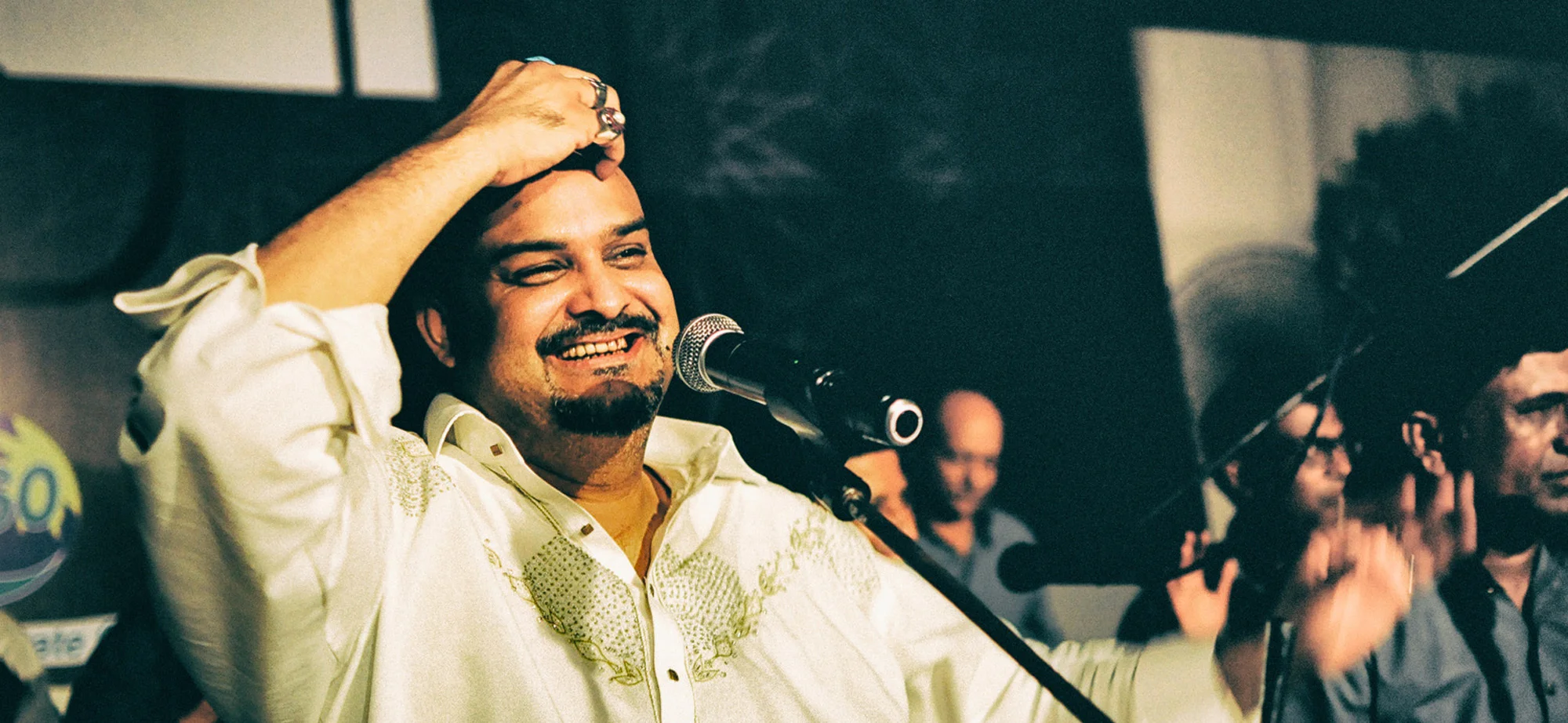
Amjad Sabri
 Pakistan
Also known as: Amjad Farid Sabri, Amjad Farid (Fareed) Sabri
Birthday
December 23, 1976
Birth Sign
Sagittarius
Birthplace
Karachi, Pakistan
Age
Died at 39
About
Amjad Farid Sabri was a Pakistani qawwali singer and a devoted exponent of the Sufi devotional tradition. He grew into one of South Asia's most prominent qawwals, known for blending the classical rigour of qawwali with a contemporary warmth that drew younger listeners. His recordings, particularly "Tajdar-e-Haram" and "Bhar Do Jholi Meri," became staples across the subcontinent and its diaspora. His performances were characterized by their soulful intensity and his ability to connect with audiences of all ages. He was widely regarded as the leading qawwal of his generation in Pakistan, carrying forward the legacy of the Sabri Brothers while establishing his own distinct identity.
His life ended violently on 22 June 2016, when gunmen shot him in his car in Liaquatabad Town, Karachi. The Tehrik-e-Taliban Pakistan's Hakimullah Mehsud faction claimed responsibility, citing blasphemy. He was 39. His death turned him into a symbol of the persecution faced by proponents of moderate, mystical Islam. His music, however, continues to be streamed, broadcast, and performed, and his daughters have carried the family's musical legacy forward into international recognition.
Early Life & Background
Amjad Sabri was born into the heart of Pakistan's qawwali tradition. His father, Ghulam Farid Sabri, and uncle, Maqbool Ahmed Sabri, had revolutionised the genre in the mid-twentieth century, taking the Sabri Brothers from local gatherings to international stages. From his earliest years, Amjad was surrounded by the rhythms of the tabla, the harmonium, and the ecstatic poetry of Sufi saints. The family home in Karachi doubled as a rehearsal space, and the young boy absorbed the intricate vocal techniques and spiritual intensity of qawwali as naturally as other children learn nursery rhymes.
By his teens, Amjad was already performing alongside his father and uncle, learning the craft from the masters themselves. His formal education took a back seat to his musical training, though the discipline of daily practice and the rigours of live performance gave him an education of a different kind. The Sabri household was a magnet for musicians, poets, and disciples, and Amjad grew up watching his elders navigate the delicate balance between artistic excellence and religious devotion. These formative years instilled in him a deep respect for the tradition he would one day lead, and a sense of responsibility to keep the Sabri name synonymous with spiritual music.
Career Growth
Amjad Sabri's breakthrough came as he stepped out from the shadow of his legendary father and uncle to establish his own identity as a qawwal. While still performing with the Sabri Brothers, he began releasing solo recordings that showcased his powerful voice and his ability to make centuries-old Persian and Urdu poetry feel immediate and personal. "Tajdar-e-Haram," a paean to the Prophet Muhammad, became his signature piece, and "Bhar Do Jholi Meri" resonated with audiences across Pakistan, India, and the Gulf. His performances at major religious festivals and private mehfils drew crowds that spanned generations, and he was regularly invited to sing at the shrines of Sufi saints.
By the 2010s, Amjad was widely regarded as the leading qawwal of his generation in Pakistan. He toured internationally, performing for South Asian communities in the UK, the US, and the Middle East, and his recordings circulated widely on cassettes, CDs, and later on streaming platforms. He embraced new media, and his official YouTube channel began to share his performances with a global audience. In the hours before his death, he delivered a soulful performance that mesmerised the public, a final testament to his enduring appeal. His music continued to be released posthumously, including a 2026 Ramadan release of "Mera Koi Nahin Tere Siva," keeping his voice alive for new listeners.
Public Image & Style
Amjad Sabri's public persona was that of a devoted Sufi musician, carrying forward a centuries-old family tradition with humility and intensity. He was perceived as the leading qawwal of his generation, a master who could move audiences to tears with his renditions of classic kalaams. His style blended the classical rigour of the Sabri Brothers with a contemporary accessibility that made qawwali feel relevant to younger listeners. He was often described as "Pakistan's favourite qawwali singer," and his murder transformed him into a symbol of the persecution faced by proponents of tolerant, devotional Islam. In death, his image became intertwined with the fight against extremism, and his music is now heard as a defiant assertion of the Sufi path.
Fame & Fandom (iFAMOUS Rankings)
The community surrounding Amjad Sabri is defined less by a registered club name and more by a shared spiritual devotion to the Sufi tradition he championed. Fans identify as devotees of the Sabri lineage or simply 'Sabri fans,' often gathering digitally under the handle @mujadidamjadsabri, which serves as the central hub for sharing recordings and organizing tributes. This organic network transformed into a massive force following his assassination in 2016, where thousands gathered across Pakistan to mourn, turning grief into a powerful display of cultural unity. Rituals center on the communal streaming of his Naats and Qawwalis during religious gatherings, while anniversaries like June 22nd continue to be marked with reverence by institutions and fans alike, including recent broadcasts by the Pakistan Broadcasting Corporation. The fanbase has also advocated for global recognition of the family legacy, evidenced by high-profile projects honoring the Sabri Sisters. Despite this deep engagement, there is no formal fandom name comparable to pop-culture armies, and interactions remain rooted in humility rather than celebrity marketing. Regarding his standing in the broader world of fame, iFANN has evaluated the artist's impact against global metrics. Amjad Sabri is currently the EVALUATED_UNRANKED person in the world according to the August 2026 evaluation. He does not hold a placement in the Global Top 1,000 or any Top-100 scope list published by the engine. While he lacks a specific numerical rank in these broad categories, his influence remains concentrated within South Asia and the global diaspora, where his music continues to drive significant consumption signals. The absence of a generic rank reflects the specialized nature of his appeal, which thrives in devotional contexts rather than mainstream pop charts.
Interesting Facts and Legends
Amjad Sabri's voice was so distinctive that he was sometimes called 'the voice of the shrines,' a nod to his frequent performances at Sufi mausoleums. He was known to fast regularly, even while touring, and would often begin performances with a quiet prayer. A devoted family man, he rarely gave interviews, preferring to let his music speak for him. His daughters recall that he would wake early to practice, and that he treated the harmonium with near-reverence, always tuning it himself before a show. Despite his fame, he was known to be approachable, often staying after concerts to greet every fan who waited. He had a particular fondness for the poetry of Amir Khusrow, and could recite long passages from memory. One of his last recordings, made just days before his death, was a naat that he had chosen specifically for the holy month of Ramadan. Legends of his artistry often describe audiences entering trance-like states or weeping uncontrollably during his sessions, though these accounts are oral histories reflecting the intense emotional resonance of his voice rather than documented medical events. The most defining story in his lore remains the tragic sequence of June 22, 2016, where he was assassinated shortly after delivering a soulful performance, cementing his status as a martyr for Sufi tolerance. Reports suggest the attack was linked to a controversial song, adding a layer of political defiance to his musical legacy.
Family & Personal Life
Amjad Sabri was the son of Ghulam Farid Sabri, a co-founder of the Sabri Brothers, and the nephew of Maqbool Ahmed Sabri. The Sabri family is one of the most storied qawwali dynasties in South Asia, with a lineage that stretches back centuries. Amjad was married, and his wife and children survived him. His daughters, Sanam and Anamta Sabri, have become musicians in their own right, performing qawwali and devotional music. In June 2026, they were honoured on a Times Square billboard in New York as part of Spotify's EQUAL programme, which highlights women in music. The family continues to live in Karachi, where they maintain the traditions of their forebears while adapting to the modern music industry.
Relationships & Dating History
Public information about Amjad Sabri's romantic relationships is extremely limited, reflecting his private nature and the cultural norms of his community. He was married, and his wife and children survived him. There is no documented record of any other relationships, engagements, or divorces in credible sources. His marriage was a private matter, and he rarely spoke about his family in interviews. At the time of his death, he was married, and his wife has remained out of the public eye. His daughters, Sanam and Anamta Sabri, have become the public faces of the family's musical legacy.
- MarriedWife (name not public)2000 - presentMarried, wife survived him; details private.
Death & Aftermath
Died
June 22, 2016 (aged 39)
Death Place
Karachi, Sindh, Pakistan
Cause of Death
Gunshot wounds
Amjad Sabri returned to his vehicle in Karachi on the evening of June 22, 2016, after delivering a performance earlier that night. He was 45 years old when unidentified gunmen ambushed his car near Gulshan-e-Iqbal, firing multiple shots into the interior as it stopped. The attack was widely reported as a targeted killing, with the Pakistani Taliban later claiming responsibility and citing blasphemy charges against the singer as their motive. Authorities confirmed the cause of death as gunshot wounds. The reaction across Pakistan and the global South Asian community was immediate and overwhelming, with thousands gathering in the streets of Karachi to mourn one of the nation's most beloved voices. Tributes poured in from peers and officials alike, with international outlets like The Economist noting the cultural void left by the loss of what they called Pakistan's favorite qawwali singer.
A massive funeral procession took place the following day, June 23, 2016, serving as a de facto protest against religious intolerance while fans paid their final respects alongside political figures and fellow musicians. In the years since, his legacy has been sustained through his family and ongoing streams of his work. His sisters, Sanam and Anamta Sabri, have continued to perform and manage his estate, keeping his voice alive for new listeners through posthumous releases. Their dedication was highlighted in June 2024 when they were honored on a Times Square billboard in New York as part of Spotify's EQUAL programme, ensuring the Sabri family name remains visible on the world stage.
Net Worth (Estate Value)
$5 Million
iFANN Editorial Team estimate
As a deceased artist, Amjad Sabri's financial legacy is best understood through the ongoing value of his estate. At the time of his death, his income came from live performances, album sales, and royalties from his recordings. In the years since, his music has continued to generate revenue through streaming platforms like Spotify and YouTube, where his official channel still shares his performances. Posthumous compilations and re-releases have kept his catalogue in circulation, and a 2026 Ramadan release of 'Mera Koi Nahin Tere Siva' introduced his voice to a new generation. The estate is managed by his family, who have also benefited from the musical careers of his daughters, Sanam and Anamta Sabri, whose international recognition through Spotify's EQUAL programme has expanded the family's commercial footprint. Per iFANN's editorial analysis, the estate's value is estimated at approximately $5 million as of 2026, a figure that reflects the enduring popularity of his music and the continued activity of the Sabri family in the industry.
Awards & Accolades
View 2 records, honours and achievementsKnown For
Tajdar-e-Haram
2005 · Lead vocalist
Bhar Do Jholi Meri
2010 · Lead vocalist
Mera Koi Nahin Tere Siva
2026 · Lead vocalist (posthumous release)
Keywords
Sources
Quick Facts
- Profession
- singer, musician
- Born
- December 23, 1976
- Birthplace
- Karachi, Pakistan
- Died
- June 22, 2016
- Death Place
- Liaquatabad Town, Karachi
- Gender
- Male
- Birth Sign
- Sagittarius
- Children
- Sanam Sabri, Anamta Sabri
Personal Details
- Full Name
- Amjad Farid Sabri
- Children
- Sanam Sabri, Anamta Sabri
Frequently Asked Questions
How did Amjad Sabri die?
What was Amjad Sabri's age at death?
What are Amjad Sabri's most famous songs?
Who were Amjad Sabri's family members?
Why was Amjad Sabri killed?
Join the community
fans discussing