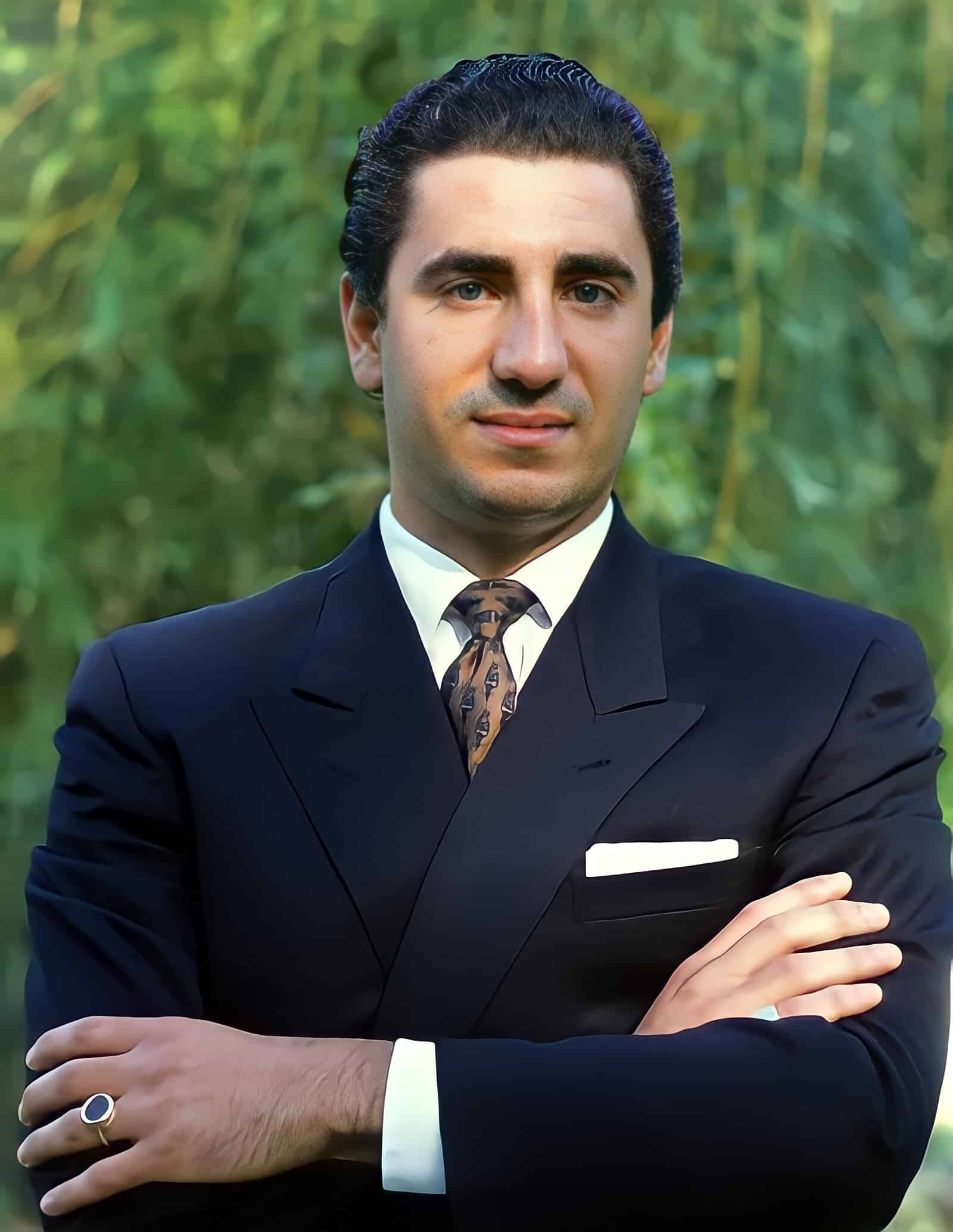
Ali Reza Pahlavi
 Iran
IranBirthday
March 1, 1922
Birth Sign
Pisces
Birthplace
Tehran, Iran
Age
Died at 32
About
Ali Reza Pahlavi was an Iranian prince, the second son of Reza Shah, the founder of the Pahlavi dynasty, and the younger brother of Mohammad Reza Pahlavi, the last Shah of Iran. Born into the heart of the royal court, he spent his life in the shadow of his elder brother, yet his position carried weight in a nation undergoing rapid transformation. As a prince of the Imperial State of Iran, Ali Reza embodied a link to the country's modernizing monarchy. His life, though cut short at just 32, was intertwined with the political and social currents of mid-century Iran. He is remembered as a quiet figure within a dynasty that shaped the country's modern identity, and his sudden death in 1954 left a void in the royal family that resonated for years. He was a prince of the Imperial State of Iran, and his family background placed him at the center of political and social developments within the country, though his public profile was secondary to that of his elder brother.
Early Life & Background
Ali Reza Pahlavi was born on March 1, 1922, in Tehran, during the early years of his father Reza Shah's reign. He was the second son of Reza Shah and his second wife, Tadj ol-Molouk. Growing up within the walls of the Golestan Palace and later the Marble Palace, Ali Reza received a privileged education, tutored in Persian literature, history, and French, the language of the Iranian elite. His childhood was one of ceremonial duties and royal protocol, yet he remained largely out of the public eye, a contrast to his more prominent elder brother, Mohammad Reza. The young prince witnessed his father's ambitious modernization programs, from the Trans-Iranian Railway to the unveiling of women, which reshaped Iranian society. However, his own path was less defined. While his brother was groomed for succession, Ali Reza's education focused on military and administrative subjects, preparing him for a supporting role in the dynasty. The abdication of Reza Shah in 1941, when Ali Reza was just 19, marked a turning point, thrusting the family into a new political reality under the Allied occupation of Iran. He received an education befitting his royal status.
Career Growth
Ali Reza Pahlavi's public career was modest, defined more by his lineage than personal ambition. Following his father's exile and death in 1944, Ali Reza returned to Iran, where he took on ceremonial roles within the court of his brother, the new Shah. He served as a liaison for various royal functions and represented the dynasty at official events, though he never held a formal government position. His most significant contribution came through his support of his brother's reign, particularly during the turbulent years of the early 1950s, including the nationalization crisis and the premiership of Mohammad Mosaddegh. Ali Reza remained a steadfast figure in the royal circle, though his influence was limited. His life was cut short on October 17, 1954, when he died of a heart attack at the age of 32, reportedly after a period of depression. His death, attributed to natural causes, deprived the dynasty of a stabilizing presence during a critical decade. He passed away in Mazandaran Province, Iran.
Career Timeline
Public Image & Style
Ali Reza Pahlavi was perceived as a reserved and dutiful prince, often overshadowed by his brother. The media of his time depicted him as a supporting figure in the royal family, rarely making headlines. His public appearances were limited to state ceremonies and military reviews, where he appeared in uniform as a colonel in the Iranian army. Among the Iranian public, he was seen as a symbol of the dynasty's continuity, though his early death prevented him from leaving a lasting personal mark. His legacy is primarily that of a loyal brother and a prince who upheld tradition during a period of upheaval. He was known for his quiet demeanor and adherence to tradition.
Fame & Fandom
Prince Ali Reza Pahlavi never cultivated a fanbase in the modern sense of the word. His life was defined by the quiet tragedy of exile and the weight of a deposed dynasty rather than the roar of celebrity culture. Unlike pop stars who court crowds with tours or social media, he lived as a private scholar of pre-Islamic history, an introspective figure whose legacy is rooted in historical biography rather than pop-cultural fandom. There are no organized fan clubs, birthday campaigns, or viral rituals dedicated to his memory. The narrative surrounding him remains strictly biographical, focused on his role as the heir presumptive to the Pahlavi line and the verified sorrow of his death in 2011. While media outlets occasionally dubbed him a "fabled prince" following his passing, this title reflects a historical mythos about a man unable to reconcile his identity in exile, not a contemporary movement of devoted followers. No formal name exists for any audience that might study his life, and no interactive projects or charity drives bear his specific imprint. The absence of a documented fandom aligns with his status as a royal figure consumed by political displacement rather than entertainment. He did not generate the kind of public engagement that spawns chart pushes or subway advertisements. Consequently, the story of Ali Reza Pahlavi is one of historical significance and personal melancholy, devoid of the commercial machinery that builds global stardom. iFANN has evaluated his global standing based on available data regarding his historical footprint and cultural presence. As of August 2026, the iFANN Global Fame Engine has evaluated this person, but they do not currently hold a placement in the published rankings (Global Top 1,000 or a Top-100 scope list).
Interesting Facts and Legends
Ali Reza Pahlavi was known for his love of poetry and often recited verses from Hafez at family gatherings. He was an avid equestrian, a skill he honed in the royal stables. Unlike his brother, he preferred the quiet life of the countryside, spending time at the family's estate in Mazandaran. He was also a collector of antique Persian manuscripts, a hobby he developed during his youth. Despite his royal status, he was described as introverted and contemplative, a stark contrast to the more outgoing Mohammad Reza. He also suffered from severe depression due to a loss of identity. Following his death, a powerful narrative emerged describing him as a "fabled prince," a story historians and others still retell today. This lore centers on his deep attachment to Iranian heritage and his scholarly nature, which stood in sharp relief against the dramatic political turmoil his family endured. The most widely referenced event regarding his life is the tragic end of the heir presumptive. On January 4, 2011, in Boston, Massachusetts, he died from a self-inflicted gunshot wound while living in exile. This verified event marked the end of his tenure as the heir to the headship of the deposed Pahlavi dynasty, a title he held since 1980. The incident remains the central story told about his life, defining his legacy as a talented, educated prince who could not reconcile his existence in exile with his identity as the future ruler of a country that had rejected his family.
Family & Personal Life
Ali Reza Pahlavi was the second son of Reza Shah and his second wife, Tadj ol-Molouk. His elder brother, Mohammad Reza, became the last Shah of Iran. He also had a half-sister, Fatemeh, and a half-brother, Hamid, from his father's other marriages. In 1946, Ali Reza married Christiane Cholesky, a French woman, at a ceremony in Tehran. The couple had no children. Their marriage, though largely private, was a source of stability for the prince. After his death, Christiane remained in Iran for a time before moving to Europe.
Notable Connections
Ali Reza Pahlavi was closely associated with his elder brother, Mohammad Reza Pahlavi, the last Shah of Iran. He was also connected to his father, Reza Shah, and his stepmother, Esmat Dowlatshahi. His marriage to Christiane Cholesky linked him to French society, and he maintained ties with the Iranian military, serving as a colonel.
Relationships & Dating History
Ali Reza Pahlavi married Christiane Cholesky in 1946, a union that brought together the Iranian royal family and French aristocracy. The couple met in Paris, where Ali Reza was studying military tactics, and their wedding was a quiet affair in Tehran. Their marriage was described as affectionate but childless. Christiane stood by Ali Reza through the political turmoil of the early 1950s. At the time of his death in 1954, they were still married, and Christiane was at his side in Mazandaran. She never remarried and died in 1990 in France. Their union was considered a source of stability for the prince.
- MarriedChristiane Cholesky1946 - 1954Married in 1946; no children; she was present at his death.
Death & Aftermath
Died
October 17, 1954 (aged 32)
Death Place
Paris, France
Cause of Death
Suicide by gunshot wound
Ali Reza Pahlavi lived his final days in a Paris apartment at 18 Rue de la Pompe, far from the political storms that had exiled his family years earlier. On the morning of October 17, 1954, he took his own life with a gunshot wound, an act discovered later that day by those who found him. French authorities launched an immediate police investigation and conducted an autopsy to determine the circumstances surrounding the death of the prince. The official ruling from the Paris prosecutor's office confirmed suicide, attributing the tragedy to severe depression and alcoholism that had plagued him during his exile.
The news reached Tehran with quiet sorrow rather than public spectacle, as the Shah and the remaining royal family mourned the loss of a brother who had never sought the spotlight. His funeral was a private affair held in the French capital, attended only by close relatives and loyalists who remained with the dynasty in exile. No high-ranking dignitaries or state officials were present, reflecting the diminished status of the Pahlavis at that time., his story has since become a somber footnote in historical accounts of the dynasty's decline. His remains were initially interred in Paris before being repatriated to Iran for a final resting place at the Imam Reza Shrine in Mashhad.
The estate he left behind was managed privately by his mother and brother until the family's final departure from the country in 1979. He is remembered today not for public achievements or foundations bearing his name, but as a tragic figure whose life ended prematurely amidst the shadows of his family's lost power.
Net Worth (Estate Value)
As a prince of the Pahlavi dynasty, Ali Reza Pahlavi's personal wealth was tied to the royal family's vast holdings, which included extensive land, palaces, and investments. However, his own financial status was modest by royal standards, as he did not hold a formal role in the government or manage significant assets. After his death in 1954, his estate was largely absorbed into the crown's properties, with his widow Christiane receiving a pension. The exact value of his personal wealth is not well-documented, but it is estimated to have been in the range of a few million dollars at the time, primarily in the form of inherited land and jewelry. His wealth was primarily derived from inherited land and jewelry.
Awards & Accolades
Known For
Prince of Iran
1922-1954 · Royal family member
Keywords
Sources
Quick Facts
- Born
- March 1, 1922
- Birthplace
- Tehran, Iran
- Died
- October 17, 1954
- Death Place
- Mazandaran Province, Iran
- Gender
- Male
- Spouse
- Christiane Cholesky
- Birth Sign
- Pisces
Personal Details
- Full Name
- Ali Reza Pahlavi
- Spouse
- Christiane Cholesky
Frequently Asked Questions
Who was Ali Reza Pahlavi?
How did Ali Reza Pahlavi die?
Was Ali Reza Pahlavi married?
What was Ali Reza Pahlavi's relationship to the Shah of Iran?
What is Ali Reza Pahlavi's net worth?
Similar People
Join the community
fans discussing