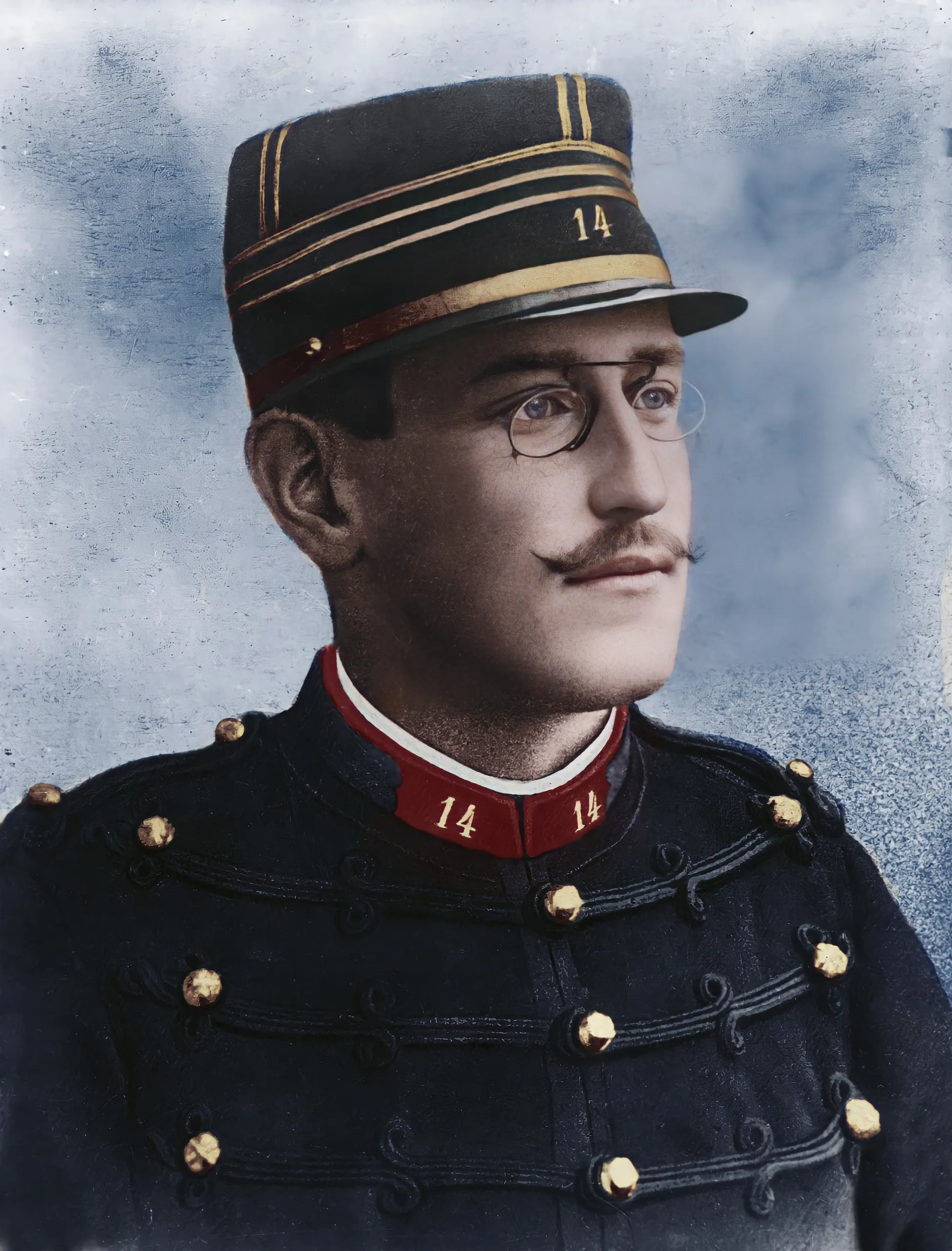
Alfred Dreyfus
 France
Birthday
+1859-10-09
Birth Sign
Libra
Birthplace
Mulhouse
Age
Died at 75
About
Alfred Dreyfus was a French army officer whose wrongful conviction for treason in 1894 ignited one of the most explosive political scandals in modern French history. Born on 9 October 1859 in Mulhouse, a town in the Alsace region near the German border, Dreyfus came from a prosperous Jewish textile family. He chose a military career, graduating from the École Polytechnique and rising through the ranks of the artillery. By the early 1890s, he was a captain on the General Staff in Paris, a position that placed him at the heart of the French military establishment. In 1894, Dreyfus was arrested and accused of passing military secrets to the German Empire. The evidence against him was flimsy, but antisemitism within the army made him an easy target. He was convicted in a closed court-martial, publicly stripped of his rank in a humiliating ceremony, and sentenced to life imprisonment on Devil's Island, a notorious penal colony off the coast of French Guiana. There he was held in solitary confinement under brutal conditions, shackled at night and given little to eat. Over the following years, doubts about his guilt began to surface. In 1896, Lieutenant Colonel Georges Picquart, the new head of military intelligence, discovered that the real spy was a French officer named Ferdinand Walsin Esterhazy. When Picquart tried to reopen the case, his superiors silenced him and transferred him to North Africa. The army, determined to protect its reputation, fabricated additional evidence against Dreyfus and court-martialed Esterhazy, who was acquitted in 1898. That same year, the writer Émile Zola published his famous open letter J'Accuse...!, accusing the military and government of a cover-up. The letter split France into two camps: the Dreyfusards, who demanded justice, and the anti-Dreyfusards, who saw Dreyfus as a traitor and a symbol of Jewish disloyalty. The affair dragged on for years. Dreyfus was brought back from Devil's Island in 1899 for a second trial, which again found him guilty, though with extenuating circumstances. He was pardoned by President Émile Loubet, but it was not until 1906 that the French Supreme Court annulled his conviction and he was fully exonerated. He was reinstated in the army as a major, though the promotion was less than his seniority warranted. In 1908, while attending the transfer of Zola's ashes to the Panthéon, Dreyfus was shot in the arm by an antisemitic journalist, who was acquitted at trial. During World War I, Dreyfus served with distinction, commanding an artillery supply column at the battles of Verdun and the Aisne. He retired after the war and lived quietly in Paris. He died on 12 July 1935, at the age of 75, and was buried in the Montparnasse Cemetery. His life and the ordeal he endured left a lasting mark on French politics, exposing deep-seated antisemitism in the military and government and leading to the separation of church and state in 1905. Among his prominent defenders were writers like Zola, Charles Péguy, and Anatole France, and politicians like Georges Clemenceau and Jean Jaurès. The affair also inspired filmmakers, including Georges Méliès, and activists who founded the Human Rights League.
Fame & Fandom
Alfred Dreyfus remains a figure of profound historical resonance rather than contemporary celebrity, his reputation anchored in the legal and political upheavals of late nineteenth-century France. As of August 2026, iFANN's Global Fame Engine has evaluated this individual, yet he does not currently hold a placement in the published rankings covering the Global Top 1,000 or any Top-100 scope list. This absence of a numeric rank reflects his status as a historical subject whose fame is measured by academic study and state commemoration rather than modern consumption metrics. While the world of pop culture often generates organized fanbases with specific names and rituals, the supporters of Dreyfus were historically known as Dreyfusards, a term designating a political movement of intellectuals and citizens who fought for justice during the Affair. This collective identity was defined by activism against antisemitism and judicial error, lacking the formalized fandom structures seen in entertainment sectors today. There are no documented fan clubs, unofficial names for his modern admirers, or fan-funded campaigns such as birthday billboards or streaming drives. The legacy of Dreyfus is maintained through educational institutions, museums like the Museum of Jewish Heritage, and official state tributes, including a permanent statue in central Paris installed following a ceremony in July 2026. His posthumous promotion in March 2026 marked the 130th anniversary of his wrongful accusation, further cementing his place in French national memory. Unlike living celebrities whose fame fluctuates with media cycles, Dreyfus endures as a symbol of human rights, with his story retold in classrooms and courtrooms rather than on social media feeds.
Interesting Facts and Legends
The wrongful conviction of Captain Alfred Dreyfus in December 1894 stands as one of the most documented miscarriages of justice in history. On January 5, 1895, he was publicly stripped of his rank in a degrading ceremony before a Parisian crowd, an event that ignited the twelve-year Dreyfus Affair. A pivotal moment occurred in January 1898 when writer Émile Zola published the open letter *J'accuse…!* in the newspaper *L'Aurore*, explicitly accusing the French Army of framing Dreyfus. This intervention galvanized public opinion and polarized the nation, creating a lasting mythos around the struggle for truth. In recent years, the narrative has extended to tangible artifacts; reports from 2026 noted that the handwriting analysis dossier used to convict him, featuring expert Etienne Charavay's confused arguments, became available for sale as a historical object. The family lineage also retains its own legend: in May 2026, Uriel Dreyfus, a descendant, was promoted to Lieutenant Colonel in the IDF, an event framed by the family as a continuation of their fight against injustice. These verified events form the core of his enduring legacy, transforming a personal tragedy into a global symbol of civil rights.
Death & Aftermath
Died
+1935-07-12 (aged 75)
Death Place
Paris, France
Cause of Death
Natural causes associated with old age
Alfred Dreyfus died on July 12, 1935, in Paris, France, at the age of seventy-four. He passed away peacefully while resting or asleep, attended by his personal physician Pierre-Paul Levy and surrounded by family members. The circumstances were entirely private, marking a quiet conclusion to a life that had previously been subjected to intense public scrutiny and legal controversy. Official records attribute the death to natural causes associated with old age. The funeral was a private affair held shortly after his passing in Paris, where he was interred in Montparnasse Cemetery.
His estate was managed by his wife Lucie Dreyfus and their son Pierre. Modern commemorations have since reinforced his historical significance, most notably when French President Emmanuel Macron delivered a tribute in July 2026 warning against resurgent antisemitism. This address coincided with the formal placement of a statue honoring Dreyfus in central Paris, which had previously been relocated for forty years before finding its permanent home. The sculpture, created in 1985 by Louis Mitelberg, depicts Dreyfus holding a broken sword.
Awards & Accolades
Keywords
Quick Facts
- Profession
- army officer, military officer
- Born
- +1859-10-09
- Birthplace
- Mulhouse
- Died
- +1935-07-12
- Death Place
- Paris
- Gender
- Male
- Spouse
- Lucie Dreyfus
- Birth Sign
- Libra
Personal Details
- Spouse
- Lucie Dreyfus
Join the community
fans discussing