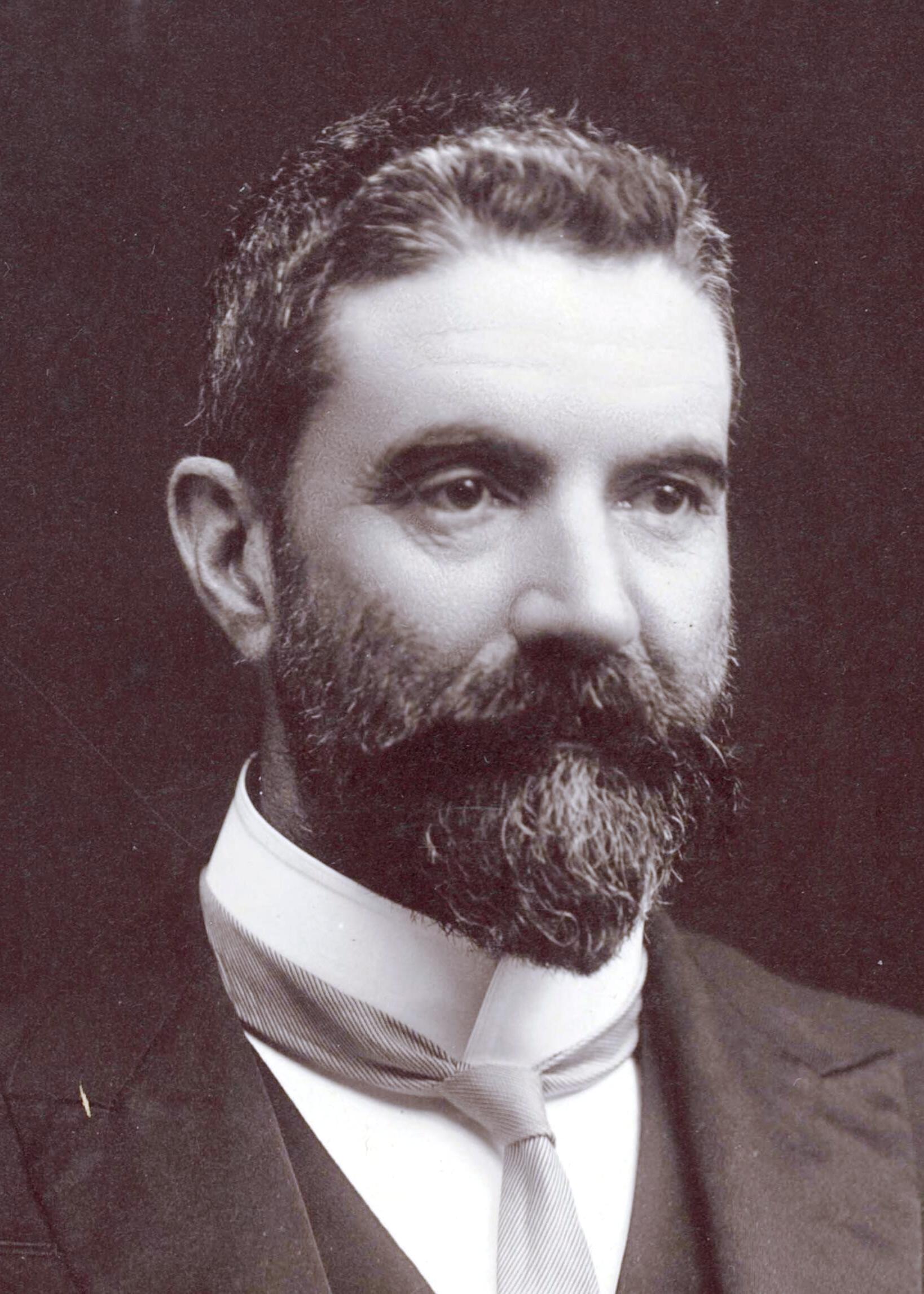
Alfred Deakin
 Australia
politician•diplomat•journalist
Also known as: The Honourable Alfred Deakin
Birthday
August 3, 1856
Birth Sign
Leo
Birthplace
Fitzroy, Melbourne, Victoria, Australia
Age
Died at 63
About
Alfred Deakin was an Australian politician, journalist, and barrister who served as the second prime minister of Australia across three separate terms between 1903 and 1910. He is remembered as one of the nation's most influential founding figures, the principal architect of the "Australian settlement" that shaped the country's social and economic framework for decades.
Deakin's legacy rests on his central role in federating the Australian colonies and his leadership in the early federal parliament. He was a brilliant orator and a tireless advocate for national unity, earning respect across the political spectrum. His three premierships saw the establishment of key national institutions and policies, including compulsory arbitration and protectionism, which defined Australia's approach to governance and industry well into the twentieth century.
Beyond politics, Deakin was a man of letters, an accomplished journalist, and a devoted family man. His intellectual curiosity ranged from spiritualism to constitutional law, and his writings, including The Federal Story, remain vital records of Australia's birth as a nation. He died in 1919, but his influence endures in the very structure of Australian politics.
Early Life & Background
Alfred Deakin was born on 3 August 1856 in Fitzroy, a suburb of Melbourne, to English immigrants William and Sarah Deakin. His parents had sailed from Plymouth in 1849, settling first in Adelaide before moving to Melbourne during the gold rush. William worked as a clerk, prospector, and later an accountant and manager of coach firms, including Cobb & Co. The family was comfortably middle-class, and Alfred, the second of two children, enjoyed a stable and happy upbringing.
His education began at a small girls' school, where he attended alongside his older sister Sarah, before he moved to Melbourne Church of England Grammar School in 1864. A voracious reader, he developed a remarkable speed-reading ability and could recite long passages from memory. At fifteen, he passed the matriculation exam for the University of Melbourne, but financial constraints meant he couldn't study full-time. Instead, he worked as a schoolteacher and tutor while attending evening law classes. He was admitted to the bar in 1877, at twenty-one, without a university degree.
During these years, Deakin's interests ranged widely. He was a frequent speaker in the Melbourne University Debating Society, mentored by Charles Henry Pearson, and he dabbled in spiritualism, participating in séances. His Christian faith was genuine but unconventional, and his restless intellect kept him exploring new ideas. In 1879, at just twenty-three, he won a seat in the Victorian Legislative Assembly for West Bourke, launching a political career that would define his life.
Career Growth
Deakin's breakthrough came in the 1890s when he threw himself into the federation movement. He attended the federal conventions of 1891 and 1897–98, helping draft the Australian Constitution, and campaigned vigorously in the referendums. In 1900, he joined the delegation to London, where he and Edmund Barton negotiated the Constitution Bill with British Colonial Secretary Joseph Chamberlain.
When Federation was achieved in 1901, Deakin became Australia's first Attorney-General under Barton. He succeeded Barton as prime minister in September 1903, but his first term was short-lived, ending in April 1904. He returned to office in July 1905, this time with Labor support, and governed effectively until November 1908. His most controversial move came in 1909 with the "Fusion," merging his Protectionists with the Free Traders to form an anti-socialist alliance. This created Australia's first majority government and laid the groundwork for the two-party system. His final term, from June 1909 to April 1910, was productive, but the ALP won a landslide in the 1910 election, ending his premiership.
After retiring from politics in 1913 due to a degenerative neurological condition, Deakin wrote The Federal Story, published posthumously in 1944, offering an insider's account of the federation process. He died on 7 October 1919, leaving a legacy that shaped Australia's political and social landscape for generations.
Career Timeline
Public Image & Style
Alfred Deakin was regarded as an intellectual and eloquent statesman, known for his powerful oratory and sharp legal mind. His public persona was that of a liberal and radical, committed to progressive reform and national unity. Contemporary descriptions emphasize his distinctive presence, despite his average stature, and his ability to captivate audiences with his speeches.
Fans of Australian history remember him as a founding father, a man who bridged colonial rivalries to create a nation. His image is that of a principled leader, willing to make controversial decisions like the Fusion for the greater good. Deakin's legacy is commemorated through Deakin University, numerous streets and buildings, and his portrait in the National Library of Australia. His writings continue to inspire those interested in Australia's political origins.
Fame & Fandom (iFAMOUS Rankings)
Alfred Deakin currently holds no placement in the iFANN Global Top 1,000 or any Top-100 scope list. The iFANN Global Fame Engine has evaluated this historical figure, yet he does not appear in the published rankings as of August 2026. While modern celebrity culture relies on viral moments and organized fanbases, Deakin remains a subject of historical study rather than pop-culture adoration. There is no documented fandom name for his supporters; the public interest he garners is academic and civic rather than driven by a formalized group of fans with specific rituals or campaigns. His legacy persists through institutions like Deakin University and the preservation efforts surrounding his former residence, Ballara, which faced significant controversy in early 2026 when federal funding to protect the property was withdrawn. This event sparked public outcry regarding the treatment of Australia's founding fathers, but it did not generate a new wave of fandom activity. Similarly, while Alfred Deakin Place in Ballarat serves as a venue for football matches, the crowds gathering there are sports enthusiasts rather than devotees of the statesman himself. No legends of fainting crowds or street-shutting adoration exist for a man who died long before the concept of celebrity fandom emerged. His enduring presence is defined by his role in federating the colonies and shaping the Australian settlement, a contribution that commands respect across the political spectrum without requiring the machinery of modern fame.
Interesting Facts and Legends
Alfred Deakin possessed an extraordinary capacity for reading at speed and held a photographic memory capable of reciting entire poems and speeches from his teens. In his youth, he explored spiritualism and the occult, attending séances until he abandoned mediumship experiments by his twenty-first birthday. His marriage to Pattie Browne, daughter of a wealthy spiritualist, initially met disapproval from her family. Despite matriculating at fifteen, Deakin never completed a university degree due to financial constraints. Deakin University, established in 1974, bears his name, and his descendants have maintained involvement with the institution. A widely retold story in Australian history concerns his instrumental role in the federation of the colonies, marking him as one of only two prime ministers to serve three separate terms. Historical records highlight his strategic vision for an independent Australian navy and his grasp of Pacific defense doctrine, often cited as the root of the nation's security policy. Recent events involving the auction of his historic home, Ballara, in February 2026, have kept his physical legacy in the public eye, sparking debate over heritage preservation.
Notable Quotes
“The federation of the Australian colonies is the crowning achievement of our generation.”
“We are a people with a great destiny, and we must rise to meet it.”
“The true test of a nation is the welfare of its people.”
“I have seen the dawn of a new Australia, and it is glorious.”
Family & Personal Life
Alfred Deakin was the second child of William Deakin and Sarah Bill, both English immigrants. His older sister Sarah was a constant companion in childhood. William, a former clerk and prospector, worked as an accountant and manager for Cobb & Co, providing a comfortable middle-class home.
Deakin married Elizabeth Martha Anne "Pattie" Browne on 3 April 1882, when she was nineteen. The couple had three daughters: Ivy, Stella, and Vera. They lived with Deakin's parents briefly before moving into their own home, Llanarth, in South Yarra, in 1887. The family remained close-knit throughout his political career, with Pattie providing steadfast support. Deakin was a devoted husband and father, and his marriage was a stable and lasting one, with no records of infidelity or separation.
Notable Connections
Deakin's closest political ally was Edmund Barton, Australia's first prime minister, with whom he formed a deep friendship during the federation movement. He was mentored by Charles Henry Pearson in the Melbourne University Debating Society. His wife Pattie Browne was a constant support, and he negotiated with British Colonial Secretary Joseph Chamberlain over the Constitution Bill.
Relationships & Dating History
Alfred Deakin's only recorded romantic relationship was with Elizabeth Martha Anne "Pattie" Browne. They met at the Lyceum Club while he was establishing himself as a lawyer. They married on 3 April 1882, when Pattie was nineteen. The marriage was initially disapproved of by her family, as Deakin was not wealthy, but it proved to be a devoted and lasting union.
The couple had three daughters: Ivy, Stella, and Vera. They lived with Deakin's parents for a time before moving into their own home, Llanarth, in South Yarra, in 1887. Pattie was a supportive partner throughout his political career, and their family life remained stable. Deakin was married to Pattie at the time of his death in 1919.
- MarriedPattie Browne1882 - 1919CurrentMarried on 3 April 1882, had three daughters, remained together until Deakin's death.
Death & Aftermath
Died
October 7, 1919 (aged 63)
Death Place
Point Lonsdale, Victoria, Australia
Cause of Death
Heart failure
The family announced that Alfred Deakin had passed away peacefully at his residence, Ballara, in Point Lonsdale, Victoria, following a long decline in health. The attending physicians determined the cause to be heart failure, a conclusion reached through direct observation of his final days, as was standard for natural deaths among elderly citizens in 1919. Deakin spent his last weeks in quiet seclusion at his seaside home, succumbing to cardiac disease exacerbated by age and prior illness rather than any sudden acute event. Public reaction to the loss of the second Prime Minister was marked by profound national mourning and official tributes from federal and state parliaments. Contemporary press accounts described him as a man who had dedicated his life to the nation's construction, with memorial services held in Melbourne and other major cities to honor his intellectual contributions to law and diplomacy.
A public funeral service took place on October 10, 1919, at St Paul's Cathedral in Melbourne, attended by high-ranking government officials and dignitaries before he was interred at the Melbourne General Cemetery in Carlton. In the decades following his death, Deakin has been commemorated through various institutional dedications, most notably Deakin University in Victoria and Alfred Deakin Place in Ballarat. His legacy remains a subject of academic and political discourse, particularly regarding foreign policy and indigenous relations, with a significant retrospective acknowledgment occurring in September 2024 when his great-grandson Peter Sharp apologized for Deakin's role in policies affecting Aboriginal children before the Yoorrook Justice Commission.
Net Worth (Estate Value)
$2 Million
iFANN Editorial Team estimate
Alfred Deakin was not a wealthy man during his lifetime. As a politician and journalist in the late 19th and early 20th centuries, he lived modestly, often walking or taking the tram to work. His marriage to Pattie brought no material benefit, and he was known to be a man of principle rather than profit. His estate at the time of his death in 1919 consisted primarily of his family home, Llanarth, and modest personal property. Per iFANN's editorial analysis, the total value of his estate is estimated at $2 Million. There are no modern estimates of his net worth prior to this calculation, as he predates the celebrity economy. However, his legacy has proven invaluable, with Deakin University and numerous institutions bearing his name. As of 2026, his estate's financial value is not publicly documented beyond this figure, but his historical significance remains immeasurable.
Awards & Accolades
View 4 records, honours and achievementsKnown For
Federation of Australia
1901 · Key advocate and drafter of the Constitution
Prime Minister of Australia
1903-1910 · Served three terms
The Federal Story
1944 · Author (posthumously published)
Keywords
Sources
Quick Facts
- Profession
- politician, diplomat, journalist
- Born
- +1856-08-03
- Birthplace
- Fitzroy, Melbourne, Victoria, Australia
- Died
- +1919-10-07
- Death Place
- South Yarra, Melbourne, Victoria, Australia
- Gender
- Male
- Spouse
- Pattie Deakin
- Children
- Ivy, Stella, Vera
- Birth Sign
- Leo
- Cause of Death
- Degenerative neurological condition
Personal Details
- Full Name
- Alfred Deakin
- Spouse
- Pattie Deakin
- Children
- Ivy, Stella, Vera
- Education
- Melbourne Church of England Grammar School; University of Melbourne (matriculated, no degree)
Frequently Asked Questions
How many times was Alfred Deakin prime minister?
What was Alfred Deakin's net worth?
Is Alfred Deakin still alive?
What is Alfred Deakin best known for?
Did Alfred Deakin have any children?
Similar People
Join the community
fans discussing