
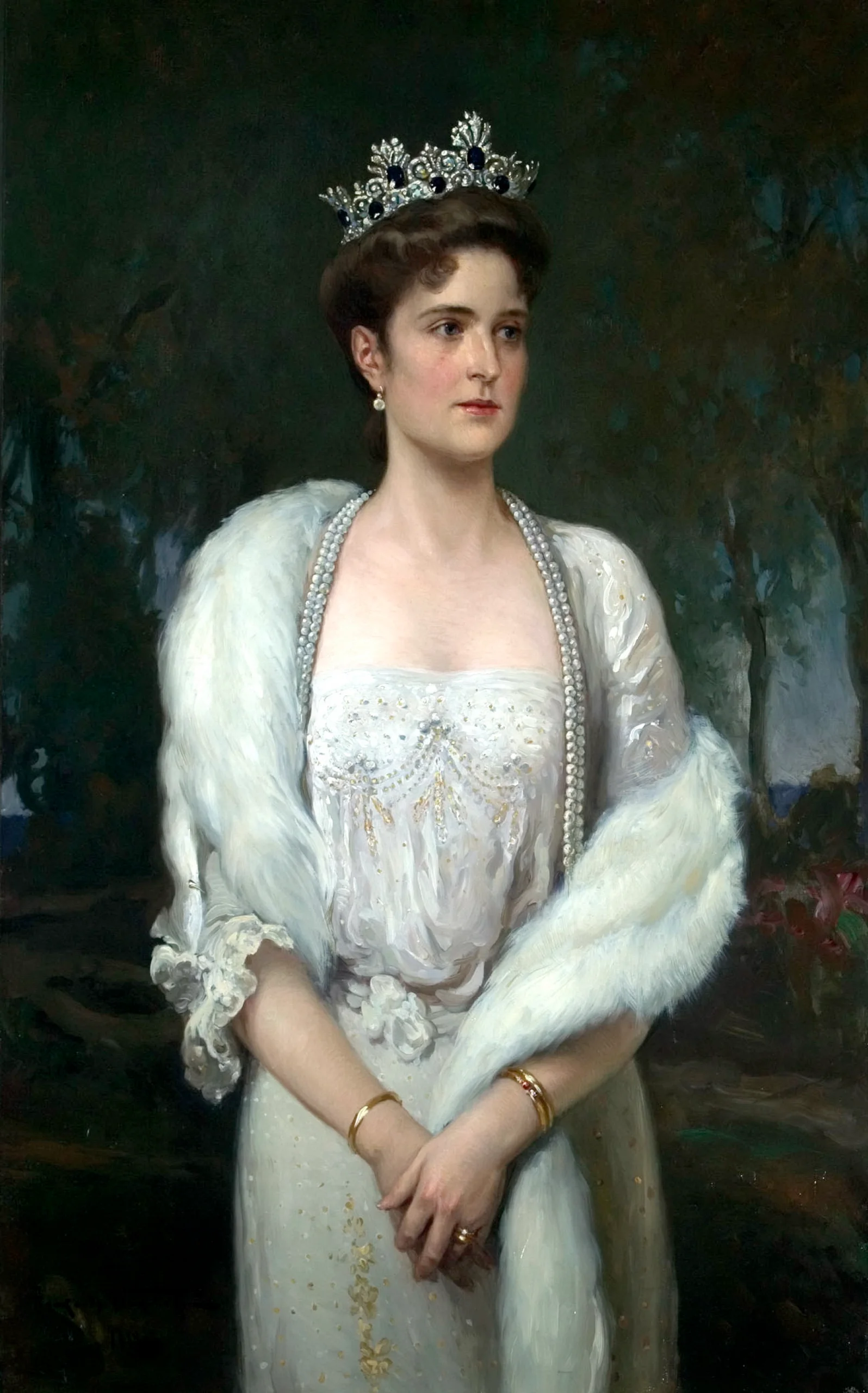
Alexandra Feodorovna
 Germany
Empress of Russia•consort•regent
Also known as: Princess Alix of Hesse and by Rhine, Princess Alix Viktoria Helene Luise Beatrix of Hesse and by Rhine, Saint Alexandra Romanova, Alix of Hesse, Empress Alexandra, Saint Alexandra the Passion Bearer
Birthday
June 6, 1872
Birth Sign
Gemini
Birthplace
Darmstadt, Germany
Age
Died at 46
About
Princess Alix of Hesse and by Rhine stands as the final Empress of Russia, defined by her unwavering religious devotion and tragic end. Born in Darmstadt in 1872, she married into the Romanov dynasty in 1894, serving as consort until their joint abdication in 1917. Her tenure was marked by intense involvement in state affairs during World War I and a fierce resistance to political reforms that alienated the nobility. She died at age 46 in 1918 alongside her husband and five children when they were executed by Bolshevik forces in Yekaterinburg. The Russian Orthodox Church later recognized her as Saint Alexandra the Passion Bearer, cementing her legacy as a martyr rather than a political figure.
Early Life & Background
Born Princess Alix Viktoria Helene Luise Beatrix of Hesse and by Rhine on June 6, 1872, in Darmstadt, Germany, she entered the world as the fourth child of Ludwig IV, Grand Duke of Hesse, and Princess Alice of the United Kingdom. As a granddaughter of Queen Victoria, her early life was steeped in a strict Anglican upbringing that emphasized duty and faith, yet it was profoundly shadowed by tragedy. When Alix was just five years old, her mother died of diphtheria, followed within months by the deaths of two of her sisters, leaving the family devastated. These losses instilled in her a deep, almost obsessive religious devotion that would shape her entire life. Her education focused on languages, music, art, and domestic skills, reflecting the expectations placed on royal women of her era. She developed a keen interest in painting and needlework, hobbies she maintained throughout her life and often used to create gifts for her family. Despite her German birth, she cultivated a strong sense of identity and loyalty that would later serve her in her new role. Before her ascent to power, Alix lived a relatively secluded life within the Hessian court, where she navigated the complex dynamics of European royalty without seeking public attention. Her path shifted dramatically in 1894 when she agreed to marry Nicholas II, the heir to the Russian throne, following the death of his father. This union required her to convert from Lutheranism to Eastern Orthodoxy and adopt the name Alexandra Feodorovna, marking the end of her life as Princess Alix and the beginning of her reign as Empress.
Career Growth
Upon marrying Nicholas II in November 1894, Alexandra immediately assumed the duties of Empress Consort, though her influence extended far beyond ceremonial roles. During World War I, she served as regent in her husband's absence while he commanded the army at the front, advocating for the preservation of autocratic rule and resisting political reforms. This stance alienated many nobles and contributed to the growing unrest that led to the Russian Revolution. Her reliance on the mystic Grigori Rasputin, initially sought to treat her son Alexei's hemophilia, became a source of scandal and fueled rumors of impropriety, though historical consensus confirms their relationship was strictly therapeutic and spiritual. She was known for her hands-on approach to household management, earning the nickname "Royal Family's Cook" for her dedication to domestic duties despite her royal status. Her artistic endeavors, including painting and embroidery, allowed her to decorate imperial residences and create personal gifts for her family. The dynasty fell in March 1917 when Nicholas II abdicated, ending her time as Empress. She spent the final months of her life under house arrest before being executed with her family in July 1918. Her legacy endured through posthumous recognition, including her canonization as a saint in 2000.
Career Timeline
Public Image & Style
Alexandra Feodorovna is often portrayed as a tragic figure, a devoted mother and wife whose life ended in violence. Her image has evolved from a symbol of autocratic failure to a saintly martyr in the eyes of the Russian Orthodox Church. Modern portrayals emphasize her resilience, faith, and the harsh realities of her position as Empress during a time of great upheaval. While some contemporaries viewed her as aloof or influenced by Rasputin, recent historical analysis paints a more nuanced picture of a woman struggling to maintain her family and faith in the face of revolution. Her legacy is one of endurance and sacrifice, remembered for her unwavering love for her children and her husband. She is frequently depicted in historical media as a woman of immense personal conviction who refused to compromise her beliefs even when faced with the collapse of her empire.
Fame & Fandom
Princess Alix of Hesse remains a figure whose name triggers immediate recognition across cultures, anchored by her status as the last Empress of Russia. Her enduring presence in global consciousness places her at the 74th most famous person in Art & Design, a position she holds within the iFANN Global Fame Rankings. This standing reflects over a century of historical analysis, artistic interpretation, and literary engagement that treats her life as a defining canvas for modern storytelling. Unlike living celebrities who cultivate active followings, Alexandra does not have a formal fandom with a specific collective title or organized campaigns. There are no fan clubs, social media armies, or birthday billboards dedicated to her memory today. Instead, interest manifests through scholarly communities, genealogists, and history enthusiasts who dissect the Romanov era. The audience engages with her legacy by analyzing artifacts like her pearl diadem or debating the myths surrounding her court. She is remembered not for performances or chart-topping hits, but for the intense religious devotion she showed toward her son Alexei and the brutal execution of her family in Yekaterinburg. These events transformed her from a controversial political figure into a martyr, ensuring her story is retold with the gravity of legend rather than the whimsy of pop culture. Recent publications like *Vanity Fair* have continued to explore the mystery of the missing Romanov jewels, keeping her story relevant in 2026.
Interesting Facts and Legends
Despite her German birth, Alexandra Feodorovna worked tirelessly to assimilate into Russian culture, learning the language and customs to become a devoted Russian empress. A persistent legend claims she had an illicit affair with the mystic Grigori Rasputin, fueling rumors that she was under his spell and corrupting the government; however, historical research has largely debunked this narrative, confirming their relationship stemmed from her desperate reliance on him to treat her son's hemophilia rather than romantic entanglement. Another iconic detail involves the Khodynka Field disaster during their coronation in May 1896, where a crowd crush resulted in hundreds of deaths, casting a shadow over their reign from the very start. She was described as having a slender build with a pale complexion and dark hair, considered of average height for women of her era. Quotes attributed to her, such as "I am not afraid of death; I am only afraid of leaving my children," highlight her fears during the revolution. The site of the execution is now marked by the Church on the Blood, a major pilgrimage destination in Yekaterinburg. Additionally, her story continues to be featured in documentaries and articles, including a 2026 piece in *Vanity Fair* regarding the missing jewels.
Notable Quotes
“I am not afraid of death; I am only afraid of leaving my children.”
“God will not let us die; He will give us strength to endure.”
Family & Personal Life
Alexandra was the fourth child of Ludwig IV, Grand Duke of Hesse, and Princess Alice of the United Kingdom. Her mother's death when Alix was five left a lasting mark on her character, fostering a deep bond with her remaining siblings and a lifelong commitment to faith. She married Nicholas II, and together they raised five children: Olga, Tatiana, Maria, Anastasia, and Alexei. The couple remained deeply devoted to one another throughout their lives, sharing both the burdens of ruling and the tragedies that befell their family. Alexandra maintained a close relationship with her children, often spending time teaching them or engaging in domestic activities. Her household was known for its emphasis on piety and simplicity, even amidst the grandeur of the imperial court. The family suffered greatly during the revolution, culminating in the execution of all members in 1918. Her son Alexei's struggle with hemophilia was a central focus of their private life, leading to the introduction of Grigori Rasputin into their circle.
Notable Connections
Nicholas II of Russia, Grigori Rasputin, Queen Victoria, Princess Alice, Ludwig IV, Grand Duke of Hesse, Olga Nikolaevna, Tatiana Nikolaevna, Maria Nikolaevna, Anastasia Nikolaevna, Alexei Nikolaevich
Relationships & Dating History
Alexandra Feodorovna had only one romantic partner in her entire life: her husband, Emperor Nicholas II of Russia. They were engaged in early 1894 after Nicholas proposed to her following the death of his father. They married on November 26, 1894, in St. Petersburg. Their union produced five children: Olga, Tatiana, Maria, Anastasia, and Alexei. The couple remained married until Nicholas's abdication in March 1917 and their subsequent execution in July 1918. There are no records of prior dating relationships or other marriages. The persistent rumor of an affair with Grigori Rasputin has been thoroughly debunked by modern historians, who attribute the closeness between Alexandra and Rasputin to her desperate need for him to manage her son's life-threatening illness. As of the date of her death in 1918, she was widowed. Since she is deceased, there is no current dating status or ongoing relationship. Her marriage was characterized by deep mutual affection and shared religious devotion, surviving despite the pressures of ruling an empire.
- MarriedNicholas II of Russia1894 - 1918They were married until their execution together in 1918.
Death & Aftermath
Died
July 17, 1918 (aged 46)
Death Place
Yekaterinburg, Russia
Cause of Death
Execution by firing squad
Alexandra Feodorovna died on July 17, 1918, in the basement of the Ipatiev House in Yekaterinburg. She was executed by a firing squad of Cheka officers and Red Guards alongside her husband Nicholas II and their children during the early hours of the morning. The chaotic Russian Civil War prevented any immediate police investigation, and for decades the Soviet government denied the killings occurred. Modern forensic analysis conducted in 1998 confirmed the deaths of all family members, debunking long-standing survival theories. International reaction initially consisted of shockwaves among monarchists and conservative elites who viewed the act as a brutal suppression of the old order. The Romanov remains were not discovered until 1991, leading to a formal judicial inquiry that eventually classified the event as political repression. A state funeral took place on July 17, 1998, exactly eighty years after the massacre, with Russian President Boris Yeltsin and Patriarch Alexy II present at the reburial in St. Petersburg's Peter and Paul Cathedral. The Church on the Blood now stands on the site of the former Ipatiev House as a major pilgrimage destination. In 2000, the Russian Orthodox Church canonized her as Saint Alexandra the Passion Bearer.
Net Worth (Estate Value)
$0
iFANN Editorial Team estimate
As a historical figure who died in 1918, Alexandra Feodorovna does not have a net worth in the traditional sense. Her estate was seized by the Bolsheviks upon her death, and the Romanov family's assets were largely lost or distributed. The value of the Romanov jewels and other artifacts has been estimated in modern times, with some pieces resurfacing and being sold at auction. However, these values belong to the state or private collectors, not to Alexandra's estate. The iFANN Editorial Team estimates her financial legacy as nonexistent in terms of personal wealth, though the cultural and historical value of her artifacts remains significant. No credible sources report a net worth for her as of 2026, as her personal fortune was absorbed by the state during the revolution.
Awards Won (1)
Alexandra Feodorovna did not receive awards in the modern sense, as she lived before the establishment of most contemporary honors. However, she was posthumously recognized for her faith and martyrdom. In 2000, the Russian Orthodox Church canonized her as Saint Alexandra the Passion Bearer, a significant religious distinction.
2000 · Religious Honor
Saint Alexandra the Passion Bearer
Known For
The Romanovs
2000 · Subject
Rasputin
1966 · Historical Figure
Anastasia
1997 · Inspiration
Keywords
Sources
Quick Facts
- Profession
- consort, regent, painter
- Born
- June 6, 1872
- Birthplace
- Darmstadt, Germany
- Died
- July 17, 1918
- Death Place
- Yekaterinburg, Russia
- Gender
- Female
- Spouse
- Nicholas II of Russia
- Birth Sign
- Gemini
Personal Details
- Full Name
- Princess Alix Viktoria Helene Luise Beatrix of Hesse and by Rhine
- Spouse
- Nicholas II of Russia
- Children
- Olga Nikolaevna · Tatiana Nikolaevna · Maria Nikolaevna · Anastasia Nikolaevna · Alexei Nikolaevich
- Education
- Private tutors; curriculum in languages, music, art, and domestic skills
Frequently Asked Questions
Who was Alexandra Feodorovna?
How did Alexandra Feodorovna die?
Did Alexandra Feodorovna have an affair with Rasputin?
When was Alexandra Feodorovna canonized?
Where is Alexandra Feodorovna buried?
Similar People
Join the community
fans discussing