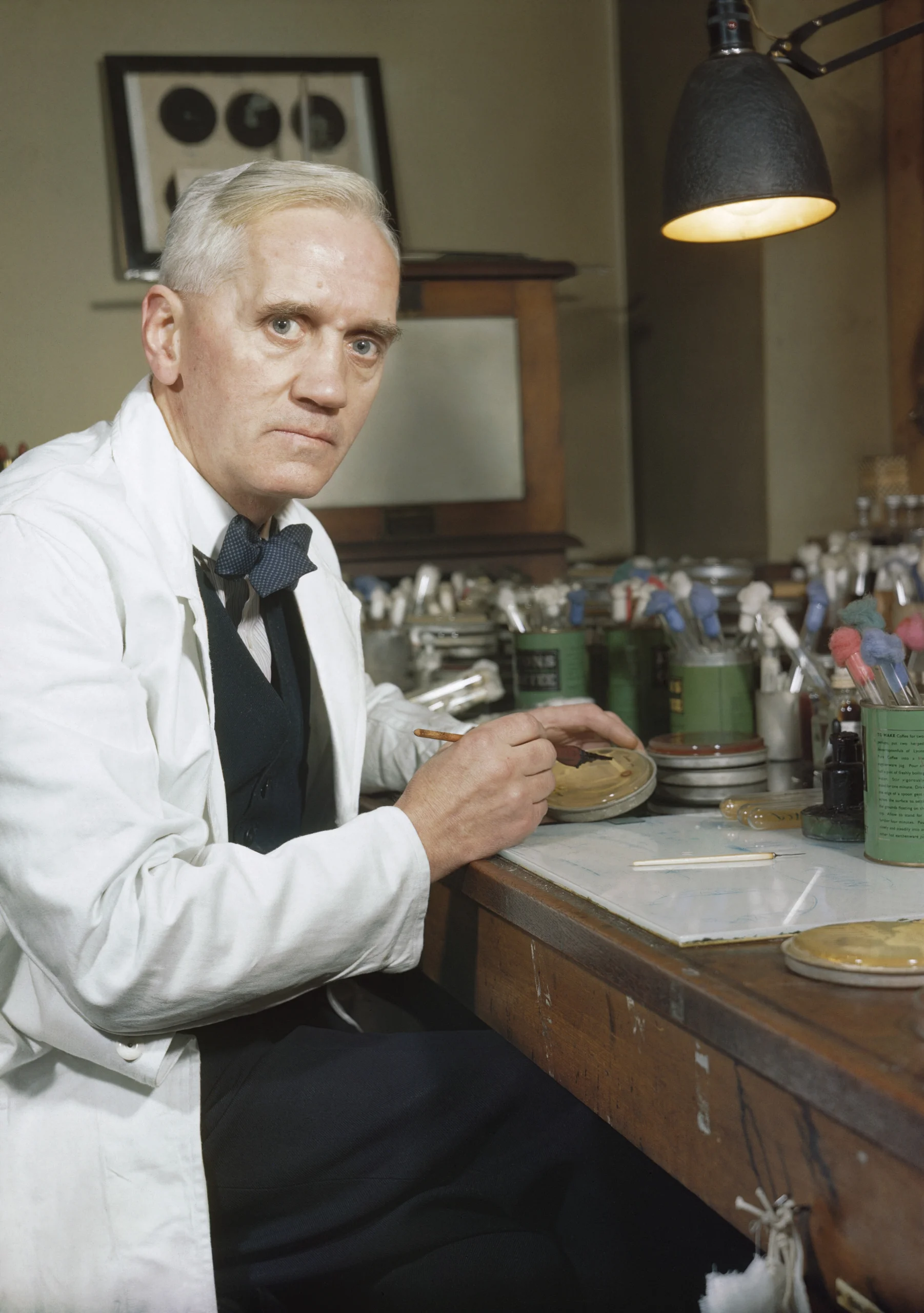
Alexander Fleming
 United Kingdom
bacteriologist•pharmacologist•physician
Also known as: Sir Alexander Fleming, A. Fleming
Birthday
August 6, 1881
Birth Sign
Leo
Birthplace
Lochfield, Ayrshire, Scotland
Age
Died at 73
About
Alexander Fleming was a Scottish physician and microbiologist who discovered penicillin, the first true antibiotic, in 1928. That single observation in a cluttered London lab changed the treatment of infection, surgery, childbirth and wartime medicine, and it earned him a share of the 1945 Nobel Prize in Physiology or Medicine.
Fleming spent nearly his entire career at St Mary's Hospital Medical School in London, where he was a careful, observant bacteriologist before and after the discovery. He is also known for finding lysozyme, an antibacterial enzyme in tears and mucus, in 1922. In his later years he served as Principal of the Wright-Fleming Institute at St Mary's and became a global scientific celebrity, travelling widely and lecturing to packed halls. He died in London on 11 March 1955, aged 73, of a heart attack.
His reputation today rests on the scale of penicillin's impact and on a warning he issued in his Nobel lecture about antibiotic resistance, a warning still quoted in 2026 public-health commentary. He was named one of TIME's 100 Most Important People of the 20th Century in 1999 and placed third in STV's 2009 poll of the Greatest Scots.
Early Life & Background
Alexander Fleming was born on 6 August 1881 at Lochfield farm near Darvel in Ayrshire, Scotland, the seventh of eight children. His father, Hugh, was a farmer, and the family worked the land at Lochfield. Hugh died when Alexander was about seven, and the family carried on running the farm.
He attended Loudoun Moor School, Darvel School and then Kilmarnock Academy. Around 1895, family circumstances took him to London, where he studied at the Royal Polytechnic Institution. He then spent several years as a shipping clerk in a Glasgow shipping office, a job he reportedly disliked. An inheritance and a family insurance payout allowed him to change course.
In 1901 he entered St Mary's Hospital Medical School in London, graduating with distinction in 1906. He qualified as a physician and surgeon and joined the Inoculation Department at St Mary's under Sir Almroth Wright, where he remained associated with the hospital for essentially his entire career. During World War I he served in the Royal Army Medical Corps, working in battlefield hospitals in France. There he observed that antiseptics often did more harm than good to infected wounds, an experience that shaped his interest in antibacterial substances. His 1922 discovery of lysozyme, an antibacterial enzyme found in nasal mucus, tears and saliva, was his first major independent finding and established his reputation as a careful, observant bacteriologist.
Career Growth
The break came in September 1928. Fleming returned from holiday to find that a Penicillium mould contaminating a culture plate of staphylococci had killed the surrounding bacteria. He named the active substance penicillin. Some sources date the observation to early September, with the classic on-this-day marker given as 28 or 3 September 1928 depending on the outlet. He published his findings in the British Journal of Experimental Pathology in 1929. The work attracted little attention, and he struggled to purify the substance.
The turning point came a decade later. From 1939 to 1941, Howard Florey and Ernst Chain at Oxford began systematic work on penicillin, achieving purification and mass production. The drug was used clinically in the early 1940s. Fleming was knighted in 1944 for services to medicine. In 1945 he shared the Nobel Prize in Physiology or Medicine with Florey and Chain for the discovery of penicillin and its curative effect in various infectious diseases. That same year he was elected a Fellow of the Royal Society, and he later served as President of the Society for General Microbiology and as Rector of Edinburgh University from 1951 to 1954.
From 1945 to 1955 he served as Principal of the Wright-Fleming Institute at St Mary's. He became a global scientific celebrity, travelling widely, including a notable 1945 US lecture tour where crowds and press treated him as a celebrity scientist. His Nobel lecture famously warned that misuse of antibiotics could breed resistant bacteria, a warning still cited in 2026 commentary on antimicrobial resistance. Penicillin was the first true antibiotic and launched the antibiotic revolution, transforming treatment of bacterial infection, surgery, childbirth and wartime medicine.
Career Timeline
Public Image & Style
Fleming's public image was shaped by the Karsh portrait: bald, formal dress, direct gaze. It is the defining photograph, the one reproduced whenever his name appears. He was famously modest about the discovery, and that modesty became part of the persona, the scientist who insisted he had been lucky rather than brilliant.
In the 1945 US lecture tour, crowds and press treated him as a celebrity scientist, a role he seemed to wear awkwardly. His social media voice does not exist, of course, but his written and spoken style was plain and cautious. He warned about antibiotic resistance in his Nobel lecture, a warning that reads today as prescient rather than performative. The media perception of him is of a careful observer rather than a showman, and that has stuck.
Fame & Fandom (iFAMOUS Rankings)
iFANN has not yet collected fame data for Alexander Fleming, so there is no ranking to report. He is not on the September 2026 iFAMOUS Rankings flagship list. His fame is historical rather than contemporary: a name recognized in textbooks, medical schools and public-health debates, not a figure with a fandom in the modern sense. No formal fanbase name exists. The people who carry his legacy are the scientific and medical community and the public-health press. Anniversary coverage, such as the 98th anniversary of the discovery marked in September 2026, and the Alexander Fleming Award for Lifetime Achievement, most recently given to Cynthia Sears, are the main forms of organized attention. There are no streaming pushes, birthday billboards or fan projects, and it would be inaccurate to invent them.
Interesting Facts and Legends
Fleming was a keen amateur painter and a member of the Chelsea Arts Club, a side of him that rarely makes the textbook entries. The original mould culture is preserved at St Mary's and in museum collections; a penicillin mould medallion made by Fleming himself is held in the Smithsonian collection. His height is not reliably documented in the sources, which describe him only as of average build.
The foundational legend is the contaminated petri dish. Fleming returns from holiday, notices a mould clearing a ring in a staphylococcus culture, and remarks, "That's funny." The outline is verified; the exact wording is popular folklore. He called the crude filtrate "mould juice," a nickname retold in 2026 anniversary coverage.
Notable Quotes
“That's funny.”
“One sometimes finds what one is not looking for.”
“Nature makes penicillin; I just found it.”
“It is not the first time that chance has favoured the prepared mind.”
Family & Personal Life
Fleming was the seventh of eight children born to Hugh Fleming, a farmer, and his wife at Lochfield farm in Ayrshire. His father died when Alexander was about seven, and the family continued to run the farm. In 1915 he married Sarah Marion McElroy, an Irish-born nurse he met in London. They had one son, Robert Fleming, born in 1924, who later became a physician. Sarah died in 1949 after a long illness.
In 1953 Fleming married Amalia Koutsouri-Voureka, a Greek bacteriologist and former colleague at St Mary's, significantly younger than him. The marriage lasted until his death in 1955. Amalia later became a prominent figure in Greek public life and a resistance activist during the Greek junta. Fleming's household in his final years was in London, where he died at home.
Notable Connections
Relationships & Dating History
Fleming's romantic life was quiet and largely private. In 1915 he married Sarah Marion McElroy, an Irish-born nurse he met in London. They had one son, Robert Fleming, born in 1924, who later became a physician. Sarah died in 1949 after a long illness. In 1953 Fleming married Amalia Koutsouri-Voureka, a Greek bacteriologist and former colleague at St Mary's, significantly younger than him. The marriage lasted until his death in 1955. Amalia survived him and later became a prominent figure in Greek public life and a resistance activist during the Greek junta. As of 2026, Fleming has been deceased since 11 March 1955; he was married to Amalia at the time of his death. No other public romantic relationships are documented in the sources.
- MarriedSarah Marion McElroy1915 - 1949Irish-born nurse he met in London; they had one son, Robert, born 1924. She died in 1949 after a long illness.
- MarriedAmalia Koutsouri-Voureka1953 - 1955Greek bacteriologist and former colleague at St Mary's; married until his death in 1955.
Death & Aftermath
Died
March 11, 1955 (aged 73)
Death Place
London, England, UK
Cause of Death
Heart attack (coronary thrombosis)
On the morning of 11 March 1955, Alexander Fleming died at his home in London. He was 73. The cause was a heart attack, coronary thrombosis, the standard and widely reported explanation. His final days were not documented in public; the record gives the fact of death without autopsy detail.
A 1955 BBC Panorama interview in which he discussed the chance discovery of penicillin is preserved in the BBC Archive and is sometimes treated as a last broadcast appearance, though its exact date relative to his death is unconfirmed. Tributes came from scientific institutions worldwide. He was buried at St Paul's Cathedral in London, a rare honour for a scientist, placing him among the small group of British figures interred there.
What followed has been institutional rather than commercial. The Alexander Fleming Award for Lifetime Achievement, given by the Infectious Diseases Society of America, remains active; it was most recently awarded to Johns Hopkins's Cynthia Sears at IDWeek 2025, reported in January 2026. Anniversary coverage keeps him in circulation: the 98th anniversary of the discovery was marked by People and multiple Today in History columns in September 2026, and a May 2026 Nature piece cites his roughly 80-year-old warning about antibiotic misuse as central to the fight against antimicrobial resistance. A late-2026 Deseret News opinion piece lamented that an important anniversary passed without fanfare, arguing we do not appreciate Fleming enough. No posthumous releases, licensing machinery, or estate earnings are documented; his legacy is carried by the award bearing his name, the preserved mould culture at St Mary's, and the periodic reprinting of his resistance warning.
Net Worth (Estate Value)
$1 Million
iFANN Editorial Team estimate
No reliable public valuation of Alexander Fleming's estate exists. As a career scientist and Nobel laureate he was comfortably but not spectacularly wealthy, and no posthumous estate-earnings machinery such as licensing or merchandise is documented. The iFANN Editorial Team's analysis of his known earnings, honors and assets points to a modest estate value of roughly $1 Million, reflecting a lifetime of salaried academic and research work rather than commercial ventures. His Nobel Prize money in 1945 was substantial for the era but not dynasty-building, and there is no record of major property holdings or investments. The absence of a commercial estate means his financial legacy is essentially the historical record of a working scientist, not a celebrity fortune. Any figure should be treated as an iFANN estimate rather than a documented valuation.
Awards Won (3)
Fleming won the 1945 Nobel Prize in Physiology or Medicine, shared with Howard Florey and Ernst Chain, for the discovery of penicillin and its curative effect in infectious diseases. He was knighted in 1944. He was elected a Fellow of the Royal Society in 1943 and held honorary degrees and foreign academy memberships. In 1999 he was named one of TIME's 100 Most Important People of the 20th Century, and in 2009 he placed third in STV's poll of the Greatest Scots.
1945 · Physiology or Medicine
Discovery of penicillin and its curative effect in various infectious diseases
1944 · Knighthood
Services to medicine
Known For
Discovery of penicillin
1928 · Discoverer
Discovery of lysozyme
1922 · Discoverer
Nobel Prize in Physiology or Medicine
1945 · Co-laureate
Keywords
Sources
Quick Facts
- Profession
- bacteriologist, pharmacologist, physician
- Born
- August 6, 1881
- Birthplace
- Lochfield, Ayrshire, Scotland
- Died
- March 11, 1955
- Death Place
- London, England, UK
- Gender
- Male
- Spouse
- Amalia Fleming, Sarah Marion McElroy
- Birth Sign
- Leo
- Cause of Death
- Heart attack (coronary thrombosis)
Personal Details
- Full Name
- Alexander Fleming
- Spouse
- Amalia Fleming, Sarah Marion McElroy
- Children
- Robert Fleming
- Education
- St Mary's Hospital Medical School, London (graduated 1906); Kilmarnock Academy; Royal Polytechnic Institution
Frequently Asked Questions
What was Alexander Fleming best known for?
Who actually invented penicillin?
How did Alexander Fleming die?
Where was Alexander Fleming educated?
What is Alexander Fleming's net worth in 2026?
Similar People
Join the community
fans discussing