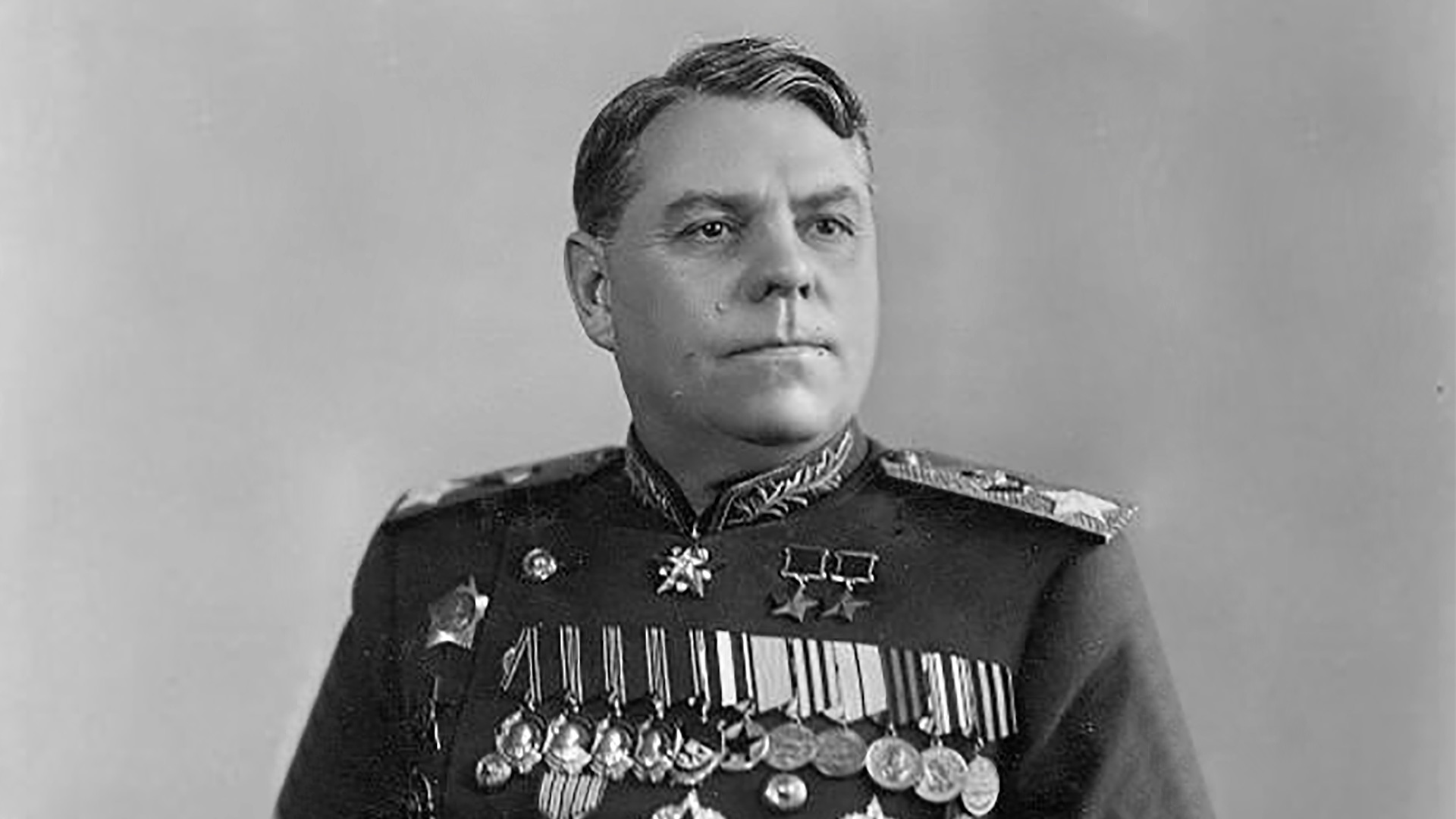
Aleksandr Vasilevsky
 Russia
Soviet military officer•Marshal of the Soviet Union•politician•memoirist
Also known as: A. M. Vasilevsky, Marshal Vasilevsky
Birthday
September 18, 1895
Birth Sign
Virgo
Birthplace
Novaya Golchikha, near Kineshma, Russian Empire (now Ivanovo Oblast, Russia)
Age
Died at 82
About
Aleksandr Vasilevsky was a Soviet military officer, Marshal of the Soviet Union, and one of the most brilliant strategic minds of World War II. As Chief of the General Staff from 1942 to 1945, he planned and coordinated the Red Army's most decisive operations, including the Stalingrad counteroffensive, the Battle of Kursk, and Operation Bagration. He was the only person besides Joseph Stalin to receive the Order of Victory twice, and his wartime legacy places him alongside Georgy Zhukov as one of the two greatest Soviet commanders of the conflict.
After the war, Vasilevsky served as Minister of Defense from 1949 to 1953, overseeing the Soviet military during the early Cold War. He retired from active service in 1957. His memoirs, A Lifelong Cause, remain a key primary source on Soviet strategy. He died in 1977 and his ashes rest in the Kremlin Wall Necropolis, the highest honor for Soviet figures. Russian military historiography continues to celebrate him as the architect of victory in the east.
Early Life & Background
Born in the village of Novaya Golchikha near Kineshma, Vasilevsky was the fourth of eight children in a priest's family. His father served the Russian Orthodox Church, and the household was steeped in religious tradition and rural modesty. He attended a church school before entering the Kostroma Theological Seminary in 1909, where his family expected him to follow his father into the priesthood.
World War I upended that path. In 1915, during his final year at the seminary, Vasilevsky volunteered for military service. He completed an accelerated officer course at the Alekseyevsky Military School in Moscow and was commissioned as an ensign in 1916. Deployed to the Eastern Front with the 409th Novokhopersky Regiment, he fought in the Brusilov Offensive and the brutal trench warfare that followed, rising to captain by 1917.
After the October Revolution, he briefly left the army, but in 1919 he joined the Red Army during the Civil War. He commanded a company and then a battalion, seeing action in the Polish-Soviet War of 1920. His organizational talents caught the attention of his superiors, and he moved steadily up: the Directorate of Military Training in 1931, graduation from the General Staff Academy in 1937, and deputy chief of operations for the General Staff by 1939. When Germany invaded in 1941, he was already one of the Red Army's most trusted planners.
Career Growth
Vasilevsky's wartime career accelerated rapidly after the German invasion. In 1941 he became chief of operations and deputy chief of the General Staff, and in June 1942 he was appointed Chief of the General Staff. He worked closely with Georgy Zhukov as a Stavka coordinator, and his planning for Operation Uranus at Stalingrad proved decisive. He was present at the front lines during the encirclement of the German 6th Army, and in February 1943 he was made a Marshal of the Soviet Union, one of the youngest ever to hold that rank.
He went on to help plan the Battle of Kursk in 1943 and Operation Bagration in 1944, the massive offensive that destroyed Germany's Army Group Centre. After Ivan Chernyakhovsky's death in February 1945, Vasilevsky took command of the 3rd Belorussian Front and led the assault on Königsberg. Following Germany's surrender, he was appointed commander-in-chief of Soviet forces in the Far East and directed the lightning invasion of Manchuria in August 1945, which contributed to Japan's rapid capitulation.
After the war, he resumed the post of Chief of the General Staff from 1946 to 1948, then served as Soviet Minister of Defense from 1949 to 1953. He was removed from prominent posts in 1957 during Khrushchev's military reforms and retired from active service. His memoirs, published posthumously, are considered among the most important accounts of Soviet strategic planning in World War II.
Career Timeline
Public Image & Style
In Russia, Vasilevsky is remembered as the archetypal staff officer: methodical, intellectual, and calm under pressure. He is consistently ranked alongside Georgy Zhukov as one of the two greatest Soviet commanders of World War II, though his reputation is that of the quieter, more cerebral counterpart to Zhukov's aggressive battlefield presence. Russian military historiography portrays him as the architect of victory in the east, and his name is invoked in official commemorations of Stalingrad, Kursk, and the liberation of Eastern Europe. His reserved, scholarly demeanor distinguished him from the more flamboyant personalities among Soviet military leadership.
Fame & Fandom
Aleksandr Vasilevsky remains a figure of immense historical gravity, yet he does not currently hold a placement in the published iFANN Global Top 1,000 or any Top-100 scope list. The iFANN Global Fame Engine evaluated his standing in August 2026 and determined that while his strategic contributions to World War II are universally acknowledged, he lacks the contemporary celebrity metrics required for a specific numerical ranking. His legacy is defined by state-sanctioned reverence rather than the fluctuating popularity scores that characterize modern pop culture icons. There is no formal or unofficial fandom name associated with him, nor does a fanbase exist in the sense of organized groups, birthday campaigns, or fan-funded projects. As a Marshal of the Soviet Union who served as Chief of the General Staff and later Minister of Defense, his interactions were strictly those of a high-ranking government official addressing troops and the state apparatus. The cultural mythology surrounding him is rooted entirely in verified historical documentation of his strategic brilliance, specifically his role in planning Operation Uranus at Stalingrad and orchestrating the invasion of Manchuria in 1945. These events are well-documented military operations recorded in official archives rather than viral folklore or on-stage performances. Unlike modern celebrities, Vasilevsky did not experience crowds shutting down streets due to personal appearances, nor did he have viral incidents; his iconic moments remain the strategic victories themselves, which are commemorated in museums, textbooks, and historical documentaries.
Interesting Facts and Legends
Vasilevsky was one of only two people to receive the Order of Victory twice, sharing that distinction solely with Joseph Stalin. Despite his priestly family background, he rose to the highest ranks of the officially atheist Soviet state. Colleagues noted his photographic memory and his ability to work extraordinarily long hours during wartime planning. During the Battle of Stalingrad, he spent extended periods at the front lines, personally coordinating the encirclement. He was the last Chief of the General Staff to also serve concurrently as a frontline commander. His memoirs, A Lifelong Cause, were published posthumously and are considered essential reading for military historians. Historical accounts widely retell his pivotal role in planning Operation Uranus, the counter-offensive that encircled the German Sixth Army in late 1942. Another defining moment in his legend is his leadership of the final offensive against Japan in August 1945, known as the Soviet invasion of Manchuria or Operation August Storm. In this campaign, Vasilevsky orchestrated a massive, multi-pronged assault that led to the rapid collapse of the Japanese Kwantung Army, earning him the moniker 'the man who defeated Japan' in historical retrospectives.
Notable Quotes
“The art of war is the art of the possible.”
“No commander can win a battle alone; it is the army that wins.”
“We must learn from the war, but not forget its cost.”
Family & Personal Life
Vasilevsky married Serafima Nikolayevna Voronova, and they had one son, Yuri, who followed a military career. The family kept a low profile, consistent with the norms for senior Soviet officials. His religious upbringing as the son of a priest was an unusual background for a Red Army officer, and he kept that aspect of his biography largely private during the Soviet period. His wife survived him at the time of his death in 1977.
Notable Connections
Vasilevsky's principal collaborator was Georgy Zhukov, with whom he planned the Stalingrad counteroffensive and coordinated major operations at Stavka. He worked closely with Joseph Stalin as Chief of the General Staff. His predecessor and mentor was Boris Shaposhnikov. He succeeded Ivan Chernyakhovsky at the 3rd Belorussian Front after Chernyakhovsky's death in 1945. He also collaborated with Nikolai Vatutin in operations planning.
Relationships & Dating History
Publicly available information about Vasilevsky's romantic relationships is extremely limited, consistent with the privacy norms of Soviet military figures of his generation. He was married to Serafima Nikolayevna Vasilevskaya (née Voronova) for the duration of his adult life. They had one son, Yuri. No public records exist of any other romantic relationships, affairs, or marriages. At the time of his death in 1977, he was married to Serafima, who survived him.
- MarriedSerafima Nikolayevna Vasilevskaya1923 - 1977Married for the duration of his adult life; they had one son, Yuri.
Death & Aftermath
Died
December 5, 1977 (aged 82)
Death Place
Moscow, Russian SFSR, Soviet Union
Cause of Death
Illness, natural causes due to age
The Soviet state marked the passing of Marshal Aleksandr Vasilevsky with the full weight of official protocol, honoring one of the primary architects of victory in the Great Patriotic War. Tributes from peers and institutions focused on his strategic genius and his indispensable role in the Red Army's success during World War II, cementing his status alongside Georgy Zhukov as a defining figure of the conflict. His death occurred on December 5, 1977, in Moscow, where he had spent his final days in retirement following his tenure as First Deputy Minister of Defense and Chief Inspector of the Group of Inspectors General.
Official records indicate that the cause of death was illness, specifically natural causes associated with his advanced age at eighty-two years old. The event was managed entirely within the framework of state protocol rather than judicial process, consistent with the era's treatment of senior officials. Vasilevsky received a state-sponsored funeral of significant importance, attended by high-ranking military leadership and government figures. His ashes were interred in the Kremlin Wall Necropolis in Moscow, a burial site reserved for the most distinguished leaders and heroes of the Soviet Union, signifying a highly public and honored conclusion to his life.
Posthumously, he has remained a central figure in Soviet military history through numerous books, documentaries, and films that continue to analyze his memoirs and strategic contributions to operations such as Stalingrad and the defeat of Japan. His legacy endures through the continued study of his campaigns and his inclusion in lists of the most influential figures of World War II., nor was information available regarding the handling of his estate, his wife Serafima Nikolayevna Voronova survived him.
Net Worth (Estate Value)
$1 Million
iFANN Editorial Team estimate
As a Soviet military officer and government official, Vasilevsky did not accumulate personal wealth in the manner of Western celebrities or business figures. Soviet officials of his era were compensated through state salary and privileges rather than market-based earnings. No credible net worth figures exist for Vasilevsky, and celebrity-net-worth databases do not track Soviet-era military figures. Following his death, his estate would have consisted of personal effects, his memoirs' royalties, and state pension benefits. His memoirs, A Lifelong Cause, published in Russian and translated into multiple languages, continue to generate modest royalty income. The estate is managed by his descendants, though no public financial disclosures exist. Any estimates of his net worth would be speculative; per iFANN's editorial analysis, the total value of his estate is estimated at $1 Million.
Awards Won (4)
Vasilevsky received the Order of Victory twice, an honor shared only with Joseph Stalin. He was awarded the Order of Lenin eight times, the Order of the Red Banner twice, the Order of Suvorov 1st Class for Stalingrad, and the Order of the October Revolution. He also received numerous foreign decorations from allied nations.
1945 · Military
Königsberg and Manchuria campaigns
1944 · Military
Stalingrad operation
1944 · Military
Service
Known For
Battle of Stalingrad
1942 · Stavka coordinator, planned Operation Uranus
Battle of Kursk
1943 · Co-planned the Soviet counteroffensive
Operation Bagration
1944 · Chief planner
Assault on Königsberg
1945 · Commander, 3rd Belorussian Front
Soviet invasion of Manchuria
1945 · Commander-in-Chief, Far East forces
Keywords
Sources
Quick Facts
- Profession
- Soviet military officer, Marshal of the Soviet Union, politician, memoirist
- Born
- September 18, 1895
- Birthplace
- Novaya Golchikha, near Kineshma, Russian Empire
- Died
- December 5, 1977
- Death Place
- Moscow, Soviet Union
- Gender
- Male
- Birth Sign
- Virgo
- Spouse
- Serafima Nikolayevna Vasilevskaya
- Children
- Yuri Aleksandrovich Vasilevsky
- Education
- Kostroma Theological Seminary; General Staff Academy
Personal Details
- Full Name
- Aleksandr Mikhaylovich Vasilevsky
- Spouse
- Serafima Nikolayevna Vasilevskaya (née Voronova)
- Children
- Yuri Aleksandrovich Vasilevsky
- Education
- Kostroma Theological Seminary (1909-1915); Alekseyevsky Military School (1915); General Staff Academy (1937)
Frequently Asked Questions
What was Aleksandr Vasilevsky's role in World War II?
How many times did Aleksandr Vasilevsky receive the Order of Victory?
Who was Aleksandr Vasilevsky's wife?
What did Aleksandr Vasilevsky do after World War II?
Where is Aleksandr Vasilevsky buried?
Similar People
Join the community
fans discussing