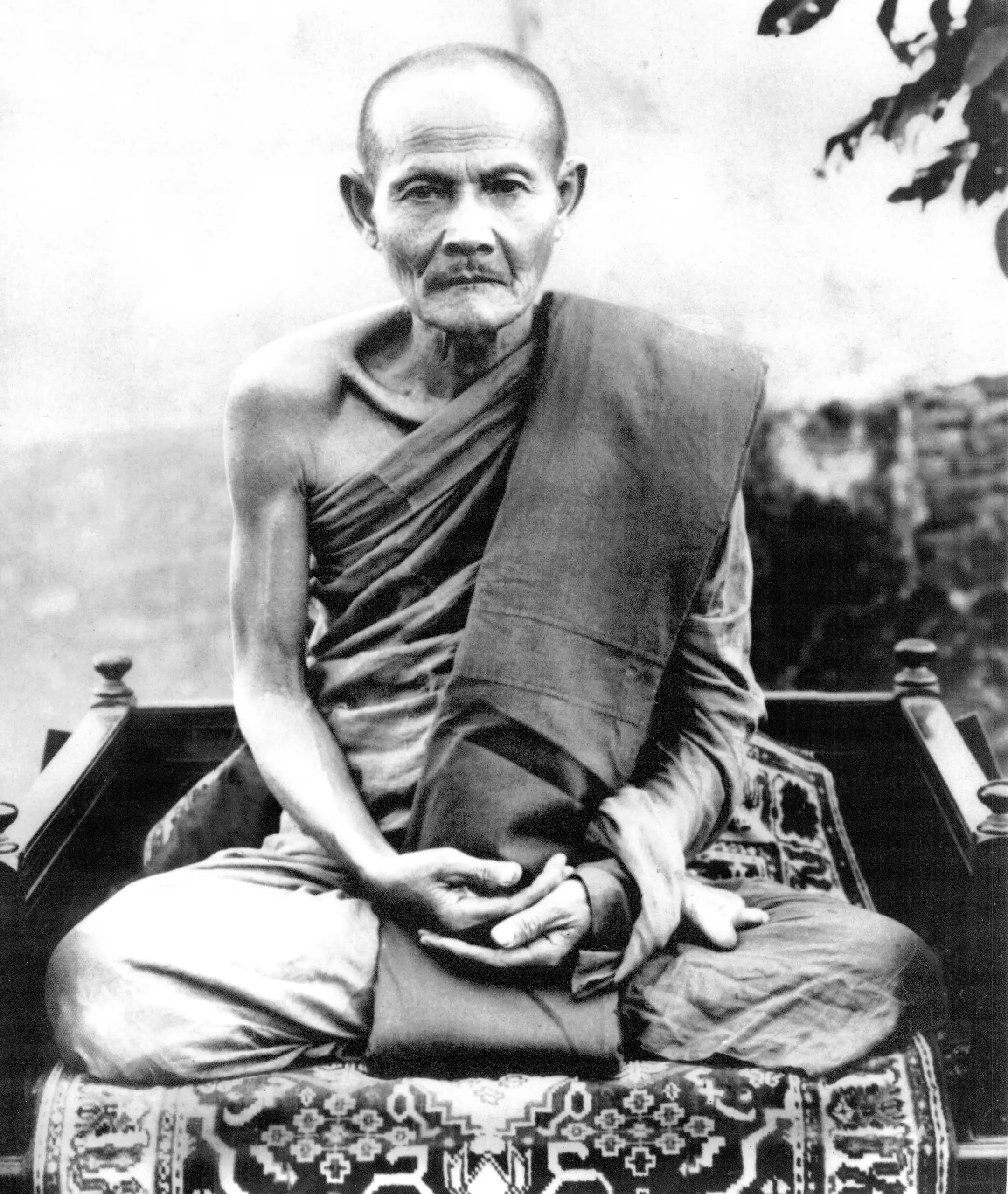
Ajahn Mun
 Thailand
Also known as: Luang Pu Mun, Bhūridatta Bhikkhu, Ācān Man Phūrithatta
Birthday
January 20, 1870
Birth Sign
Sagittarius
Birthplace
Baan Kham Bong, Khong Chiam district, Ubon Ratchathani Province (now Nong Khai), Thailand
Age
Died at 79
About
Ajahn Mun Bhuridatta (born Bun on January 20, 1870) stands as the seminal figure in Theravada Buddhism and the founder of the Thai Forest Tradition, a movement defined by strict adherence to the Vinaya monastic code and rigorous ascetic practices known as dhutanga. Alongside his primary teacher Ajahn Sao Kantasīlo, he revitalized forest monasticism during an era when many monks had drifted toward urban comforts and scholasticism, shifting the focus back to direct meditative experience. His life's work established a lineage that now extends globally, influencing meditation centers across the United States, Europe, Australia, and Southeast Asia. Known for his formidable reputation as an ascetic, he practiced extreme disciplines such as eating only one meal a day and sleeping in charnel grounds or caves. He emphasized direct experience of enlightenment through meditation, distinguishing his approach from the scholarly traditions common in Thailand at the time. His teachings formed the core of what is now widely recognized as the Ajahn Mun lineage, attracting disciples who sought liberation through rigorous practice. He passed away in 1949, leaving behind a vast network of followers and a living tradition that continues to thrive.
Early Life & Background
Born Bun into a farming family in Baan Kham Bong, located in the Khong Chiam district of Ubon Ratchathani Province (now Nong Khai), Mun grew up in the Isan region of northeastern Thailand. Like many boys of his era, he received a basic education at a local temple school before entering the monkhood. At age 15 in 1885, he was ordained as a novice monk, beginning a life of spiritual seeking. In 1893, he received full ordination as a bhikkhu under the guidance of Ajahn Sao Kantasīlo, a relationship that would define his entire career. From the outset, Mun displayed an intense spiritual drive that set him apart from his peers. While many monks of his time focused on textual study and comfortable urban life, Mun felt drawn to the wilderness and the challenges of strict ascetic practice.
Before achieving widespread recognition, Mun spent decades wandering through the dense forests of Laos, Cambodia, and various provinces of Thailand. He lived as a dhutanga bhikkhu, observing extreme ascetic disciplines such as wearing robes made from discarded rags and sleeping in charnel grounds or caves. These early years were marked by profound physical hardship and spiritual testing, which he viewed as essential for purifying the mind. His first major retreat occurred in Sarika Cave around 1906, where he remained for three years until 1909. During this solitary retreat, he endured hallucinations and supernatural challenges that became central to his hagiography. These experiences solidified his resolve and prepared him for the role he would later play in reviving the forest tradition.
Career Growth
Mun's career was not measured in commercial success but in the transformation of individuals and the establishment of a monastic lineage. His breakthrough came in the early 20th century when he began gathering disciples who were drawn to his uncompromising commitment to the Dhamma. Unlike traditional scholars, Mun emphasized direct experience of enlightenment through meditation rather than mere textual study. Key milestones include his full ordination in 1893 and his subsequent wandering as a dhutanga monk throughout the early 1900s. His three-year retreat in Sarika Cave from 1906 to 1909 marked a turning point, solidifying his reputation as a formidable ascetic.
By the 1920s, Mun had established a core group of disciples, including Ajahn Maha Bua, Ajahn Lee, and Ajahn Thate, who would later become renowned teachers in their own right. Throughout the 1930s and 1940s, he expanded the Thai Forest Tradition, establishing numerous forest monasteries and training centers. His influence peaked in the mid-20th century, and his teachings continue to guide practitioners today. The lineage he founded is often referred to as the "Ajahn Mun Lineage," and it remains one of the most respected traditions within Theravada Buddhism. His work ensured that the rigorous practices of the forest tradition survived and thrived in the modern world.
Career Timeline
Public Image & Style
Ajahn Mun is portrayed as a towering figure of spiritual authority, known for his humility, discipline, and profound wisdom. Media portrayals emphasize his ascetic lifestyle, his dedication to meditation, and his role as the father of the Thai Forest Tradition. His teachings are characterized by clarity, practicality, and a focus on direct experience rather than theoretical knowledge. He is revered for his unwavering commitment to the monastic code and his ability to communicate deep spiritual truths in accessible language. His image as a wandering monk sleeping in forests and caves has become iconic within Buddhist communities worldwide. Specific details about his height or physical appearance are not well-documented, as accounts focus on his spiritual demeanor and meditative presence rather than physical characteristics.
Fame & Fandom
Ajahn Mun Bhuridatta never courted a modern audience, nor did he seek the adulation reserved for pop icons. His followers were not fans in the commercial sense but disciples seeking liberation through rigorous meditation and ascetic discipline. The Thai Forest Tradition he helped establish attracted practitioners globally, yet this community operates without formal fan clubs, organized campaigns, or digital rituals that define contemporary celebrity culture. There is no official name for his following; they are simply students of the dharma, bound by shared practice rather than fandom branding. While some online forums discuss his life, these spaces lack the structured activism or merchandise drives typical of entertainment fandoms. His legacy rests entirely on spiritual authority and the enduring power of his teachings rather than market-driven popularity metrics. Despite the absence of a commercial fanbase, his influence remains profound across Southeast Asia and beyond. According to the iFANN Global Fame Rankings, Ajahn Mun stands as the 49th most famous person in Thailand, a position holding steady from the previous cycle. He also ranks as the 82nd most famous person from Thailand in the same assessment. These placements confirm his status as a towering historical figure whose reach extends far beyond the monastery walls.
Interesting Facts and Legends
One of the most famous stories about Ajahn Mun involves his three-year retreat in Sarika Cave, where he reportedly confronted a giant spirit guarding the cave. This story is part of his hagiography but is considered spiritual biography rather than verified history. A debated legend claims that the Buddha himself congratulated Ajahn Mun upon attaining enlightenment, a narrative used to inspire devotion among practitioners. He was known for his ability to teach complex meditation techniques in simple, practical terms, making them accessible to both monks and laypeople. He traveled extensively, often walking hundreds of miles through difficult terrain, and slept in caves, charnel grounds, and under trees. His reputation as a formidable ascetic monk set a high standard for monastic life through his strict observance of dhutanga practices. Numerous accounts describe Ajahn Mun facing demonic entities during his meditations, which he overcame through unwavering mindfulness and compassion. He is said to have communicated with celestial beings and spirits, though these accounts are part of his spiritual biography.
Notable Quotes
“The Dhamma is not something you can find in books; it must be experienced directly.”
“If you want to know the truth, you must see it with your own eyes.”
Family & Personal Life
As a Buddhist monk bound by the Vinaya code, Ajahn Mun never married, had no romantic relationships, and did not have children. His entire life was dedicated to spiritual practice and teaching. There are no records of dating history, engagements, or marriages because monastic vows preclude such activities. His "family" consisted of his disciples, whom he treated with paternal care and guidance. He maintained close ties with his parents and siblings during his early years, but after ordination, his primary focus was on the Sangha. His legacy lives on through the thousands of disciples he trained and the monasteries they established across the globe.
Notable Connections
Relationships & Dating History
As a Buddhist monk bound by the Vinaya code, Ajahn Mun never married, had no romantic relationships, and did not have children. His entire life was dedicated to spiritual practice and teaching. There are no records of dating history, engagements, or marriages because monastic vows preclude such activities. His "family" consisted of his disciples, whom he treated with paternal care and guidance. He maintained close ties with his parents and siblings during his early years, but after ordination, his primary focus was on the Sangha. His legacy lives on through the thousands of disciples he trained and the monasteries they established across the globe.
Death & Aftermath
Died
November 11, 1949 (aged 79)
Death Place
Nong Khai, Thailand
Cause of Death
Natural causes from old age and illness
Luang Pu Mun Bhuridatta passed away peacefully on November 11, 1949, at Wat Pa Ban Taad near Nong Khai. His death followed months of declining health caused by persistent stomach ailments that had gradually weakened his body due to old age. Despite his physical suffering, he remained fully conscious and continued to offer teachings to visiting disciples until the very end. Monastic attendants witnessed his final moments as he sat in meditation, marking a serene conclusion to a life defined by rigorous ascetic discipline.
The news of his passing drew thousands of monks and laypeople from across Thailand to the forest monastery. The funeral ceremony was a massive event featuring a grand cremation pyre surrounded by dense crowds so large they spilled into the surrounding fields. High-ranking Buddhist officials and government leaders joined the mourners who chanted sutras and paid tribute to the patriarch of the Thai Forest Tradition. His relics were subsequently enshrined in stupas at Wat Pa Ban Taad and other key monasteries like Wat Suan Khwan, which have since become major pilgrimage destinations for devotees. Posthumously, he was recognized by the Thai Sangha Supreme Council and the royal court as a "Great Master" and "The Great Patriarch of the Forest Meditation Lineage." Annual memorial services continue to honor his legacy as the father of the tradition, ensuring his influence remains active within Theravada Buddhism today. In the years following his death, his disciples compiled his oral teachings into foundational texts such as Dhamma Talks of Ajahn Mun Bhuridatta. These works facilitated the global spread of the lineage, establishing monasteries in the United States, United Kingdom, Australia, and Europe. As a monk bound by the Vinaya code, he owned no personal property, and his few belongings were immediately distributed among his students or used for temple maintenance.
Net Worth (Estate Value)
$0
iFANN Editorial Team estimate
As a monk, Ajahn Mun owned no personal property. According to monastic rules, all belongings were either distributed among disciples or used for temple maintenance upon his death. Therefore, he had no net worth in the conventional sense. His estate consists of his spiritual legacy, which continues to generate value through the global spread of the Thai Forest Tradition, donations to monasteries bearing his name, and the publication of his teachings. No specific financial figures exist for his estate, as it was never held in a personal capacity. The iFANN Editorial Team estimates his economic impact as negligible in monetary terms but immeasurable in spiritual value.
Awards & Accolades
View 4 records, honours and achievementsKnown For
Thai Forest Tradition
1920s · Founder
Dhamma Talks of Ajahn Mun Bhuridatta
Posthumous · Author
Keywords
Sources
Quick Facts
- Profession
- Buddhist monk, teacher
- Born
- January 20, 1870
- Birthplace
- Baan Kham Bong, Khong Chiam district, Ubon Ratchathani Province
- Died
- November 11, 1949
- Death Place
- Wat Pa Ban Taad, Nong Khai, Thailand
- Gender
- Male
- Birth Sign
- Sagittarius
Personal Details
- Full Name
- Bun Bhuridatta
- Children
- Education
- Temple school education; ordained novice at age 15; full ordination under Ajahn Sao Kantasīlo in 1893
Frequently Asked Questions
Who was Ajahn Mun?
Where was Ajahn Mun born?
Did Ajahn Mun ever marry?
What is the Thai Forest Tradition?
How did Ajahn Mun die?
Similar People
Join the community
fans discussing