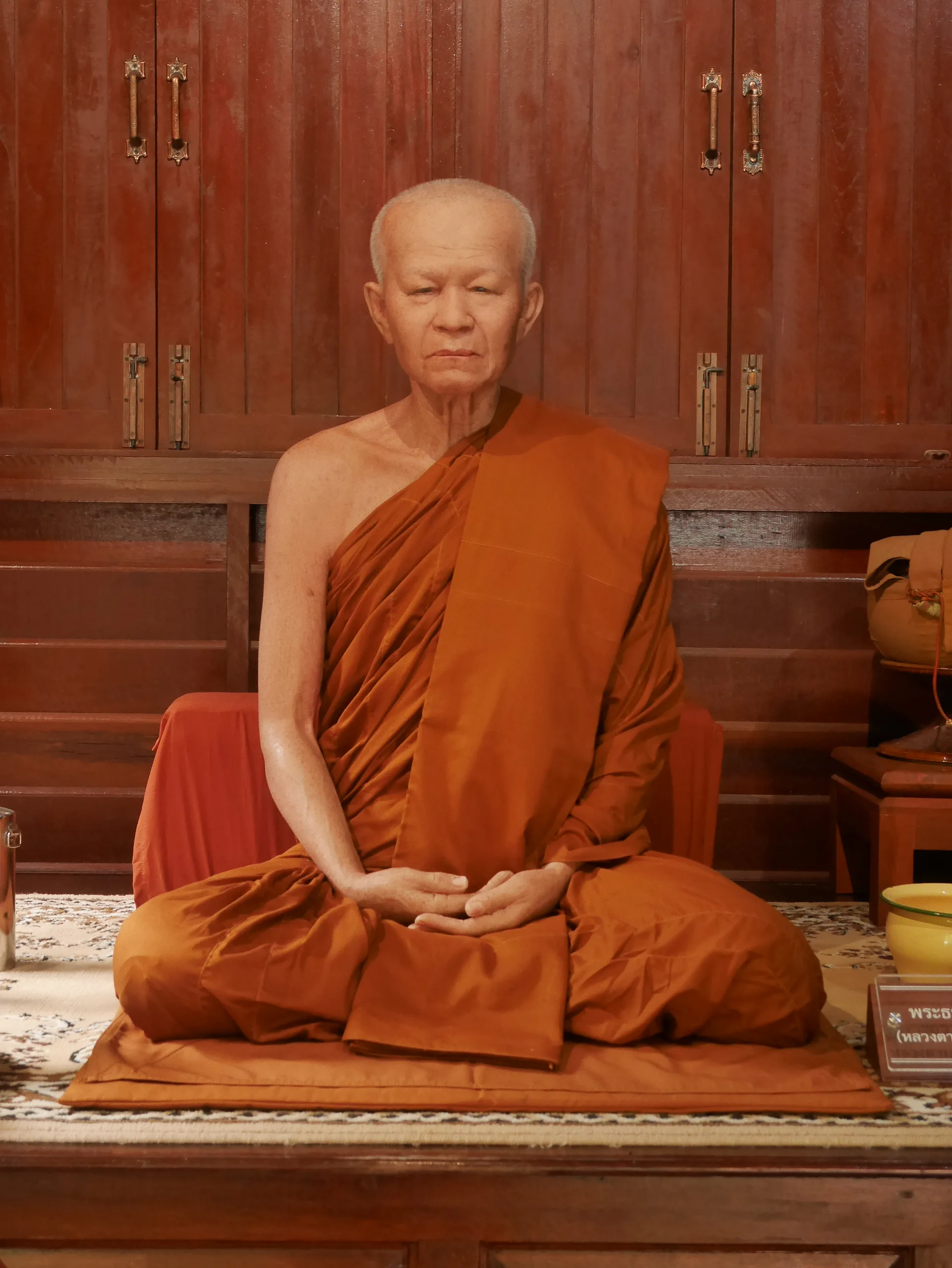
Ajahn Maha Bua
 Thailand
Also known as: Ajahn Maha Bua Nanasampanno, Ñāṇasampanna Bhikkhu, Ñāṇasampanno, Būa Lōhitdī
Birthday
August 12, 1913
Birth Sign
Leo
Birthplace
Ban Tat, Bueng Khong Long, Udon Thani, Thailand
Age
Died at 97
Height
5 ft 5 in (1.65 m)
About
Ajahn Maha Bua Nanasampanno was a preeminent Thai Buddhist monk and the most revered master of the Thai Forest Tradition in the 20th century. Born Boon Lohitdī in 1913, he dedicated his life to rigorous meditation, strict monastic discipline, and the preservation of the lineage established by his teacher, Ajahn Mun Bhuridatta. He passed away on January 30, 2011, at the age of 97 due to natural causes associated with old age.
Throughout his life, he served as the Ajahn Yai, or head monk, of the Thai Forest Tradition, guiding thousands of disciples toward enlightenment. His teachings emphasized direct realization over intellectual study, often delivered with sharp wit and humor. Even after his death, his influence remains profound, with his works translated into multiple languages and his monastery continuing to serve as a major center for spiritual practice worldwide.
Early Life & Background
Boon Lohitdī was born into a farming family in the village of Ban Tat, located in the Bueng Khong Long district of Udon Thani province. From a young age, he displayed a keen interest in religious matters, though his path was shaped more by the spiritual climate of the region than formal secular schooling. In 1939, at the age of 26, he entered the monkhood as a novice at Wat Pa Pung Kham. He received full ordination shortly thereafter, committing himself entirely to the monastic life.
Before gaining widespread recognition, he lived a life of strict asceticism in the deep forests of Northeast Thailand. Following the tradition of dhutanga, or forest ascetic practices, he often dwelled alone for extended periods, engaging in solitary retreats. His early education focused exclusively on the Pali Canon and the Vinaya, the monastic code of conduct. A pivotal moment occurred when he met Ajahn Mun Bhuridatta, the founder of the modern Thai Forest Tradition. Ajahn Mun recognized Bua's profound potential and took him as a direct disciple, grooming him to carry the lineage forward after his own passing.
Career Growth
Ajahn Maha Bua's career was defined by his role as a Dhamma teacher and meditation master rather than commercial success. His "success" was measured by the number of disciples he guided to enlightenment and the spread of the Forest Tradition. After his ordination in 1939, he traveled extensively throughout the forests of Isan under the guidance of Ajahn Mun during the 1940s and 1950s, teaching laypeople who sought his counsel.
In the 1960s, he established Wat Pa Ban Tat, which became his primary monastery and a major center for the Forest Tradition. By the 1970s and 1980s, he gained national prominence as a teacher known for his sharp, direct, and often humorous style. He became a central figure in the revival of strict monastic discipline in Thailand. In 1994, he was appointed as the Ajahn Yai, solidifying his status as the leading authority on the tradition until his death. Throughout the 2000s, he continued to teach until advanced age, with his talks translated into multiple languages and distributed globally via books and recordings.
Career Timeline
Public Image & Style
Ajahn Maha Bua was known for his distinctive appearance: a shaved head, saffron robes, and a calm, often mischievous demeanor. His signature style was one of simplicity and austerity, rejecting luxury while maintaining a sharp wit. He possessed a unique ability to use humor to teach complex philosophical points, making his teachings accessible to both scholars and laypeople. Media perception of him was overwhelmingly positive, viewing him as a living saint and a model of monastic virtue. His presence commanded respect not through force but through the sheer gravity of his spiritual realization and dedication to the path.
Fame & Fandom
The spiritual community surrounding Ajahn Maha Bua operated with a quiet intensity that defied modern metrics of celebrity. His followers did not form a formalized group with a specific name or organized campaigns; instead, their devotion manifested through deep personal practice and the sheer gravity of his presence in the Thai Forest Tradition. While he never courted the spotlight of pop culture, the scale of reverence he commanded was evident in the massive public response to his passing, where thousands gathered without fanfare to honor a life dedicated to rigorous meditation.
The enduring nature of his legacy is now quantified by the iFANN Global Fame Rankings. Ajahn Maha Bua holds a steady position as the 62nd most famous person in Thailand. This prominence reflects his status as a direct disciple of Ajahn Mun Bhuridatta and a master who inherited a lineage focused on profound spiritual realization. His influence extends beyond national borders, securing him the rank of the 98th most famous person from Thailand. These placements confirm that while his fame was rooted in monastic discipline rather than public performance, his impact remains a significant cultural force recognized by the iFANN system.
Interesting Facts and Legends
Ajahn Maha Bua is surrounded by legends that form the core of his mythology among devotees. Disciples frequently recount stories of his ability to transcend physical limits, such as levitating during meditation or communicating telepathically. While these are often framed as folklore, they serve as the primary vehicle for his spiritual authority. He was famous for teaching asubha, the contemplation of the unattractive nature of the body, with such intensity that it reportedly caused some practitioners to experience profound psychological breakthroughs or even fainting spells. His funeral gathering, where hundreds of thousands attended without incident, is considered a legendary event in modern Thai history. Despite his fame, he never cultivated a pop-culture fandom with official names or organized campaigns, yet his devotees affectionately called him Luangta, a term reflecting deep familial reverence.
Notable Quotes
“The Dhamma is not something to be studied, but something to be realized.”
“If you want to find the truth, you must first let go of everything you think you know.”
“Meditation is not about becoming something else; it is about becoming what you already are.”
Family & Personal Life
As a Theravada Buddhist monk who had taken vows of celibacy, Ajahn Maha Bua never married and had no romantic relationships or biological children. The concept of romantic partnership was incompatible with his monastic vows. His "family" consisted of his monastic community, the Sangha, and his lay disciples, whom he referred to as his spiritual children. He lived simply within the confines of his monastery, wearing the standard saffron robes and adhering strictly to the Vinaya rules regarding food, sleep, and interaction with women. His upbringing in a farming family in Ban Tat instilled a grounded simplicity that characterized his entire life.
Notable Connections
Ajahn Mun Bhuridatta (Teacher), Princess Chulabhorn (Patron), Ajahn Chah (Contemporary).
Relationships & Dating History
Ajahn Maha Bua never entered into any romantic relationships, marriages, or engagements. As a Theravada Buddhist monk, he took vows of celibacy that made romantic partnership incompatible with his monastic duties. Consequently, there are no records of spouses, fiancés, or partners. His "family" consisted entirely of his monastic community and lay disciples, whom he treated with the care of a father to his children. He lived a life of total renunciation, focusing solely on spiritual practice and teaching until his death in 2011.
Death & Aftermath
Died
January 30, 2011 (aged 97)
Death Place
Wat Pa Ban Tat, Bueng Khong Long, Udon Thani, Thailand
Cause of Death
Natural causes associated with old age
Ajahn Maha Bua passed away on January 30, 2011, at Wat Pa Ban Tat in the Bueng Khong Long district of Udon Thani province. His monastic community and family reported that he died from natural causes associated with old age and declining health after a period of suffering from various ailments. The circumstances were consistent with a peaceful passing within the religious institution. Thousands of devotees gathered immediately following his death, treating the event as a matter of profound national spiritual significance rather than a legal incident. A grand cremation ceremony took place on March 7, 2011, attended by an estimated 50,000 to 100,000 people including high-ranking government officials and senior monks.
Her Royal Highness Princess Chulabhorn presided over the final ceremonies, presenting gold bars weighing 920.5 kilograms for the construction of a new ordination hall in his honor. Tributes poured in from peers and institutions, with many labeling him a living saint and an arahant, though this remained a matter of faith rather than an official ecclesiastical declaration. The body was cremated following standard Buddhist protocol, and the ashes were later enshrined at the monastery or distributed to branch monasteries dedicated to his memory. In the posthumous period, Ajahn Maha Bua's legacy solidified through the preservation of his extensive library of dhamma talks, books, and films, which continue to be published globally by organizations like Forest Dhamma and Luangta.eu.
Several foundations and meditation centers continue to operate in his name, funded largely by donations from his vast network of followers. His estate was handled entirely by the monastic community and temple administration according to Buddhist Vinaya rules, ensuring all assets were dedicated to the temple and charitable causes without personal inheritance by family members.
Net Worth (Estate Value)
$0
iFANN Editorial Team estimate
As a monk, Ajahn Maha Bua owned no personal wealth. According to Buddhist Vinaya rules, he possessed nothing personally; all resources were held in trust by the monastery for communal use. Therefore, his personal net worth is effectively zero. His "estate" consists of the assets of Wat Pa Ban Tat and the intellectual property of his teachings, which generate revenue through book sales, donations, and media licensing. These funds are reinvested into the temple and charitable activities. There is no private inheritance for family members, as he had none. The iFANN Editorial Team estimates his personal financial standing at $0, reflecting his total renunciation of material possessions during his lifetime.
Awards & Accolades
View 5 records, honours and achievementsKnown For
Thai Forest Tradition
N/A · Leading Master
Wat Pa Ban Tat
1960s · Founder and Abbot
Keywords
Sources
Quick Facts
- Profession
- Buddhist monk
- Born
- August 12, 1913
- Birthplace
- Ban Tat, Bueng Khong Long, Udon Thani, Thailand
- Died
- January 30, 2011
- Death Place
- Wat Pa Ban Tat
- Gender
- Male
- Birth Sign
- Leo
Personal Details
- Full Name
- Boon Lohitdī
- Height
- 5 ft 5 in (1.65 m)
- Children
- Education
- Self-taught in Pali Canon and Vinaya; trained under Ajahn Mun Bhuridatta
Frequently Asked Questions
When did Ajahn Maha Bua die?
What was Ajahn Maha Bua's birth name?
Did Ajahn Maha Bua have any children?
Who was Ajahn Maha Bua's teacher?
Where is Ajahn Maha Bua's monastery located?
Social Media
Similar People
Join the community
fans discussing