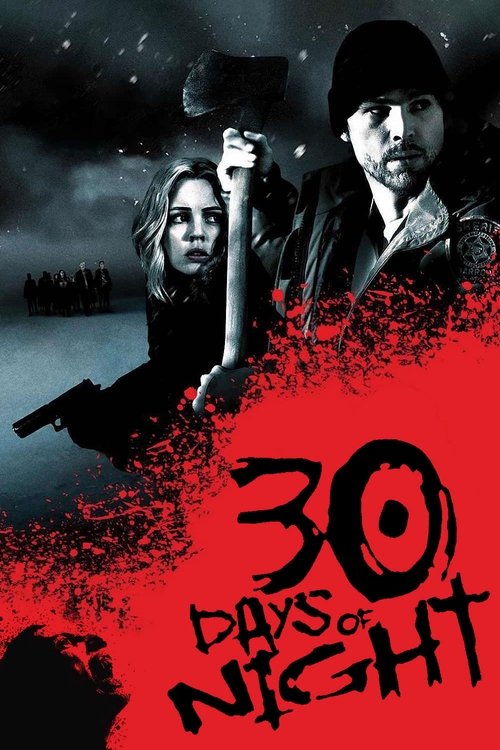
Barrow, Alaska, is the northernmost town in the United States, a place of fewer than 200 souls that each winter endures a polar night: 30 straight days without a sunrise. That's the setup for David Slade's 2007 horror film, adapted from the graphic novel by Steve Niles and Ben Templesmith. When the sun dips below the horizon, a pack of vampires led by the calculating Marlow (Danny Huston) descends, turning the long darkness into a hunting ground. Sheriff Eben Oleson (Josh Hartnett) and his estranged wife Stella (Melissa George) must rally a handful of survivors to outlast the month-long siege.
Slade, who had just come off the psychological thriller Hard Candy, brings a stark visual sensibility to the material. Working with cinematographer Jo Willems, he bathes the screen in cold blues and stark whites, making the town feel both beautiful and oppressive. The vampires are not the romantic creatures of Twilight; they are feral, primal predators, communicating in a guttural invented language and moving with terrifying speed. The film had a $30 million budget and grossed over $80 million worldwide, a solid return for a genre picture. It also spawned a sequel, 30 Days of Night: Dark Days, and a 2026 4K restoration that renewed critical interest.
Availability and pricing can change. Confirm on the provider's site before purchasing.
PlotSpoiler-free
As the last flight out of Barrow prepares to depart, a stranger (Ben Foster) arrives on the tarmac, his face a mask of barely contained violence. He smashes cell phones and destroys communication equipment, a harbinger of the horror that is about to unfold. Sheriff Eben Oleson is preparing to leave for a new job in Anchorage, a decision that has strained his marriage to Stella, the town's fire marshal. The couple is on the brink of separation, but the coming darkness will force them to put aside their differences.
On the first night of the polar night, the vampires strike. They move through the town with brutal efficiency, slaughtering the townsfolk in a frenzy of blood and chaos. Eben, Stella, and a small group of survivors, including Eben's younger brother Jake (Mark Rendall), the gruff Beau Brower (Mark Boone Junior), and a few others, manage to escape the initial massacre. They take refuge in the attic of the hardware store, a cramped space that becomes their sanctuary for the next few days.
The vampires are led by Marlow, a creature of intelligence and cruelty. He communicates in a guttural language, taunting his prey and methodically hunting them down. The survivors are forced to move when the vampires burn down their hiding place, and they navigate the frozen, blood-soaked streets, dodging the predators. Supplies dwindle, tempers fray, and the psychological toll of constant fear begins to wear on everyone. Eben emerges as the reluctant leader, while Stella's knowledge of the town's infrastructure proves vital, she knows the layout of the buildings and the utility tunnels, giving the group a chance to stay one step ahead.
As the days drag on, the group is whittled down. The vampires are relentless, and the survivors are always on the verge of being discovered. A helicopter is due to arrive when the sun returns, but that is weeks away. The hope of rescue seems impossibly distant. The central conflict is stark: a handful of ordinary humans, armed with limited weapons and wits, against a pack of immortal monsters who have all the advantages, speed, strength, and the cover of perpetual night. The film builds tension through its claustrophobic atmosphere, the isolation of the setting, and the ever-present threat of the vampires closing in. Each day brings a new challenge, a new loss, and the slow erosion of hope. The title itself is both literal and metaphorical, the 30 days of darkness represent not just a natural phenomenon but a trial by fire, a crucible that exposes the best and worst of human nature under extreme duress.
30 Days of Night succeeds as a visually striking and brutally effective vampire horror, thanks to its ferocious creatures and atmospheric Alaskan setting. However, thin character development and a reliance on genre conventions keep it from reaching the heights of its source material. The film's uncompromising take on vampires is its greatest asset.
 United States