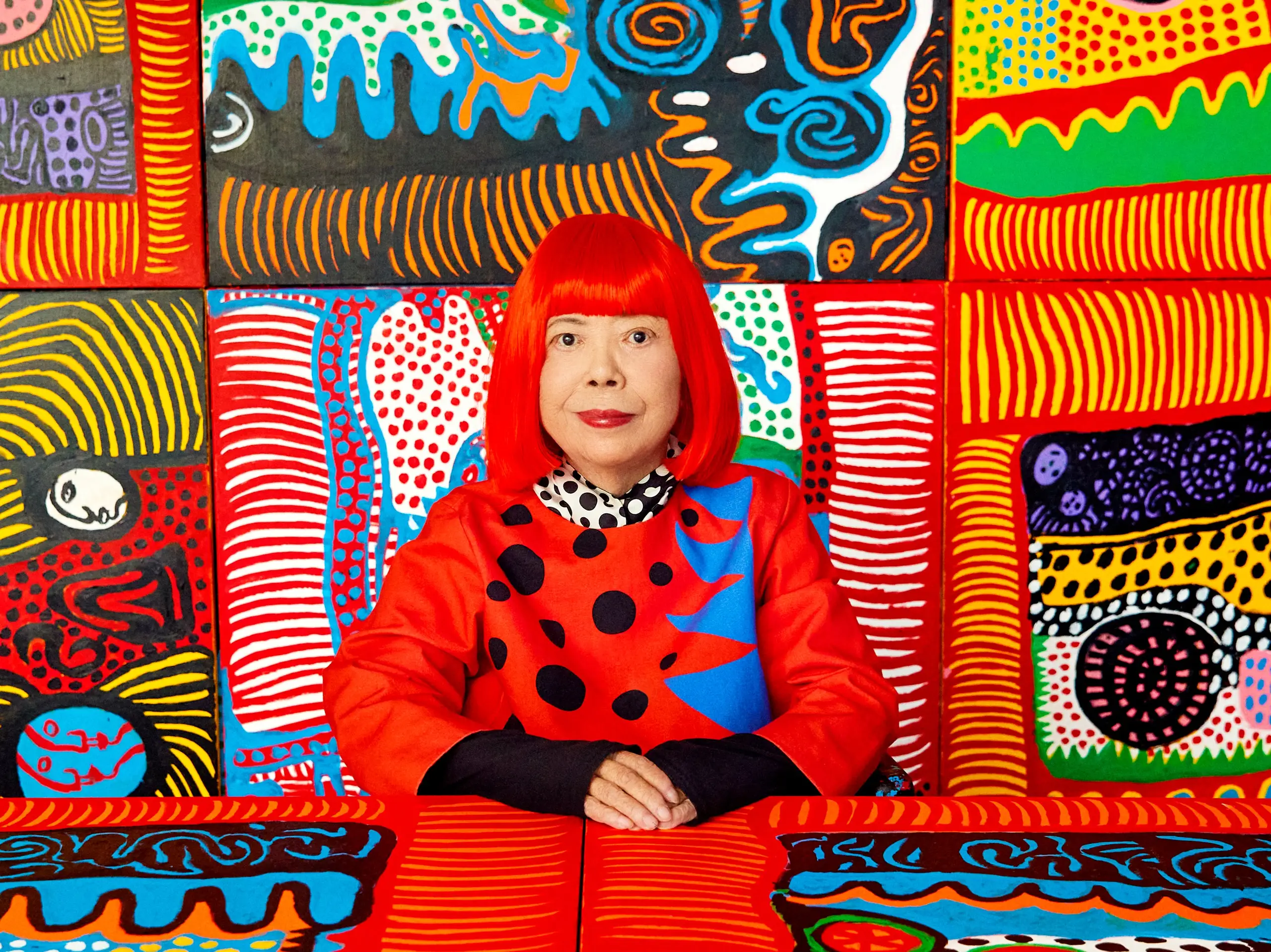
Yayoi Kusama
 Japan
JapanConceptual artist•sculptor•novelist
Birthday
March 22, 1929
Birth Sign
Aries
Birthplace
Matsumoto, Nagano Prefecture, Japan
Age
97 years old
About
Yayoi Kusama is a Japanese conceptual artist whose polka dots, pumpkins, and Infinity Mirror Rooms have made her one of the most recognizable figures in contemporary art. Born in 1929, she has spent over seven decades pushing the boundaries of painting, sculpture, installation, and performance. Today, she is widely regarded as the world's top-selling female artist, with her works commanding millions at auction and her immersive installations drawing massive crowds wherever they travel.
Kusama's art is deeply personal, rooted in hallucinations she has experienced since childhood. She transforms these visions into a visual language of dots and nets that feels both playful and profound. Her Infinity Mirror Rooms, using mirrors, lights, and reflective surfaces, create endless, otherworldly spaces that have become cultural touchstones. She has received Japan's Order of Culture and continues to create at 97, with major exhibitions around the world.
Early Life & Background
Yayoi Kusama was born on March 22, 1929, in Matsumoto, a city in Japan's Nagano Prefecture, surrounded by the Japanese Alps. Her family ran a prosperous plant nursery and seed farm, a setting that would later inspire her famous pumpkin motif. The youngest of several children, she grew up in a household where her artistic ambitions were met with resistance, particularly from her mother, who wanted her to follow a more traditional path. Despite this, Kusama began drawing at a young age, often using the family's seed packets as canvases.
From childhood, she experienced vivid hallucinations, fields of dots and nets that seemed to cover everything she saw. These visions became the core of her artistic vocabulary. In 1948, she enrolled in the Nihonga program at the Kyoto City University of Arts, where she studied traditional Japanese painting. But she found the rigid conventions stifling and soon gravitated toward more experimental forms. A turning point came when she wrote to American artist Georgia O'Keeffe, seeking guidance. O'Keeffe's encouraging response helped Kusama decide to move to the United States. In 1958, she arrived in New York City, a 29-year-old artist with little money but immense determination, ready to make her mark on the avant-garde scene.
Career Growth
Kusama's breakthrough came in the 1960s New York art world, where she staged provocative 'happenings' featuring naked participants painted with polka dots. These performances, along with her Infinity Net paintings, placed her at the center of the avant-garde, influencing contemporaries like Andy Warhol and Claes Oldenburg. She also began creating her iconic Infinity Mirror Rooms during this period, immersive installations that would later become her signature.
After a challenging decade, Kusama returned to Japan in 1973, and by 1977 she had voluntarily moved into a mental health facility in Tokyo, where she still lives today, working daily in a nearby studio. A revival in the 1980s brought her work back into the international spotlight. Key milestones include representing Japan at the 1993 Venice Biennale, a 2012 collaboration with Louis Vuitton, and her 2014 pumpkin sculpture selling for $7.9 million at auction, a record for a female artist at the time. The Yayoi Kusama Museum opened in Tokyo in 2017, and in 2026, major retrospectives at Museum Ludwig in Cologne and Sotheby's Maison in Hong Kong, along with a Cincinnati Art Museum exhibition, continue to draw record crowds.
Career Timeline
Public Image & Style
Kusama's public persona is as distinctive as her art. She appears in a bright red bobbed wig and polka-dotted clothing, a look she has maintained for decades. Her work blends pop art, minimalism, and surrealism, often exploring themes of infinity and obsession. The media portrays her as a pioneering avant-garde artist who has transcended multiple movements. Her installations, particularly the Infinity Mirror Rooms, have become Instagram sensations, drawing younger audiences who queue for hours to experience them. Fans have no official name, but her exhibitions regularly break attendance records, and her social media presence is indirect yet massive through the viral nature of her work.
Fame & Fandom
Yayoi Kusama commands a global attention that spans decades of cultural evolution, merging the avant-garde history of performance art with the immediacy of modern digital virality. Her presence in the contemporary consciousness is quantified by her standing in the iFANN Global Fame Rankings, where she holds the position of the 58th most famous person in Art & Design, a placement holding steady from the previous cycle. This ranking reflects a sustained trajectory of influence that transcends traditional artistic movements to become a dominant force in visual culture. While the specific mechanics of these assessments remain within the scope of the ranking methodology, the result is a clear indication of her status among the world's most recognized creative figures. The audience surrounding Kusama does not operate under a formalized moniker; there is no documented name for her supporters beyond general references to "Kusama fans" or "art enthusiasts." Unlike organized groups with specific chants or internal nicknames, this community is defined by the collective ritual of queueing for her installations. Fans coordinate through social media platforms to secure limited entry slots for her Infinity Mirror Rooms, turning the waiting period into a shared experience that has become a central part of her legacy. This grassroots organization manifests in viral campaigns and user-generated content tagged #YayoiKusama, which functions as a de facto marketing engine. The interaction between the artist and her followers is mediated through the physical act of entering her work, designed to induce self-obliteration rather than direct celebrity worship.
Interesting Facts and Legends
Kusama has been writing poetry and fiction since the 1970s, publishing several novels and poetry collections in Japanese. Her fixation on pumpkins originates from a childhood memory of a pumpkin in her family's field that appeared to speak to her. She was a pioneer of performance art in the 1960s New York scene, notably organizing nude "Body Festivals" where performers painted polka dots on their bodies and danced in Manhattan streets, events that frequently led to police intervention. Another legendary incident involves her 1966 "Anatomic Explosion" at the Venice Biennale, where she staged a nude protest against the Vietnam War while distributing leaflets. A widely retold story claims she wishes to "paint herself into infinity," a phrase elevated to folklore as the origin of her visual language. In August 2026, records were broken at the Museum Ludwig in Cologne, Germany, where over 300 works took over the museum, drawing crowds so large they required strict time-slot management. The phenomenon of photographing oneself inside her mirror rooms has evolved into a modern rite of passage, with fans joking that the queue is often longer than the artwork itself. She remains a dominant force at age 97, receiving honors such as the Asahi Prize in 2001, the Praemium Imperiale in 2006, and the Medal with Purple Ribbon in 2003.
Notable Quotes
“I fight pain, anxiety, and fear every day, and the only method I have found that relieved my illness is to keep creating art.”
“A polka dot has the form of the sun, which is a symbol of the energy of the whole world and our living life, and also the form of the moon, which is calm. Polka dots can't stay in one place; they're like a movement, polka dots are a way to infinity.”
Family & Personal Life
Kusama was born into a prosperous family in Matsumoto, Japan, that ran a plant nursery and seed farm. Her mother opposed her artistic ambitions, and her relationship with her family was strained. She has never married and has no children. Since 1977, she has lived voluntarily in a mental health facility in Tokyo, where she has a studio nearby. Her family's seed business inspired her early drawings and later her iconic pumpkins, which she associates with her childhood.
Notable Connections
Kusama's circle includes fellow artist Joseph Cornell, with whom she had a deep but complicated relationship. She influenced Andy Warhol and Claes Oldenburg in the 1960s. Georgia O'Keeffe encouraged her early career. Her work is represented by David Zwirner, Victoria Miro, and Ota Fine Arts, and she collaborated with Louis Vuitton in 2012.
Relationships & Dating History
Kusama has never married and has no children. Her most significant relationship was with American artist Joseph Cornell, whom she met in the early 1960s in New York. Cornell, who was 26 years her senior, was a reclusive assemblage artist living with his mother, which limited their time together. Despite this, they shared a deep artistic and emotional connection, communicating frequently by phone. Their relationship ended with Cornell's death in 1972. Since then, Kusama has remained single, dedicating her life to her art and her voluntary residence at a mental health facility in Tokyo. As of 2026, she is single and continues to create daily.
- DatedJoseph Cornell1960 - 1972Deep artistic and emotional connection, limited by Cornell's reclusive lifestyle; ended with his death.
Salary, Net Worth In 2026
$120 Million
iFANN Editorial Team estimate
Per iFANN's editorial analysis, Yayoi Kusama's net worth stands at $120 Million as of 2026. This figure reflects her consistent position as the world's top-selling female artist, with major auction sales forming the bulk of her wealth. Her 2014 pumpkin sculpture sold for $7.9 million, setting a record that she has since surpassed multiple times. Income streams also include public commissions, museum exhibitions, and licensing deals, most notably her 2012 collaboration with Louis Vuitton. Represented by leading galleries such as David Zwirner, Victoria Miro, and Ota Fine Arts, her works command premium prices in the market. The Yayoi Kusama Museum in Tokyo, which opened in 2026, contributes additional revenue through ticket sales and merchandise. While precise financial verification can be complex, her economic trajectory has shown steady appreciation over the decades, solidifying her financial dominance in the art world.
Awards Won (6)
Kusama has received numerous prestigious honors, including the Praemium Imperiale for painting in 2006, Japan's Order of Culture in 2016, and the Asahi Prize in 2001. She has also been recognized with the Medal with Purple Ribbon and the Wolfgang Hahn Prize. Her contributions to art have been celebrated with honorary doctorates and lifetime achievement awards.
2016 · National Honor
Lifetime achievement
2006 · Painting
Painting
Known For
Infinity Mirror Rooms
1965 · Creator
Pumpkin sculptures
1981 · Artist
Polka dot paintings
1960 · Artist
Keywords
Sources
Quick Facts
- Profession
- Conceptual artist, sculptor, novelist
- Born
- March 22, 1929
- Birthplace
- Matsumoto, Japan
- Gender
- Female
- Birth Sign
- Aries
Personal Details
- Education
- Kyoto City University of Arts (Nihonga program)
Frequently Asked Questions
Is Yayoi Kusama still alive?
Why does Yayoi Kusama wear a red wig?
Why does Yayoi Kusama live in a mental hospital?
What is Yayoi Kusama's most famous work?
How much is Yayoi Kusama's net worth?
Similar People

Join the community
fans discussing