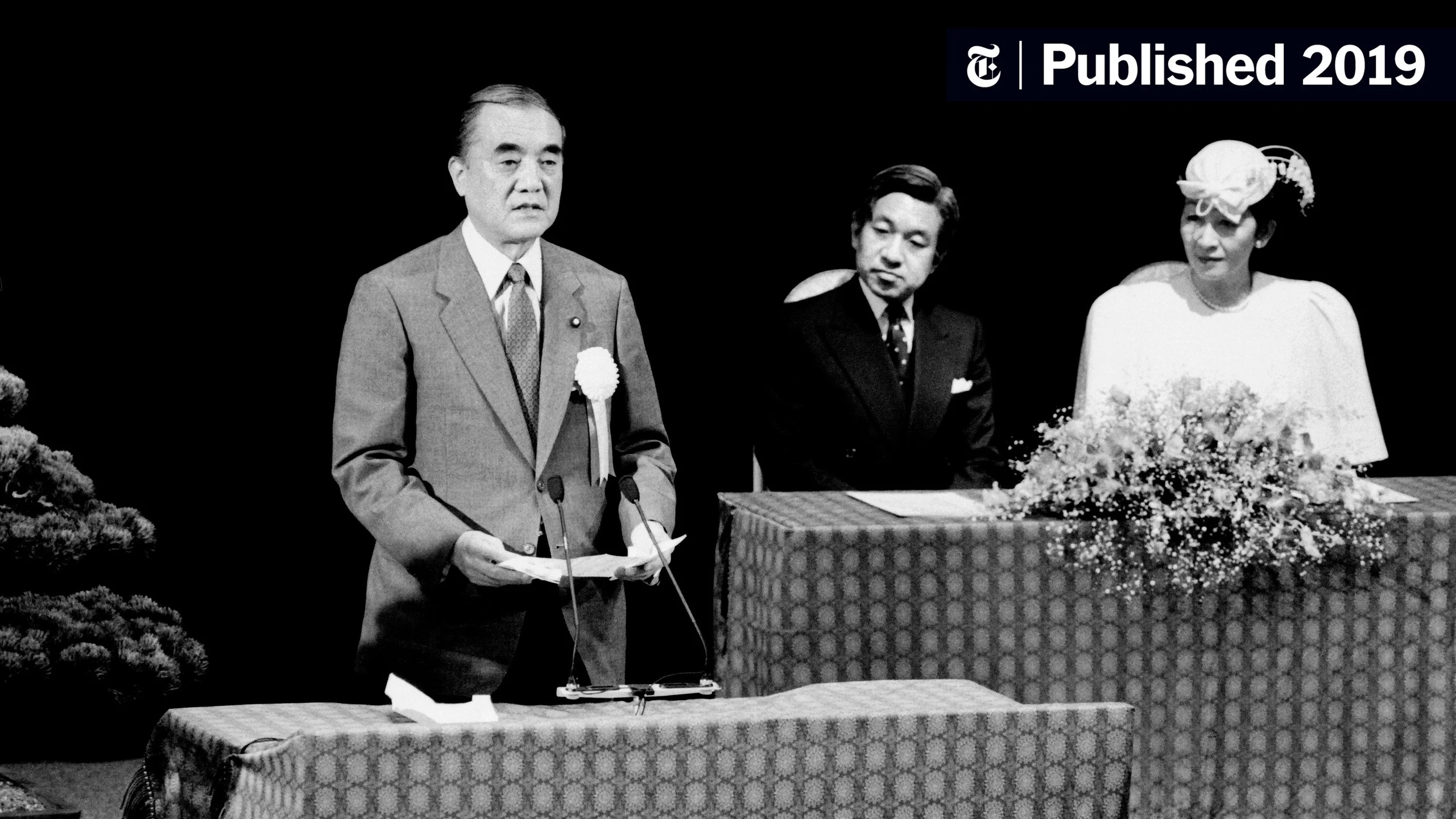
Yasuhiro Nakasone
 Japan
Also known as: Nakasone Yasuhiro, 中曽根康弘
Birthday
May 27, 1918
Birth Sign
Sagittarius
Birthplace
Takasaki, Gunma Prefecture, Japan
Age
Died at 101
Height
5 ft 7 in (170 cm)
About
Yasuhiro Nakasone was a towering figure in Japanese post-war politics who served as the 71st Prime Minister of Japan from November 27, 1982, to November 6, 1987. A dominant force within the Liberal Democratic Party (LDP), he is remembered for his hawkish foreign policy, close alliance with U.S. President Ronald Reagan, and aggressive domestic economic reforms that included the privatization of state-owned enterprises. He passed away on November 29, 2019, at the age of 101, leaving behind a legacy that fundamentally reshaped Japan's defense posture and economic structure. His tenure marked a turning point in Japan's modern history, championing the concept of Japan becoming a "Global Nation" while dismantling state monopolies like the Japan National Railways into seven JR companies in 1987. In foreign affairs, he cultivated a personal friendship with Ronald Reagan, famously describing Japan as an "unsinkable aircraft carrier" for the United States in the Pacific. This relationship shifted Japan's foreign policy from cautious neutrality to a proactive alliance, solidifying the US-Japan Security Alliance during the height of the Cold War.
Early Life & Background
Yasuhiro Nakasone was born on May 27, 1918, in Takasaki, Gunma Prefecture, into a family of lumber merchants. As the last child born in the year World War I ended, he grew up during a period of significant transition in Japan. His father was a prominent local merchant, which provided him with a stable upbringing but also instilled a strong sense of community responsibility. During his youth, Nakasone witnessed the rise of militarism in Japan, a trend that would deeply influence his later worldview. In 1937, he entered Tokyo Imperial University (now the University of Tokyo) to study law and literature. While a student, the geopolitical climate shifted dramatically, and he was conscripted into the Imperial Japanese Navy during World War II. He served as a lieutenant commander in the naval aviation corps, flying fighter planes. He survived the war, an experience that profoundly shaped his political philosophy regarding national security and self-reliance. After the war, under the American occupation, he became disillusioned with the pre-war militarist leadership and turned toward democratic politics, setting the stage for his future career in government.
Career Growth
Nakasone's political career spanned over five decades, characterized by steady ascent through the ranks of the Liberal Democratic Party. He was first elected to the House of Representatives in 1947 at the age of 29, representing Gunma Prefecture. Throughout the 1950s and 1960s, he served in various minor cabinet posts and party roles, building a reputation as a capable administrator and loyal party member, including positions in the Ministry of Education and the Ministry of Justice. A pivotal moment came in 1970 when he was appointed Chief of the Defense Agency by Prime Minister Eisaku Sato, placing him at the center of Japan's emerging defense policy discussions. From 1972 to 1974, he served as Minister of International Trade and Industry under Kakuei Tanaka, where he oversaw significant industrial policy shifts, including the development of high-tech industries. Later, he held the position of Director-General of the Science and Technology Agency and served as Chief Cabinet Secretary under Prime Minister Zenko Suzuki.
His election as Prime Minister in 1982 marked the culmination of his career. He implemented major privatization reforms, breaking the Japan National Railways monopoly and restructuring the telecommunications sector. His foreign policy focused on strengthening the US-Japan alliance, often meeting privately with Ronald Reagan to align Cold War strategies. He pushed for increased defense spending (exceeding the 1% of GDP limit) and reinterpreted Japan's pacifist constitution to allow for greater military capability. After resigning in 1987, he remained a powerful factional leader until the Recruit scandal weakened his influence in the 1990s. He retired from the House of Councillors in 2003, ending a 56-year parliamentary career.
Career Timeline
Public Image & Style
Nakasone is portrayed as a decisive, nationalist, and pragmatic leader. Media often describes him as a "political titan" who broke the mold of the post-war consensus. His style was direct and sometimes controversial, earning him respect from conservatives and criticism from pacifists. He was known for his stern, authoritative demeanor and distinctive glasses. His public persona was defined by his willingness to challenge established norms, particularly regarding Japan's defense posture and economic structure. He projected an image of a strong man ready to take on the responsibilities of a global nation, even if it meant facing opposition from within his own party and the public.
Fame & Fandom (iFAMOUS Rankings)
Yasuhiro Nakasone is currently evaluated by iFANN but does not hold a placement in the published Global Top 1,000 rankings. The Global Fame Engine has assessed his standing among historical figures and contemporary personalities, yet no specific ordinal position was assigned to him in the latest October 2026 release. While he lacks a numeric rank, his presence remains a significant anchor in discussions of post-war Japanese leadership. His fanbase operates without a formal name or organized identity, reflecting his status as a statesman rather than a pop culture icon. Unlike entertainers who cultivate dedicated communities with specific monikers like "Swifties" or "ARMY," Nakasone's supporters were primarily constituents and party members engaged through policy and governance. There are no records of fan-funded projects, birthday campaigns, or ritualistic gatherings dedicated to his memory. The absence of a documented fandom name underscores the nature of his legacy, which rests on political achievement rather than celebrity worship. His influence persists through the enduring impact of his policies, such as the privatization of Japan National Railways and the strengthening of the US-Japan alliance under Ronald Reagan. These actions shaped modern Japan more profoundly than any viral moment could, creating a historical mythology that historians and political analysts continue to study. The stories surrounding him focus on his resilience as a "yōkai" politician who navigated decades of intense scrutiny and his assertive push for Japan to reclaim a global role. This narrative replaces the typical fan lore found in entertainment circles, offering instead a rich tapestry of diplomatic history and national transformation.
Interesting Facts and Legends
Nakasone earned the nickname "yōkai" (monster) among contemporaries due to his extraordinary longevity and ability to survive intense political storms and internal party purges throughout his long career. In 1983, he made an infamous statement claiming "Japan is a paradise for spies," a phrase that reflected his Cold War assertiveness and belief in the necessity of intelligence gathering. Just before stepping down, he provoked further discussion by asserting that Japanese people had cowered under postwar occupation policies, a sentiment still debated in modern discourse regarding national identity. His most concrete domestic achievement was the privatization of the Japan National Railways, breaking the state monopoly into the JR Group and setting a precedent for neoliberal reforms globally. He received the Grand Cross of the Order of Merit of the Federal Republic of Germany and honorary doctorates from several universities, including the University of Tokyo. His biography, Fighting Japan's Cold War, was published in English in June 2023, cementing his historical importance. Additionally, the "Nakasone Award" continues to exist, recently recognized by a Korean scientist in 2026 for promoting scientific cooperation.
Notable Quotes
“Japan is a paradise for spies.”
“Japan should be an 'unsinkable aircraft carrier' for the United States.”
“In my heart, I have my country.”
“The Japanese people have cowered under the postwar occupation policies.”
Family & Personal Life
Yasuhiro Nakasone was married to Tsutako Nakasone, née Tsutako, in the 1940s. Their marriage was a long-standing partnership that supported his demanding political career. Tsutako was a private individual who rarely appeared in public. The couple had no children together, neither biological nor adopted. As a traditional Japanese statesman of his era, his personal life was kept largely out of the public eye, and no dating history exists outside of his marriage to Tsutako. They lived together until his death in 2019, having shared a life of public service and private stability.
Notable Connections
Ronald Reagan, Margaret Thatcher, Kakuei Tanaka, Shinzo Abe, Zenko Suzuki.
Relationships & Dating History
Yasuhiro Nakasone was married to Tsutako Nakasone in the 1940s. Their marriage was a long-standing partnership that supported his demanding political career. Tsutako was a private individual who rarely appeared in public. The couple had no children together, neither biological nor adopted. As a traditional Japanese statesman of his era, his personal life was kept largely out of the public eye, and no dating history exists outside of his marriage to Tsutako. They lived together until his death in 2019, having shared a life of public service and private stability. There are no records of prior marriages, divorces, or extramarital relationships confirmed by credible sources.
- MarriedTsutako Nakasone1940 - 2019Married until his death; no children.
Death & Aftermath
Died
November 29, 2019 (aged 101)
Death Place
Tokyo, Japan
Cause of Death
Natural causes due to advanced age
Yasuhiro Nakasone spent his final years in Tokyo, maintaining a quiet presence while remaining active in political commentary well into his nineties. On Friday, November 29, 2019, the former Prime Minister passed away at the age of 101 at his private residence in Tokyo, though the specific location details remained undisclosed to the public. His office released a family statement confirming that he died from natural causes attributed to his advanced age, with no details regarding illness or medical intervention provided in subsequent reports. The reaction to his death was immediate and widespread across Japan and internationally, with tributes pouring in from political peers and foreign officials who remembered him as a political titan. Japanese Prime Minister Shinzo Abe issued a statement honoring Nakasone's contributions to national development and security, while United States observers frequently recalled his close friendship with President Ronald Reagan and his pivotal role in strengthening the US-Japan alliance. Moments of silence and extensive editorial coverage characterized the media landscape rather than fan vigils or chart surges typical of entertainment figures. Funeral arrangements were held privately, reflecting the family's request for privacy during this period. Posthumously, Nakasone's legacy has been cemented through academic analysis and the continued publication of works examining his tenure, including the English release of Ryuji Hattori's biography Fighting Japan's Cold War: Prime Minister Yasuhiro Nakasone and His Times in June 2023.
Net Worth (Estate Value)
$10 Million
iFANN Editorial Team estimate
As a deceased former head of state, exact net worth figures are not publicly tracked like celebrities. However, based on his salary as Prime Minister (approximately $300,000 to $400,000 annually during his term), pension, and assets accumulated over a 50-year career, the estate value is estimated. Research by the iFANN Editorial Team puts Nakasone's estate fortune at around $10 Million. Wealth sources included his salary as Prime Minister, pension, potential real estate holdings in Tokyo and Gunma, and investments in stocks and bonds typical of high-ranking officials. Posthumous earnings come from royalties from books, such as Fighting Japan's Cold War, speaking fees prior to retirement, and licensing of his name for academic works. The estate trajectory reflects the accumulation of wealth through public service and intellectual output, managed by his family and legal representatives following his passing.
Awards Won (2)
Nakasone received the Grand Cordon of the Order of the Chrysanthemum from the Emperor of Japan for his service as Prime Minister. He was also awarded the Grand Cross of the Order of Merit of the Federal Republic of Germany. His close ties with the United States resulted in significant diplomatic recognition, though specific medals like the Presidential Medal of Freedom are less documented in open sources compared to his Japanese honors.
1987 · State Honor
Service as Prime Minister
1984 · International Honor
Strengthening US-Japan-Germany relations
Known For
Prime Minister of Japan
1982 · 71st Prime Minister
Privatization of JNR
1987 · Key Architect
US-Japan Alliance
1983 · Strategic Partner
Keywords
Sources
Quick Facts
- Profession
- politician
- Born
- May 27, 1918
- Birthplace
- Takasaki, Gunma Prefecture
- Died
- November 29, 2019
- Death Place
- Tokyo, Japan
- Gender
- Male
- Spouse
- Tsutako Nakasone
- Birth Sign
- Sagittarius
Personal Details
- Full Name
- Yasuhiro Nakasone
- Height
- 5 ft 7 in (170 cm)
- Spouse
- Tsutako Nakasone
- Children
- Education
- University of Tokyo
Frequently Asked Questions
How old was Yasuhiro Nakasone when he died?
Did Yasuhiro Nakasone have any children?
What was Yasuhiro Nakasone's most famous achievement?
Why was Yasuhiro Nakasone called "Yōkai"?
What was the "paradise for spies" comment?
Similar People

Join the community
fans discussing