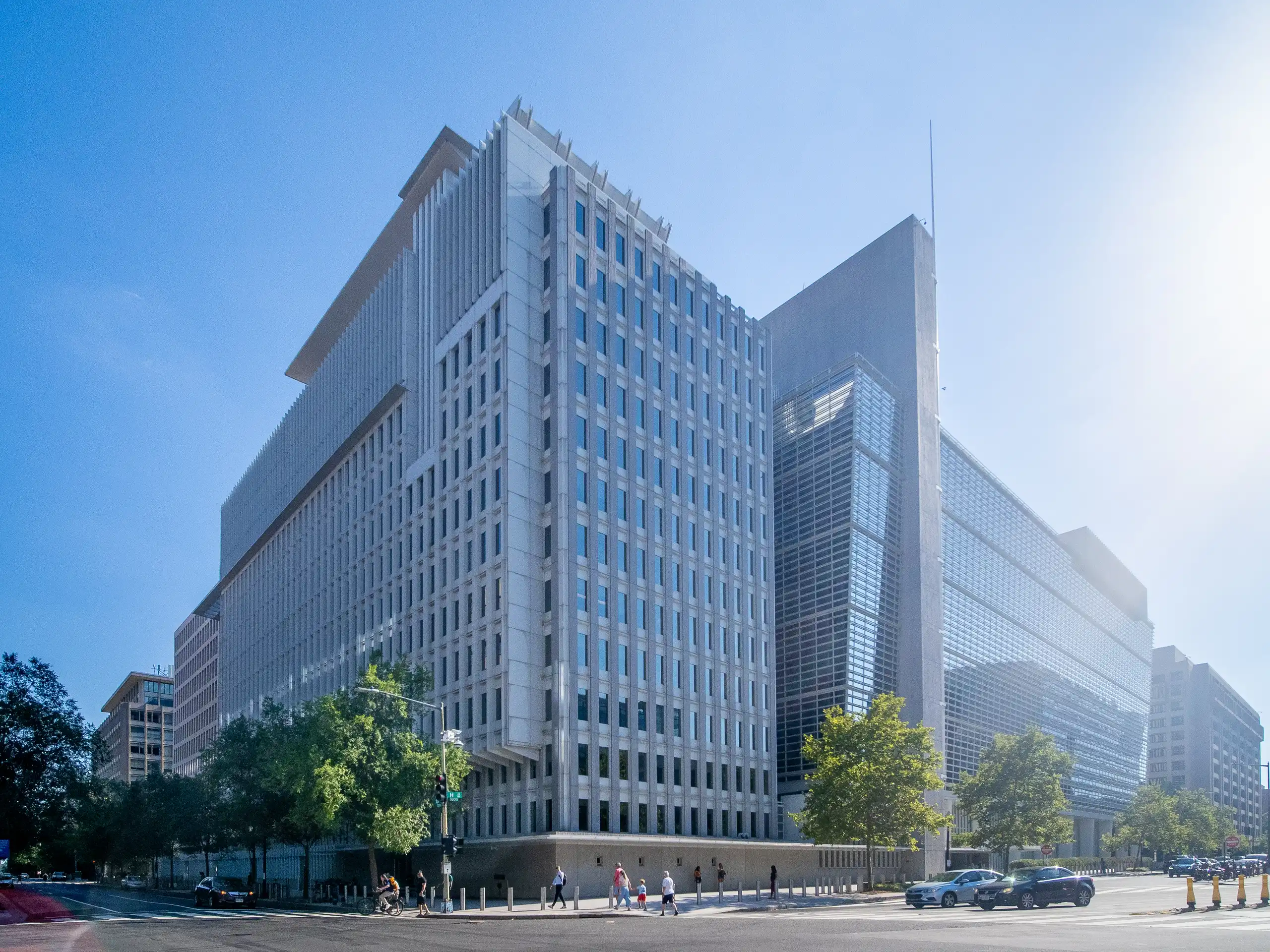
World Bank
 United States
"Working for a World Free of Poverty"
About
Founded at the Bretton Woods Conference in 1944, the World Bank is an international financial institution that provides loans, grants, and technical assistance to governments of low- and middle-income countries. It is a specialized agency of the United Nations and one of the largest sources of development finance globally. The organization is owned by 189 member countries, which act as shareholders, and its headquarters are in Washington, D.C.
The World Bank Group consists of five institutions: the International Bank for Reconstruction and Development (IBRD), the International Development Association (IDA), the International Finance Corporation (IFC), the Multilateral Investment Guarantee Agency (MIGA), and the International Centre for Settlement of Investment Disputes (ICSID). The term "World Bank" typically refers to IBRD and IDA, which focus on public sector projects. IFC supports private sector development, MIGA provides political risk insurance, and ICSID settles investment disputes.
With over 10,000 employees and offices in more than 120 locations, the World Bank finances projects in infrastructure, education, health, agriculture, and environmental sustainability. It also produces influential research and data, such as the World Development Report and the Doing Business Index, which shape global development policy.
Mission
The World Bank Group's mission is to end extreme poverty and promote shared prosperity on a livable planet. It aims to reduce the percentage of people living on less than $1.90 a day to no more than 3% globally by 2030, and to foster income growth for the bottom 40% of the population in every country. The institution provides financial resources, policy advice, and technical expertise to help developing countries achieve sustainable development.
History
July 1944 saw delegates from 44 allied nations gather at the Mount Washington Hotel in Bretton Woods, New Hampshire, for the United Nations Monetary and Financial Conference. The goal was to design a post-war economic system that would prevent the competitive devaluations and trade wars of the 1930s. Out of that meeting came the International Bank for Reconstruction and Development (IBRD), the first institution of what would become the World Bank Group. The IBRD's initial purpose was to finance the reconstruction of war-torn Europe.
The bank opened for business on June 25, 1946, with Eugene Meyer as its first president. The first loan request came from France, a one-page letter asking for $500 million for post-war rebuilding. That loan, approved in 1947, was followed by others to European countries under the Marshall Plan. By the 1950s, as Europe recovered, the bank shifted its focus to developing countries in Asia, Africa, and Latin America, funding large infrastructure projects like dams, power plants, and roads.
In 1960, the International Development Association (IDA) was created to provide soft loans and grants to the poorest nations. Under President Robert McNamara (1968-1981), the bank dramatically expanded its lending and turned its attention to directly reducing poverty. McNamara's 1973 speech in Nairobi introduced the term "absolute poverty" and set the bank on a new course. The 1980s brought structural adjustment loans, which required policy reforms in borrowing countries, sparking criticism. In response, the bank adopted more participatory and socially conscious approaches, emphasizing environmental sustainability and good governance.
Subdivisions
International Bank for Reconstruction and Development (IBRD)
Provides loans and guarantees to middle-income and creditworthy low-income countries.
International Development Association (IDA)
Offers interest-free loans and grants to the world's poorest countries.
International Finance Corporation (IFC)
Focuses on private sector development through investment and advisory services.
Multilateral Investment Guarantee Agency (MIGA)
Provides political risk insurance to encourage foreign direct investment.
International Centre for Settlement of Investment Disputes (ICSID)
Arbitrates investment disputes between governments and foreign investors.
Notable People
John Maynard Keynes
Co-architect of Bretton Woods Conference · 1944
Led the UK delegation and helped design the IBRD.
Harry Dexter White
Co-architect of Bretton Woods Conference · 1944
Led the US delegation and drafted the IBRD charter.
Robert McNamara
President · 1968-1981
Shifted the Bank's focus to fighting absolute poverty and expanded lending.
Eugene Meyer
First President · 1946
Opened the World Bank for business but resigned after six months.
Ajay Banga
President · 2023-present
Current president, focused on climate change and private sector engagement.
Milestones
1944
Bretton Woods Conference establishes the IBRD.
1946
World Bank opens for business on June 25.
1947
First loan: $250 million to France for reconstruction.
1960
International Development Association (IDA) is founded.
1973
President McNamara coins 'absolute poverty' and shifts focus to poverty reduction.
1988
Multilateral Investment Guarantee Agency (MIGA) is created.
2010
World Bank adopts the Open Agenda, increasing transparency and access to data.
Departments
Sources
Organization Info
- Founded
- July 1944
- Headquarters
- 1818 H Street NW, Washington, D.C., United States
- Country
- United States
- President
- Ajay Banga
- Type
- Government
- Member Countries
- 189
- Annual Lending (approx)
- $60 billion
Financials
- Employees
- 10000
Official Website
www.worldbank.org
Join the community
fans discussing