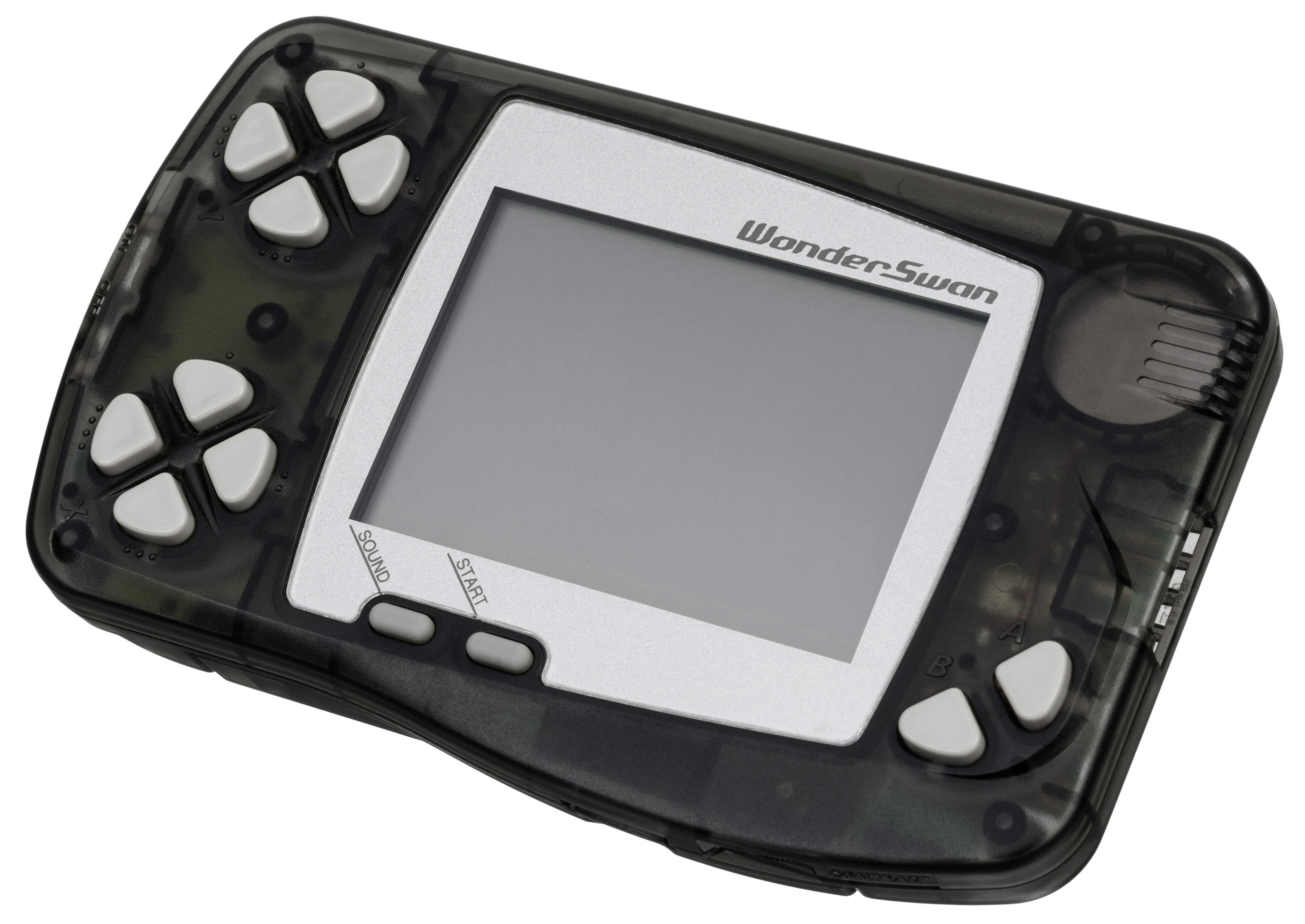
WonderSwan
"Gunpei Yokoi's final handheld with a rotating screen and killer battery life"
Overview
Bandai launched the WonderSwan in Japan on March 4, 1999, marking the final hardware project for legendary designer Gunpei Yokoi before his death. This 16-bit handheld arrived during a fierce sixth-generation console war, positioning itself as an affordable yet capable rival to Nintendo's Game Boy Color and SNK's Neo Geo Pocket Color. Users appreciated its unique dual-orientation design, which let players rotate the device for vertical or horizontal gameplay, alongside exceptional battery life powered by just one AA cell. Later models like the WonderSwan Color and SwanCrystal added vibrant displays to enhance visual quality.
The system relied on Yokoi's philosophy of lateral thinking with withered technology, prioritizing innovative features over raw graphical power. Its monochrome LCD offered 16 shades of gray at a crisp 256x256 resolution, while the Color model introduced a reflective screen capable of displaying 256 colors simultaneously. The SwanCrystal went further as the first handheld to combine color support with a backlight, solving visibility issues in dim environments. Despite never leaving Japanese shores officially, the console cultivated a devoted following through its tight library of anime adaptations and original RPGs.
Gameplay
The original WonderSwan featured a monochrome LCD screen with a resolution of 256x256 pixels, capable of displaying 16 shades of gray. Its most distinctive physical feature was its ability to rotate 90 degrees, allowing players to switch between vertical and horizontal gameplay orientations without changing the software or using a separate accessory. This dual-orientation design accommodated different genres, letting RPGs utilize vertical scrolling while platformers demanded horizontal control. The device ran on a single AA battery, offering up to 20 hours of playtime, a significant advantage over competitors requiring multiple batteries or rechargeable packs.
The controller layout included a D-pad, two action buttons labeled A and B, and start/select buttons, maintaining a compact form factor similar to the Game Boy but slightly wider to accommodate the rotating mechanism. The WonderSwan Color introduced a reflective color LCD screen capable of displaying 256 colors simultaneously, though it retained the same resolution. The SwanCrystal added a backlit color display, making it the first handheld to offer both color and backlighting, further enhancing visibility in low-light conditions.
Story
As a hardware platform rather than a single title, the WonderSwan does not have a unified story or plot. Instead, its narrative identity is defined by its extensive library of games, many of which were adaptations of popular anime, manga, and tokusatsu series. Notable titles include Tales of Phantasia, Tales of Destiny, and Dragon Ball Z spin-offs, which carried the rich storytelling of their source material into the portable format. The system also hosted original IP such as Star Soldier: Vanishing Earth and various role-playing games that utilized the unique rotation mechanic to enhance immersion.
While no specific WonderSwan story exists, the platform served as a vessel for the Gunpei Yokoi Spirit, focusing on creative gameplay mechanics over raw graphical power. This approach often resulted in unique narrative experiences distinct from the more generic offerings of its time. Games leveraged the hardware's specific strengths to create immersive worlds where battery efficiency and ergonomic design played a crucial role in player engagement.
Keywords
Sources
Game Info
- Developer
- Bandai
- Publisher
- Bandai
- Engine
- Custom 16-bit architecture (Sharp LH5801 CPU)
- Release Date
- March 4, 1999
- Modes
- Single-player, Multiplayer (Link Cable)
- Platforms
- WonderSwan, WonderSwan Color, SwanCrystal
- Final Project of Gunpei Yokoi
- Yes
- Battery Life
- Up to 20 hours on one AA battery
- Screen Resolution
- 256x256 pixels
- Total Units Sold (Estimate)
- Approximately 3 million
- Processor
- Sharp LH5801 (16-bit)
- Region Exclusivity
- Japan only
Join the community
fans discussing