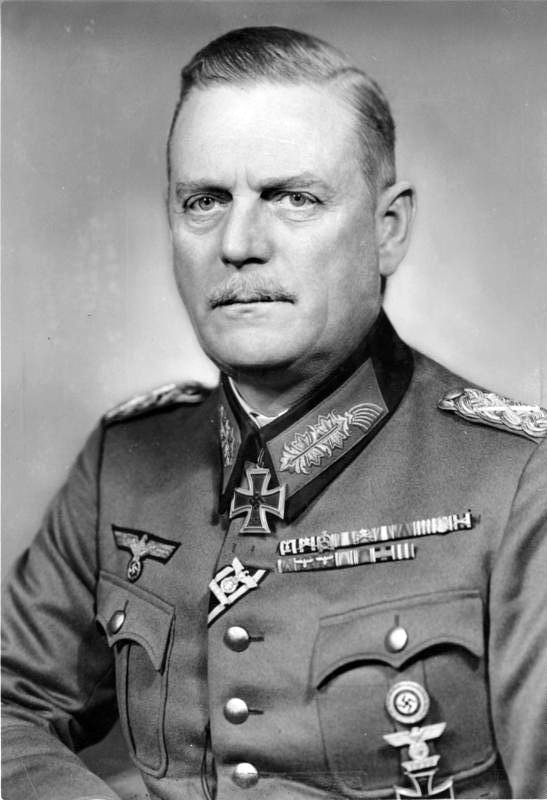
Wilhelm Keitel
 Germany
politician•military officer•military personnel
Birthday
+1882-09-22
Birth Sign
Virgo
Birthplace
Helmscherode
Age
Died at 64
About
Wilhelm Keitel, born in Helmscherode in 1882, became a prominent figure in Nazi Germany's military apparatus. He rose through the ranks to become a field marshal and, most significantly, served as the chief of the Oberkommando der Wehrmacht (OKW), the supreme command of the German armed forces. This position placed him at the heart of military decision-making throughout World War II. His career trajectory saw him head the Armed Forces Office at the Reich Ministry of War starting in 1935, eventually leading to his command of the OKW after Adolf Hitler reorganized the military structure in 1938. Within this role, Keitel was known for his unwavering loyalty to Hitler, often earning him the reputation among his peers as the dictator's compliant "yes-man."
Fame & Fandom
The legacy of Wilhelm Keitel stands apart from the adulation reserved for entertainers or athletes, rooted instead in the grim gravity of historical accountability. There is no organized fanbase, no designated fandom name, and no community of enthusiasts gathering to celebrate his life; rather, he remains a figure of serious historical study and legal cautionary tales. His presence in global consciousness is defined by the weight of his actions during the Third Reich and the subsequent judgment at Nuremberg, where he became an archetype for the failure of moral autonomy under authoritarian command. The absence of a formal fan culture reflects the nature of his notoriety: it is a somber remembrance of war crimes and the collapse of a regime, devoid of the rituals, inside jokes, or charitable drives that characterize modern celebrity worship. Recent coverage continues to reference his role in the unconditional surrender and the subsequent trials, confirming that his story serves as a cornerstone for discussions on global justice rather than pop-culture lore. iFANN has evaluated this profile through its Global Fame Engine, determining that Wilhelm Keitel does not currently hold a placement in the published rankings, including the Global Top 1,000 or any scope-specific lists. This status reflects the unique nature of his fame, which exists outside the metrics of commercial consumption or viral engagement. While he is a household name in military history textbooks and legal archives, he does not register within the dynamic scale of contemporary popularity that the rankings measure.
Interesting Facts and Legends
Wilhelm Keitel's career trajectory saw him rise from a provincial background to become the Chief of the Armed Forces High Command (OKW), placing him at the center of Nazi Germany's military machine. His unwavering loyalty to Adolf Hitler often overshadowed his own strategic decisions, leading to accusations that he acted merely as a conduit for the Führer's will. A widely retold and documented aspect of his legacy involves his testimony during the Nuremberg Trials in 1946, where he asserted he blindly obeyed orders despite being responsible for issuing criminal directives. One specific incident frequently cited in legal discussions is the "Reprisal Order" issued under his authority, which instructed that fifty Soviet citizens were to be executed for every one German soldier killed by partisans. This document served as primary evidence for his conviction on charges of war crimes and crimes against humanity. The most iconic moment universally referenced regarding Keitel is his signing of the unconditional surrender documents for Germany. On May 7, 1945, at Reims, France, and again on May 8, 1945, in Berlin-Karlshorst, Keitel signed the ratification of the German surrender to the Allied forces. These events marked the definitive end of World War II in Europe, capturing Keitel as a defeated figure signing papers while Allied generals looked on. He was found guilty by the International Military Tribunal on October 1, 1946, and subsequently hanged on October 16, 1946.
Death & Aftermath
Died
+1946-10-16 (aged 64)
Death Place
Nuremberg, Bavaria, Germany
Cause of Death
Execution by judicial hanging
Wilhelm Keitel spent his final days in a prison cell within the Nuremberg Palace of Justice, awaiting the verdict that would seal his fate as a convicted war criminal. The International Military Tribunal had just concluded its proceedings, rejecting his defense that he merely followed orders and finding him guilty of crimes against peace, war crimes, and crimes against humanity. On October 16, 1946, shortly after midnight, he was executed by hanging alongside Hermann Göring and ten other officials in a coordinated event that marked the end of the Third Reich's military leadership. Army Provost Marshal's office.
Public reaction remained devoid of tributes or vigils, as Allied powers and the German population viewed the execution as a necessary act of justice for his role in issuing the Commissar Order and the Night and Fog Decree. No funeral service took place, and his body was cremated at the Nuremberg Krematorium before his ashes were scattered in the Isar River near Munich to prevent any future veneration of his grave. Posthumously, Keitel has appeared in documentaries and books detailing the Nuremberg Trials, often serving as an archetype of blind obedience.
Awards & Accolades
Keywords
Quick Facts
- Profession
- politician, military officer, military personnel
- Born
- +1882-09-22
- Birthplace
- Helmscherode
- Died
- +1946-10-16
- Death Place
- Nuremberg
- Gender
- Male
- Birth Sign
- Virgo
Join the community
fans discussing