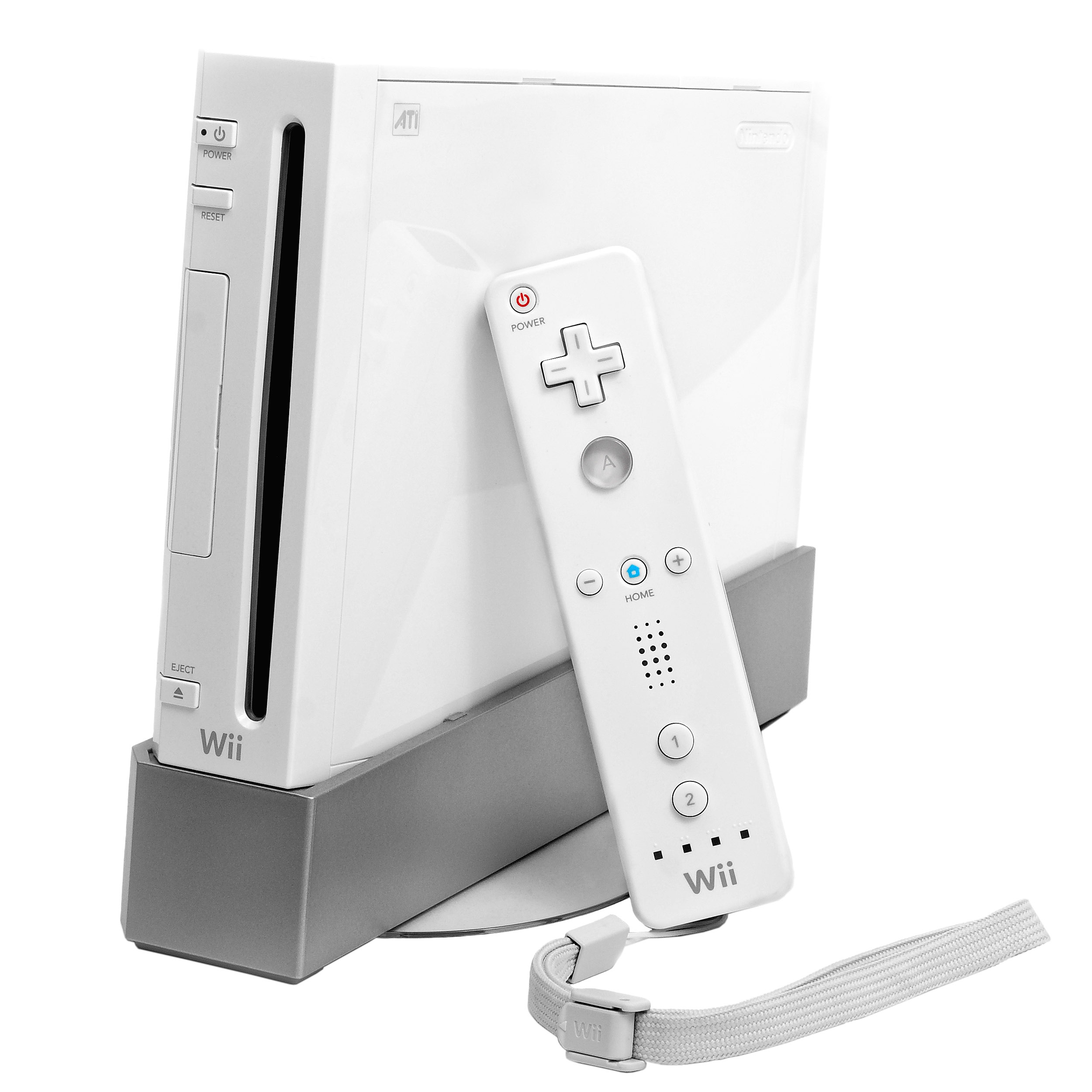
Overview
Released on November 19, 2006, in North America and worldwide the following December, the Wii stands as Nintendo's fifth major home console. It arrived during the seventh generation of video game hardware alongside the Xbox 360 and PlayStation 3, yet it took a radically different path. While competitors chased higher resolution and raw processing power, Nintendo President Satoru Iwata directed the team toward innovation that could reach non-gamers. The project began under the codename Revolution before Shigeru Miyamoto and Genyo Takeda finalized the design around the new motion-sensing controller.
The system featured built-in internet connectivity for the first time, enabling online multiplayer, downloads via the Wii Shop Channel, and wireless connections with the Nintendo DS. Early models carried backward compatibility with GameCube software and accessories, but later revisions like the RVL-101 Family Edition and the Wii Mini removed these features to cut costs. Production wrapped up in October 2013 for the original model, though the budget-friendly Mini version lingered briefly into 2014.
Nintendo's strategy paid off immediately. The console sold out rapidly in most markets due to overwhelming demand, driven largely by the bundled title Wii Sports. By the end of its lifecycle, lifetime sales reached 101 million units, making it the seventh best-selling console ever as of April 2026. This success pulled millions of new customers into the hobby, though the shift toward casual gaming eventually alienated some core fans. The subsequent Wii U failed to bridge that gap effectively, becoming Nintendo's worst-selling home console.
Gameplay
The defining feature of the Wii was its motion-sensing control scheme centered on the Wii Remote. This wireless device used accelerometers and an infrared sensor bar to track movement in three-dimensional space, allowing players to swing, point, and tilt the controller to interact with games. Users could aim at the screen like a laser pointer for menu navigation or shooting mechanics, creating a physical experience that felt natural rather than abstract.
Bundled with the console, Wii Sports demonstrated this technology through five accessible simulations: tennis, baseball, bowling, golf, and boxing. The philosophy behind this design was explicitly stated by Miyamoto, who compared the inclusivity of gaming to reading society does not distinguish between book readers and non-readers, so neither should gaming. Additional accessories expanded these capabilities, including the Wii Balance Board for fitness titles like Wii Fit, the Classic Controller Pro for traditional button inputs, and the Wii Zapper for light-gun shooters.
While the Balance Board became a cultural phenomenon, it also generated mixed reactions among owners alongside other peripherals. The Classic Controller Pro found wider acceptance for playing Virtual Console games and certain third-party titles that required standard button layouts. Online play was supported through the Wii Connect 24 service, offering limited communication and gameplay options compared to rival ecosystems.
Story
As a hardware platform rather than a single software title, the Wii does not possess a unified story or plot synopsis. Its narrative impact comes from the diverse library of games it hosted, ranging from first-party franchises like Super Mario Galaxy, The Legend of Zelda: Twilight Princess, and Metroid Prime 3: Corruption to third-party adaptations. The "story" of the Wii is largely defined by the social interactions and experiences facilitated by its multiplayer-focused design, which turned living rooms into communal gaming spaces.
Keywords
Sources
Game Info
- Developer
- Nintendo
- Publisher
- Nintendo
- Release Date
- 2006-11-19
- Modes
- Single-player, Multiplayer, Local Multiplayer
- Platforms
- Wii
- Lifetime Sales
- 101 million units
- Codename
- Revolution
- Predecessor
- GameCube
- Successor
- Wii U
- Launch Price
- $249.99
- Production End
- October 2013
- Shop Channel Closure
- 2019
Join the community
fans discussing