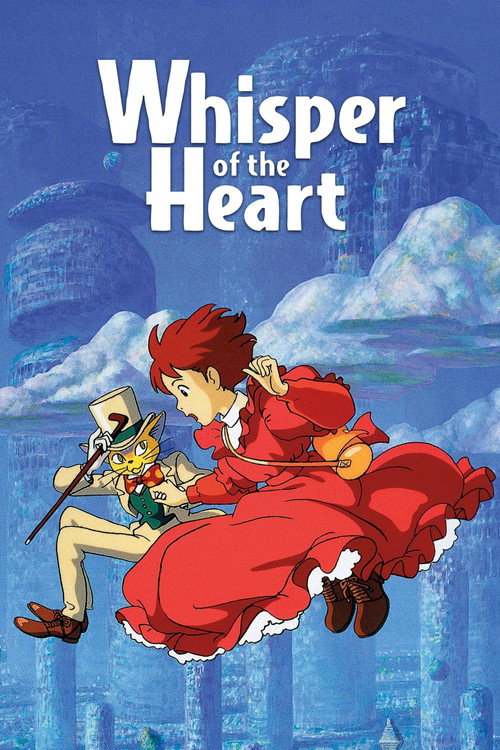
 Japan
Japan“The film is a sweet, unassuming valentine to the creative spirit, and it finds its magic in the smallest, most human moments.”
Janet Maslin
The New York Times
Shizuku Tsukishima is a 14-year-old girl in suburban Tokyo who spends more time reading and writing song lyrics than studying for her exams. Her days follow a familiar rhythm until she notices a curious pattern: every library book she borrows has been checked out before her by someone named Seiji Amasawa. This small mystery nudges her off her usual path, leading her to a hidden antique shop with a cat statue in the window, an elderly violin restorer, and eventually to Seiji himself, a boy her age who already knows exactly what he wants to do with his life.
Directed by Yoshifumi Kondo, the only feature he completed before his death in 1998, the film is a quiet, realistic coming-of-age story that trades the fantasy elements typical of Studio Ghibli for a grounded exploration of creativity, self-doubt, and first love. Hayao Miyazaki wrote the screenplay and storyboarded key sequences, particularly the fantasy vignettes featuring the Baron cat statue. Released in 1995, the film earned ¥3.15 billion at the Japanese box office and holds a 7.9 rating on IMDb. It remains one of Ghibli's most intimate works, often cited by fans as a favorite for its honest depiction of the creative process.
Stream
Max
Rent
Amazon Prime Video
$3.99
Availability and pricing can change. Confirm on the provider's site before purchasing.
Shizuku Tsukishima lives with her parents and older sister Shiho in a quiet suburb of Tokyo. Her father works at a library, her mother is completing a graduate degree, and Shizuku herself is in her final year of junior high school, where she is known more for daydreaming than for academic diligence. She fills her notebooks with song lyrics and devours novels, but she has no clear idea what she wants to do after graduation.
One summer day, she notices that every library book she has borrowed was previously checked out by the same name: Seiji Amasawa. This coincidence sparks her curiosity, but she soon gets distracted by her family cat, Moon, who has a habit of riding the train alone. Following Moon one afternoon, Shizuku finds herself in an unfamiliar neighborhood where she discovers a small antique shop with a cat figurine in the window. She nicknames the statue the Baron and enters the shop, where she meets Shiro Nishi, an elderly man who restores violins and clocks.
Mr. Nishi shows her a beautiful antique clock and tells her about the craftsmanship behind it. Shizuku is enchanted. She later learns that the mysterious Seiji Amasawa is Mr. Nishi's grandson, a boy her age who is already apprenticing with a violin maker in Italy. When Seiji returns to Japan for a visit, he and Shizuku meet in person. He is blunt, confident, and dismissive of her aimlessness, which stings but also pushes her to examine her own life.
Determined to prove to herself that she can commit to something, Shizuku decides to write a novel. She chooses as her subject the Baron cat statue, imagining a fantasy tale about his search for his lost love. She throws herself into the project with obsessive energy, staying up late, neglecting her schoolwork, and covering her desk with crumpled drafts. Her grades slip, her parents worry, and her best friend Yuko struggles with her own romantic problems, creating tension in their friendship. Shizuku begins to wonder if she has taken on more than she can handle, but she keeps writing, driven by a need to see the story through. The film traces her journey through the messy, exhausting, and ultimately rewarding process of making something from nothing, all while her feelings for Seiji deepen through letters and shared dreams about the future.
4K Remaster Official Trailer [Dubbed]
Ghibli Fest 2024 Trailer
Studio Ghibli Fest 2019 Trailer
Critical Consensus
A gentle, heartfelt coming-of-age story that captures the anxieties and joys of adolescence with remarkable sensitivity. While it lacks the fantastical elements of other Ghibli films, its emotional honesty and beautiful animation make it a quietly essential entry in the studio's catalog.
“The film is a sweet, unassuming valentine to the creative spirit, and it finds its magic in the smallest, most human moments.”
Janet Maslin
The New York Times
“This is a film that understands the heart of a young girl, and it treats her dreams with the respect they deserve. It is a quiet masterpiece.”
Roger Ebert
Chicago Sun-Times
“A tender and achingly sincere portrait of artistic awakening, 'Whisper of the Heart' is Studio Ghibli's most intimate film, and one of its most profound.”
David Ehrlich
IndieWire
“This is a film about the terror and joy of finding your purpose, and it handles that universal theme with a grace that few movies ever achieve.”
Peter Bradshaw
The Guardian
“A beautifully observed slice of life that captures the emotional turbulence of adolescence with a gentle, knowing touch. The animation is exquisite.”
Todd McCarthy
Variety
Yoko Honna
Shizuku Tsukishima (voice)
Issey Takahashi
Seiji Amasawa (voice)
Takashi Tachibana
Seiya Tsukishima (voice)
Director
Yoshifumi Kondo
Writers
Hayao Miyazaki, Aoi Hiiragi
Composer
Yuji Nomi
Cinematographer
Atsushi Okui
Producer
Toshio Suzuki
Mainichi Film Awards (1995)
Best Animation Film: Won
Japan Academy Prize (1996)
Best Music: Nominated
Tokyo International Anime Fair (1996)
Best Film: Won
Kinema Junpo Awards (1996)
Best Film (Readers' Choice): Won
Animage Anime Grand Prix (1996)
Best Film: Won
Join the community
fans discussing