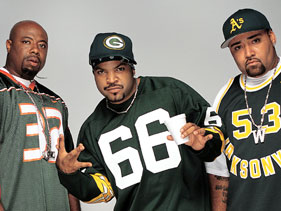
Westside Connection
3
Members
About
Westside Connection was conceived by Ice Cube in 1994 as a vehicle to assert West Coast hip-hop dominance. Ice Cube recruited WC, who had gained recognition with WC and the Maad Circle, and Mack 10, a rising solo artist from Inglewood. The trio shared a common background in Los Angeles street culture and a desire to counter the East Coast's commercial and critical prominence. Their chemistry was immediate, fueled by mutual respect and a shared aggressive delivery.
The group's debut album, Bow Down, arrived on October 8, 1996, via Priority Records. It debuted at number 2 on the Billboard 200, selling over 150,000 copies in its first week. The title track became an anthem, with its confrontational lyrics and G-funk production. The album was certified Platinum by the RIAA on December 10, 1996, and spawned the hit single "Gangstas Make the World Go Round." Westside Connection's success solidified the West Coast sound in a period marked by regional tension.
After a seven-year hiatus, the group returned with Terrorist Threats in 2003. The album featured a more polished production and included the single "Gangsta Nation" featuring Nate Dogg, which peaked at number 33 on the Billboard Hot 100. Despite moderate chart success, internal conflicts over finances and creative direction led to Mack 10's departure in 2005, effectively ending the group. Ice Cube and WC have occasionally performed together since, but Westside Connection has not reunited.
Formation Story
Ice Cube envisioned a supergroup that could channel the raw energy of West Coast rap into a unified front. He approached WC, whom he had collaborated with on the 1994 track "West Up!" from the Sunset Park soundtrack, and Mack 10, who had impressed Cube with his debut single "Foe Life." The three met informally at Cube's recording studio in Los Angeles, where they quickly developed a rapport. No formal auditions or training periods existed; the group formed organically through existing industry connections. Their debut single "Bow Down" was recorded in early 1996 and released that summer, building anticipation for the album.
Members


Musical Style
Westside Connection's sound was firmly rooted in West Coast G-funk, characterized by synthesizer melodies, deep basslines, and funk samples. Their lyrics were confrontational, often targeting East Coast rivals and celebrating gangsta lifestyle. On Bow Down, production by Ice Cube, Bud'da, and others emphasized hard-hitting drums and melodic hooks. By Terrorist Threats, the group incorporated harder drums and more contemporary production, reflecting the early 2000s shift in hip-hop. Lyrically, the album expanded to include commentary on post-9/11 America and street politics, though the core themes of aggression and regional pride remained.
Discography
| Title | Year |
|---|---|
| Terrorist Threats | 2003 |
| Bow Down | 1996 |
Cultural Impact
Westside Connection became a symbol of West Coast unity during the East Coast-West Coast feud. Their debut album's title track was interpreted as a direct challenge to East Coast artists, particularly The Notorious B.I.G., and helped galvanize the West Coast fanbase. The group's commercial success demonstrated that West Coast rap could compete on a national scale. Their music was featured in films like The Players Club (1998) and video games like Need for Speed: Underground, extending their reach beyond hip-hop audiences. While they did not achieve lasting mainstream crossover, their influence on subsequent West Coast collectives is acknowledged.
Fandom Culture
Westside Connection did not cultivate an official fandom with a name, lightstick, or color. Their audience was drawn from the established fan bases of Ice Cube, WC, and Mack 10. Fans often identified with the group's defiant West Coast pride and gangsta imagery. No notable fan traditions or projects are documented, as the group's active period predated the social media era.
Awards & Accolades
View 2 records, honours and achievementsMilestones
Debut album 'Bow Down' peaks at #2 on Billboard 200 and is certified Platinum.
Second album 'Terrorist Threats' released, peaks at #16 on Billboard 200.
Group disbands after Mack 10 departs due to conflicts.
Trivia
The group's name directly references the Westside of Los Angeles, particularly South Central and Compton. The song "Bow Down" was initially a solo Ice Cube track before becoming a group effort. WC and Mack 10 appeared in Ice Cube's 1997 film The Players Club as characters. Terrorist Threats faced multiple delays due to label issues and internal conflicts. Despite their on-record rivalry with East Coast artists, Ice Cube later reconciled with many of them, and the group's breakup stemmed from internal disputes over credit and money.
Keywords
Quick Facts
- Formed
- 1994
- Origin
- Los Angeles
- Label
- Priority Records
- Genres
- West Coast hip-hop, gangsta rap, hardcore hip-hop, G-funk
- Status
- Disbanded
Group Info
- Formed
- 1994
- Debut
- 1996-10-08
- Debut Song
- Bow Down
- Origin
- Los Angeles, California
- Company
- Cube Vision
- Label
- Priority Records
- Status
- Disbanded (2005)
Join the community
fans discussing