 India
India“Spielberg has made a movie that is beautiful to look at and deeply moving, even if it sometimes feels like a collection of set pieces rather than a cohesive whole.”
A.O. Scott
The New York Times
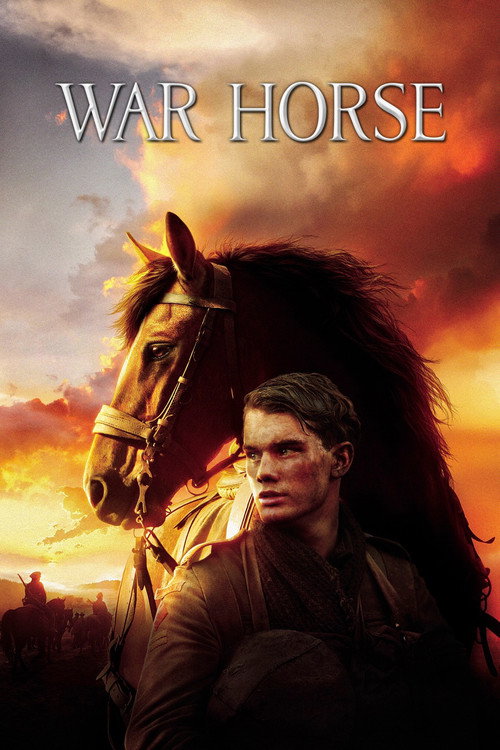
Steven Spielberg adapts Michael Morpurgo's novel into a sweeping drama set against the devastation of World War I. The film follows Albert Narracott, played by Jeremy Irvine, who forms an unbreakable bond with a spirited horse named Joey before his father sells the animal to the British Cavalry. With a budget of $66 million and a runtime stretching over two hours and twenty-five minutes, the production delivers a visually stunning experience that balances intimate farm life with the chaos of trench warfare.
The narrative shifts focus from the English countryside to the muddy fields of France, tracking Joey as he passes through the hands of various owners including German soldiers and French civilians. Each chapter highlights the shared humanity between enemies while depicting the brutal reality of modern combat. John Williams provides a soaring score that underscores the emotional weight of the story without overpowering the visual storytelling.
Availability and pricing can change. Confirm on the provider's site before purchasing.
Set in rural Devon on the eve of World War I, the story introduces Albert Narracott, a quiet teenager living on a struggling farm with his parents Ted and Rose. Albert spends his days working alongside a spirited bay Irish Hunter horse named Joey, whom he names after the sound it makes. Their relationship deepens through shared labor and mutual trust, creating a foundation of loyalty that defines the boy's character. Life changes abruptly when Ted Narracott, plagued by alcoholism and mounting debt, makes a desperate decision at a local auction. He sells Joey to Major Jamie Stewart for the British Army Cavalry, leaving Albert heartbroken and vowing to find his friend again.
Joey is immediately thrust into the chaos of war as he is deployed to France. The film documents his harrowing journey through the Western Front, where he serves under Major Stewart before being separated during a chaotic battle. Captured by German forces, Joey endures the horrors of trench warfare alongside a young soldier named Gunther. Their time together reveals a shared humanity amidst the carnage, as they care for one another despite being on opposing sides. Later, Joey falls into the hands of a French couple, Emile and his granddaughter Emilie, who treat him with kindness until German troops raid their home and seize the horse once more.
Throughout these trials, Albert refuses to accept that Joey is lost forever. He enlists in the army, driven by the singular goal of finding his friend. His journey takes him from the muddy trenches of the Somme to the front lines, where he witnesses the devastation of modern warfare firsthand. The narrative intercuts between Albert's desperate search and Joey's odyssey across the battlefield. A particularly tense sequence involves Joey becoming trapped in No Man's Land during a heavy artillery barrage, surrounded by barbed wire and shelling. This scene serves as the emotional climax of the middle act, raising the stakes for Albert's quest. As Albert moves closer to the front, he encounters other soldiers who have known Joey, including the cynical Captain James Nicholls and the gentle Lieutenant Charlie Waverly. Each encounter reinforces the idea that Joey is not just a war animal, but a symbol of hope and loyalty that transcends the conflict. The film builds toward a convergence of paths, with Albert and Joey moving inexorably toward each other against the backdrop of the Great War's final days.
War Horse (2011) Theatrical Trailer 2
War Horse (2011) Theatrical Trailer
Critical Consensus
While some critics found the pacing slow and the sentimentality heavy-handed, War Horse is widely praised for its technical achievements, particularly the puppetry of the horses and John Williams' score. It stands as a visually magnificent, emotionally resonant tribute to the animals of WWI, even if the human drama occasionally feels secondary to the spectacle.
“Spielberg has made a movie that is beautiful to look at and deeply moving, even if it sometimes feels like a collection of set pieces rather than a cohesive whole.”
A.O. Scott
The New York Times
“War Horse is a visual masterpiece... The horses are so real you can smell the hay and feel the dirt. It's a triumph of imagination and technology.”
Peter Travers
Rolling Stone
“A grand, sweeping epic that captures the horror of war and the beauty of the natural world with equal measure. Spielberg is in top form.”
Todd McCarthy
The Hollywood Reporter
“The film's greatest strength lies in its portrayal of the bond between boy and horse, a relationship that feels authentic and deeply touching.”
David Rooney
The Hollywood Reporter
“A visually stunning but emotionally manipulative film that relies too heavily on its score to carry the weight of its story.”
Mark Kermode
The Guardian
Jeremy Irvine
Albert Narracott
Peter Mullan
Ted Narracott
Emily Watson
Rose Narracott
Niels Arestrup
Grandfather
David Thewlis
Lyons
Tom Hiddleston
Capt. James Nicholls
Benedict Cumberbatch
Maj. Jamie Stewart
Céline Buckens
Emilie
Toby Kebbell
Geordie Soldier
Patrick Kennedy
Lt. Charlie Waverly
Leonard Carow
Michael
David Kross
Gunther
Liam Cunningham
Captain Mitchell
Robert Atkinson
Corporal
Ned Dennehy
Private
Director
Steven Spielberg
Writers
Lee Hall, Richard Curtis, Michael Morpurgo
Composer
John Williams
Cinematographer
Janusz Kamiński
Producers
Steven Spielberg, Kathleen Kennedy
Academy Awards (2012)
Best Cinematography: Nominated
Academy Awards (2012)
Best Sound Mixing: Nominated
Academy Awards (2012)
Best Sound Editing: Nominated
Academy Awards (2012)
Best Original Score: Nominated
Academy Awards (2012)
Best Art Direction: Nominated
Golden Globe Awards (2012)
Best Motion Picture – Drama: Nominated
Golden Globe Awards (2012)
Best Director: Nominated
BAFTA Awards (2012)
Best Film: Nominated
Critics' Choice Movie Awards (2012)
Best Song: Won
Join the community
fans discussing