“A movie of such intense, almost unbearable power that it leaves you shaken long after the credits roll. It is a horror film without monsters, only men.”
Roger Ebert
Chicago Sun-Times
 United States
"A teacher enters the outback and finds hell waiting for him."
It begins with a coin toss. A schoolteacher named John Grant, posted to a one-room schoolhouse in the dust-choked town of Tiboonda, flips a penny to decide whether to spend his Christmas holiday drinking in Sydney or staying put. The coin sends him to the city. He never makes it. Grant's train stops in the mining town of Bundanyabba, a place the locals call The Yabba, and within twenty-four hours he has lost his entire paycheck in a backroom poker game, missed his connection, and become the property of a town that treats hospitality like a trap.
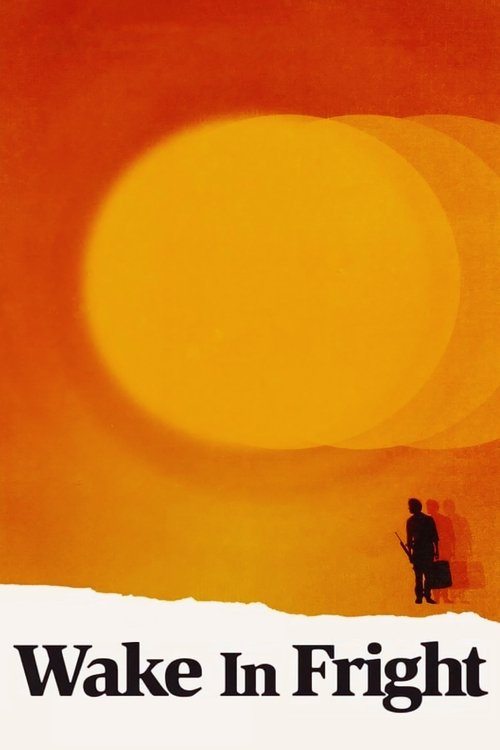
Directed by Canadian-born Ted Kotcheff and released in Australia in July 1971, Wake in Fright is not a horror film in any conventional sense. There are no monsters, no ghosts, no supernatural menace. What it has instead is heat, beer, and a code of mateship pushed until it curdles into something predatory. The film was adapted by Evan Jones from Kenneth Cook's 1961 novel Out of Step, and it stars Gary Bond as Grant, a man whose education and refinement mean nothing in a place that measures worth in how much you can drink without falling down.
The film flopped on release, then vanished for decades. The original negative was lost, and for roughly thirty years the only surviving prints were muddy, faded copies that made the outback look like a washed-out postcard. A restoration in the 2000s brought it back, and a 4K remaster followed, allowing audiences to see what Kotcheff and cinematographer Brian West actually shot: a landscape so bright and flat it feels like an interrogation room. The critical reassessment has been near-unanimous. What was once dismissed as an ugly little film about drunks is now ranked among the essential works of Australian cinema, a portrait of national character that the country spent years pretending not to recognize.
Availability and pricing can change. Confirm on the provider's site before purchasing.
John Grant teaches in Tiboonda, a town so small the train stops there only when someone flags it down. He is a Sydney man, educated, soft-handed, and he hates the outback with a quiet, polite fury. When the school term ends, he plans to travel to Sydney to see his girlfriend. A coin toss decides whether he goes by train through the mining town of Bundanyabba or takes a different route. The coin sends him to The Yabba, and that is where the trap closes.
The Yabba is a mining town built on heat and beer. The first man Grant meets is Jock Crawford, a local policeman who buys him a drink and refuses to let him pay. One drink becomes six. The pub is loud, airless, and full of men who treat drinking as a civic duty. Grant, trying to be polite, matches them. He does not yet understand that politeness is the hook. By nightfall he is drunk, and Jock has steered him toward a backroom gambling den where men play two-up, a coin-tossing game that looks simple and is not.
Grant watches for a while, then bets. He wins. He bets again. He wins again. The men around him cheer, and the cheering feels like friendship. He puts his entire paycheck on the table. He loses. Just like that, the money for his train ticket and his Sydney holiday is gone, and so is any easy way out of The Yabba. The next train does not come for days. He has no cash, no car, and no one to call.
What follows is a slow, methodical dismantling. Grant tries to leave, hitchhiking on the highway that runs past town, but the road is a strip of blacktop through nothing, and the heat is punishing. He returns. He meets Doc Tydon, a disgraced physician who lives in a filthy house on the edge of town and drinks from morning until night. Doc is intelligent and articulate, and that makes him worse than the others. He sees exactly what is happening to Grant and does nothing to stop it. He offers Grant a place to sleep, then drinks him under the table.
The town keeps Grant moving from one bar to the next, one house to the next. He meets Tim Hynes, a local businessman, and Tim's wife Janette, who looks at Grant with a hunger that has nothing to do with affection. He meets Dick, a loud, grinning man who treats Grant like a new toy. Dick is the one who suggests the kangaroo hunt. It is a local tradition, he says. A way to make a bit of money. Grant, broke and exhausted, agrees.
The hunt is the film's centerpiece and its most notorious sequence. A group of men drive out into the dark with rifles and spotlights. They drink as they drive. When they find kangaroos, they shoot, and they keep shooting, and the killing goes on far longer than any hunt should. The animals are not dispatched cleanly. The men are not hunters; they are a mob with guns. Grant tries to keep up, fires his rifle, and at some point crosses a line he cannot uncross. The sequence was assembled from real footage shot on a culling operation, and the actors were placed into it. The result is not staged violence. It is violence, captured.
After the hunt, Grant is barely holding together. He has been awake for days, has drunk enough to poison a horse, and has participated in something that has stripped away the last of his self-respect. He begins to hallucinate. The faces around him blur. The heat does not let up, even at night. He thinks about killing himself, and the film does not treat this as melodrama. It treats it as a logical conclusion. The Yabba has taken his money, his dignity, and his sense of who he is. What is left is a man trying to remember why he wanted to leave in the first place.
Official Arrow Trailer
Original Trailer
Official Restoration Trailer
Critical Consensus
A suffocating portrait of the Australian outback as a psychological trap, Wake in Fright holds up as one of the most unsettling films ever made about a man losing himself. Critics praise Kotcheff's unflinching direction and Gary Bond's fraying performance, while audiences respond to its raw, documentary-like power. Few films capture heat and despair this precisely.
“A movie of such intense, almost unbearable power that it leaves you shaken long after the credits roll. It is a horror film without monsters, only men.”
Roger Ebert
Chicago Sun-Times
“Kotcheff's direction is relentless, creating a claustrophobic nightmare that feels more real than any supernatural terror. A landmark of Australian film history.”
Peter Bradshaw
The Guardian
“Brutal, beautiful, and utterly devastating. This is a film that does not flinch from the ugliness of the human condition, making it a necessary watch for anyone interested in serious cinema.”
Pauline Kael
Variety
“A film that haunts the viewer with its depiction of the Australian psyche, blending naturalism with surreal horror in a way that few directors have ever achieved.”
A.O. Scott
IndieWire
Donald Pleasence
Doc Tydon
Gary Bond
John Grant
Chips Rafferty
Jock Crawford
Sylvia Kay
Janette Hynes
Jack Thompson
Dick
Peter Whittle
Joe
Al Thomas
Tim Hynes
John Meillon
Charlie
Director
Ted Kotcheff
Writers
Evan Jones, Kenneth Cook
Composer
John Scott
Cinematographer
Brian West
Producer
George Willoughby
Cannes Film Festival (1971)
Best Director: Won
Sydney Film Festival (1971)
Audience Award: Won
Australian Film Institute Awards (1972)
Best Film: Nominated
Australian Film Institute Awards (1972)
Best Director: Nominated
Australian Film Institute Awards (1972)
Best Actor: Nominated
National Film Registry (2020)
Cultural Preservation: Inducted
Join the community
fans discussing