
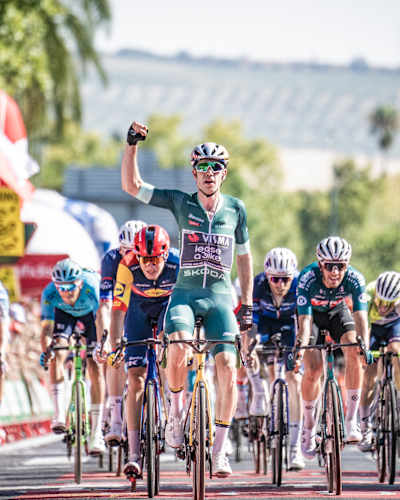
Vuelta a España
 Spain
Spain"Spain's Grand Tour of cycling, a three-week test of endurance through dramatic landscapes."
7+
Editions
About
The Vuelta a España is one of professional cycling's three Grand Tours, alongside the Tour de France and Giro d'Italia. It is an annual multi-stage road race that traverses Spain and occasionally neighboring countries, covering roughly 3,000 to 3,500 kilometers over 21 stages. The event typically runs from late August to mid-September, serving as the final Grand Tour of the season. Its routes are famous for steep, punishing mountain climbs like the Alto de l'Angliru and Lagos de Covadonga, which often decide the general classification. The race's leader wears the maillot rojo, a red jersey introduced in 2010 that has become an iconic symbol. The Vuelta attracts the world's top cycling teams and riders, and its winner earns a place among the sport's elite. Beyond competition, the race showcases Spain's diverse geography, from coastal roads to high mountain passes, drawing large roadside crowds and global television audiences. It has grown from a modest newspaper promotion in 1935 into a major international sporting event, now organized by Unipublic, a subsidiary of the Tour de France's owner ASO.
History
The Vuelta was born in 1935, the brainchild of former cyclist Clemente López Dóriga and editor Juan Pujol at the Madrid sports newspaper Informaciones. They wanted to boost circulation by creating a Spanish version of the Tour de France. The first edition featured 14 stages covering about 3,425 kilometers, starting and ending in Madrid. Belgian rider Gustaaf Deloor won that inaugural race and repeated the feat in 1936. Then the Spanish Civil War and World War II forced a hiatus until 1941, and even after that the race was not held every year until 1955, when it became an annual fixture. The early post-war editions were dominated by Spanish riders like Julián Berrendero and Delio Rodríguez, who still holds the record for most stage wins with 39. The Vuelta originally took place in spring, but in 1995 the organizers shifted it to late summer, giving it a distinct identity as the season's final Grand Tour. That change, along with internationalization efforts like foreign starts in Portugal and France, boosted its global profile. In 1979, the race came under the management of Unipublic, and since 2014 Unipublic has been part of the Amaury Sport Organisation (ASO), which also owns the Tour de France. This connection has integrated the Vuelta into a broader media and commercial network, increasing its reach and prestige.
Notable Editions
1935: First Vuelta a España
Inaugural edition; 14 stages; Belgian Gustaaf Deloor wins.
1955: Annual fixture begins
Start of uninterrupted annual editions; race becomes firmly established.
1995: Move to September
Calendar shift from spring to late summer; enhances role as final Grand Tour.
2012: Crisis-era spectacle
Route packed with steep climbs like Cuitu Negru and Bola del Mundo; designed to boost national morale during economic crisis.
2017: French start
Grand Départ in Nîmes, France; 3,324 km route with multiple mountain finishes.
Past Champions
| Year | Name |
|---|---|
| 1935 | Gustaaf Deloor |
| 1936 | Gustaaf Deloor |
| 1941 | Julián Berrendero |
| 1942 | Julián Berrendero |
| 1955 | Jean Dotto |
| 1961 | Angelino Soler |
| 1992 | Tony Rominger |
| 1993 | Tony Rominger |
| 1994 | Tony Rominger |
| 2000 | Roberto Heras |
Notable Moments
1935
First edition
Gustaaf Deloor wins the inaugural Vuelta a España, a 14-stage race covering 3,425 km.
1961
Youngest winner
Angelino Soler wins at age 21, still the youngest champion in Vuelta history.
1995
Calendar change
The Vuelta moves from spring to late summer, becoming the final Grand Tour of the season.
1999
Angliru debut
The Alto de l'Angliru, one of cycling's hardest climbs, is first used; José María Jiménez wins the stage.
2012
Economic crisis route
Organizers design an exceptionally tough mountain route to boost national morale during Spain's financial crisis.
2014
ASO takeover
Unipublic becomes part of the Amaury Sport Organisation, integrating the Vuelta with the Tour de France's structure.
2017
French Grand Départ
The race starts in Nîmes, France, for the first time, highlighting its international reach.
2023
Roglič ties record
Primož Roglič wins his fourth Vuelta, equaling Roberto Heras' record for most overall victories.
Cultural Impact
The Vuelta a España is woven into Spain's cultural fabric. It showcases the country's diverse regions, from the Basque Country's green hills to Andalusia's sun-baked roads, promoting tourism and local pride. The race's iconic climbs, like the Angliru and Covadonga, have become almost mythical among cycling fans, representing the ultimate test of endurance. As the final Grand Tour of the season, the Vuelta often delivers dramatic, unpredictable racing, with riders who faltered in the Tour de France seeking redemption. This narrative has made it a favorite among cycling enthusiasts. The Vuelta has also inspired books, documentaries, and extensive media coverage, cementing its place as a cornerstone of Spanish sporting identity and a key event on the global cycling calendar.
Controversies
The Vuelta has faced its share of controversies. The most significant interruption came from 1937 to 1940, when the Spanish Civil War forced the race to be canceled. Doping scandals have also touched the event, as they have many professional cycling races, though specific high-profile cases are less documented in the available sources. In 2012, the route's extreme difficulty was criticized by some as a cynical attempt to distract from Spain's economic hardship, though others saw it as a welcome morale boost. The 1995 calendar shift initially sparked debate about the race's identity, but it ultimately strengthened the Vuelta's position as the season's climactic Grand Tour.
Broadcast Partners
Sponsors
Related Events
Keywords
Sources
Event Info
- Sport
- Cycling
- Frequency
- Annual
- Founded
- +1935
- Country
- Spain
- Organizer
- Unipublic
- Founded
- 1935
- Most wins
- Roberto Heras (4) and Primož Roglič (4)
- Most stage wins
- Delio Rodríguez (39)
Join the community
fans discussing