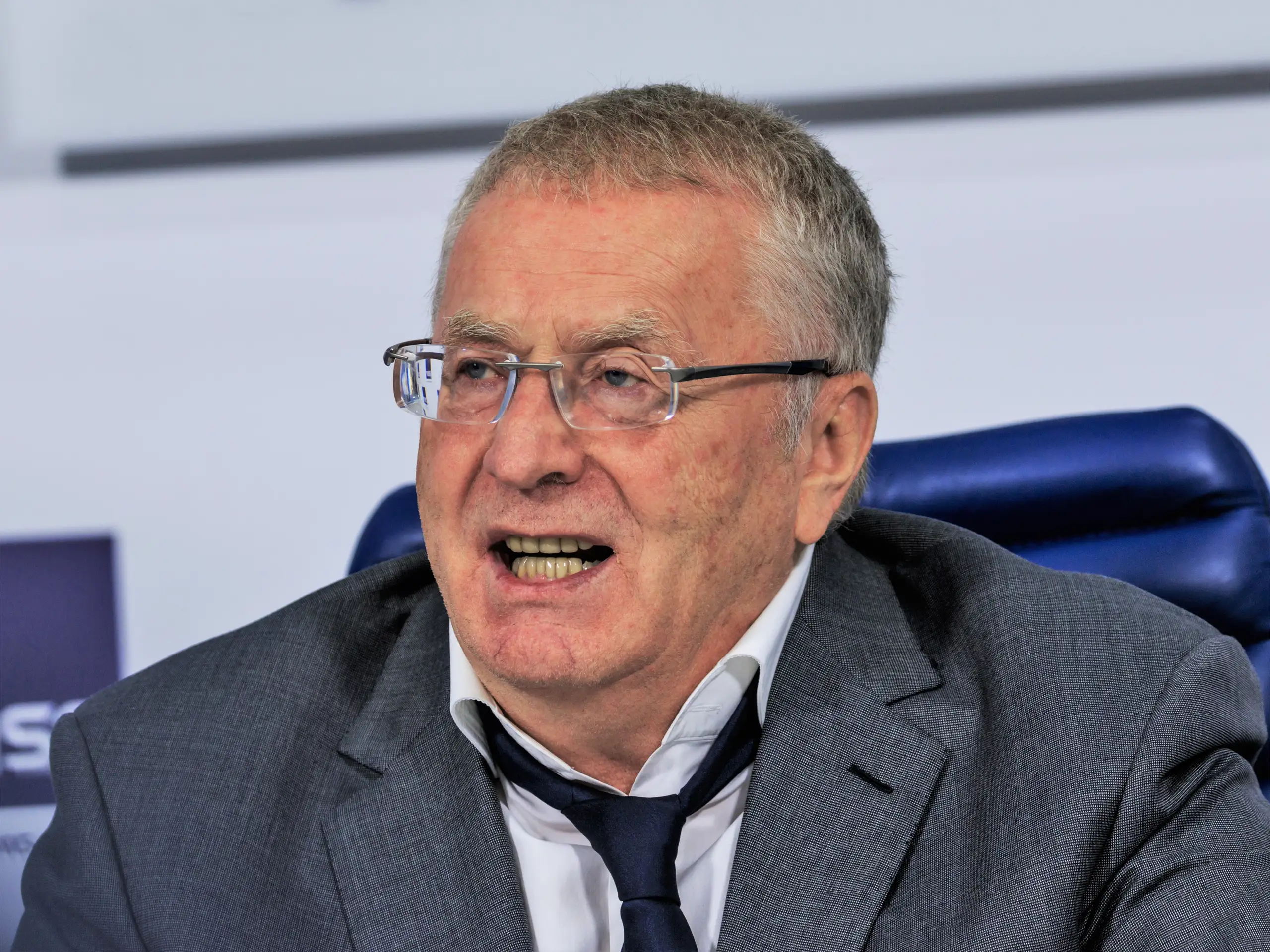
Vladimir Zhirinovsky
 Russia
politician•lawyer•military personnel
Also known as: Vladimir Volfovich Eidelstein, Vladimir Eidelstein, Zhirinovsky, Vladimir V. Zhirinovsky
Birthday
April 25, 1946
Birth Sign
Sagittarius
Birthplace
Almaty, Kazakhstan
Age
Died at 75
Height
5 ft 10 in (178 cm)
About
Vladimir Volfovich Zhirinovsky was a Russian politician, lawyer, and former military officer who served as the founder and long-time leader of the Liberal Democratic Party of Russia. Born Vladimir Volfovich Eidelstein in Almaty, he built a career defined by ultranationalist rhetoric and theatrical provocation. He held the position of Deputy Chairman of the State Duma for extended periods and ran for the presidency of Russia multiple times, becoming a polarizing fixture in Russian politics often described by Western media as a "clownish provocateur" or a "mock opponent" to Vladimir Putin. His legacy includes a unique blend of political influence and cultural mythologization, with posthumous tributes ranging from naval liners to limited edition luxury items. He remains a significant figure in the history of modern Russian politics, known for his fiery speeches and controversial foreign policy proposals.
Early Life & Background
Vladimir Volfovich Eidelstein entered the world on April 25, 1946, in Almaty, then part of the Kazakh Soviet Socialist Republic. His early life was shaped by the frequent relocations of his father, Volodymyr Eidelstein, a Jewish Soviet diplomat, and his mother, Nina Zhirinovskaya, a Russian teacher. The family lived in various locations including Iraq and Syria before returning to the Soviet Union. This mobile upbringing exposed the young Eidelstein to different cultures and languages, laying the groundwork for his future linguistic abilities. He pursued higher education in Moscow, focusing on languages and literature. Between 1964 and 1970, he studied Turkish language and literature at the Institute of Oriental Studies. In 1972, he enrolled in the Law Faculty at Leningrad State University, graduating in 1977. Before entering full-time politics, he worked as a lawyer and researcher, publishing books on international law and foreign policy, which established his credentials as a legal expert and thinker.
Career Growth
Zhirinovsky's political ascent began in the late 1980s during the era of *glasnost*, where his fiery speeches and nationalist views quickly garnered attention. In 1989, he co-founded the Liberal Democratic Party of Russia (LDPR), officially registering it in 1991. He became its undisputed leader, guiding the party through decades of Russian political turbulence. His first major electoral test came in 1993 when he was elected to the State Duma, serving as Deputy Chairman from 1993 to 2000. He ran for President of Russia four times, finishing fourth in 1996 with roughly 7% of the vote, fifth in 2000 with 5.8%, third in 2007 with 9.3%, and sixth in 2012 with 6.2%. Despite never winning the presidency, his repeated campaigns solidified his status as a constant presence in Russian elections. He returned to the State Duma in 2003 and again in 2011, retaining the role of Deputy Chairman until his death. Throughout his career, he was a delegate to the Parliamentary Assembly of the Council of Europe from 1996 to 2008, known for making wild claims about Russian foreign policy and advocating for aggressive territorial expansion. He received the Order "For Merit to the Fatherland" in the 4th class in 2006, the 3rd class in 2010, and the 2nd class in 2016, alongside the Order of Alexander Nevsky in 2015.
Career Timeline
Public Image & Style
Zhirinovsky cultivated a public persona characterized by flamboyant suits, loud voices, and confrontational behavior. He was often described as a "clownish provocateur" due to his theatrical outbursts in parliament, which included shouting, throwing papers, and physically confronting colleagues. His style blended ultranationalist ideology with performance art, creating a unique brand that attracted both genuine supporters and those who found his antics entertaining. Media coverage frequently highlighted his controversial statements and aggressive demeanor, cementing his reputation as a polarizing figure who refused to adhere to traditional diplomatic norms. One notable proposal involved moving the capital of Russia from Moscow to Novosibirsk, a suggestion that sparked debate despite being partly joking. His ability to act as a "safe" outlet for nationalist sentiment while tolerating Kremlin oversight defined his unique political niche.
Fame & Fandom (iFAMOUS Rankings)
Vladimir Zhirinovsky never cultivated a traditional fanbase with a unified name or ritualistic adoration. His supporters were primarily constituents of the Liberal Democratic Party of Russia, bound by political loyalty rather than the idolization typical of celebrity culture. The movement functioned as a political machine driven by his theatrical aggression and ultranationalist rhetoric rather than grassroots fan campaigns or charity drives. While some 2026 narratives describe surreal posthumous phenomena, such as an interview with his spirit or a tribute iPhone, these remain folkloric evolutions of his persona rather than organized fan initiatives. According to the 37th most famous person from Russia, Zhirinovsky holds a specific placement in global fame metrics. This ranking appears in the September 2026 iFAMOUS Rankings. The scale of his influence once commanded headlines across Europe and Asia through his fiery parliamentary outbursts and shocking proposals. Today, his name persists in commercial tributes like a liner bearing his identity, yet these projects lack the organic fervor of a dedicated fandom. He was a singular force whose career blurred the lines between governance and performance art, leaving behind a complex history where state machinery and public spectacle became indistinguishable. Clips of his parliamentary tantrums became viral memes, creating a secondary, informal audience of internet users who found his behavior entertaining or inspiring.
Interesting Facts and Legends
Vladimir Zhirinovsky spoke multiple languages fluently, including Turkish, Arabic, and French, a skill set developed during his childhood travels and university studies. He changed his surname from Eidelstein to Zhirinovsky in 1993 to create a more distinct political identity that aligned with his nationalist platform. He made cameo appearances in several films and TV shows, often playing exaggerated versions of himself. One notable proposal involved moving the capital of Russia from Moscow to Novosibirsk, a suggestion that sparked debate despite being partly joking. He held the rank of Ambassador Extraordinary and Plenipotentiary in the Russian diplomatic service, a title often granted to high-ranking officials. During his university years, he served in the Soviet military, eventually rising to the rank of lieutenant colonel in the Strategic Rocket Forces, a detail that later bolstered his image as a patriotic defender of the state. He was also designated as a "People's Artist of the Russian Federation," a title sometimes contested or honorary in nature for non-artists in specific contexts.
Notable Quotes
“If we lose the war, we will lose everything. If we win, we will gain everything.”
“I am not a politician; I am a patriot.”
“The world is divided into those who love Russia and those who hate it. I love Russia.”
“If you want peace, prepare for war. If you want war, prepare for peace.”
Family & Personal Life
Zhirinovsky was married three times throughout his life. His first marriage to Natalia occurred in the 1970s and ended in divorce without children. His second marriage to Elena produced his only widely recognized child, a son named Alexander Zhirinovsky, born in 1991. Alexander has occasionally appeared in the media but has largely stayed out of direct partisan politics. In 2004, Zhirinovsky married Olga, who was significantly younger than him and served as his assistant and close aide for many years. They remained married until his death in 2022. There are no publicly confirmed children from this marriage. His funeral took place on April 9, 2022, at the Troyekurovskoye Cemetery in Moscow, where his body was cremated and ashes interred among other prominent figures. The ceremony combined Orthodox Christian rites with military honors befitting his former rank.
Notable Connections
Relationships & Dating History
Vladimir Zhirinovsky was married three times. His first wife was Natalia, whom he married in the 1970s. The marriage ended in divorce, and they had no children together. Details regarding the duration and reasons for the split are sparse in public records. His second marriage to Elena took place in the late 1980s. This union produced his only widely recognized child, a son named Alexander Zhirinovsky, born in 1991. Alexander has occasionally appeared in the media but has largely stayed out of direct partisan politics compared to his father. The marriage ended in divorce in the early 2000s. In 2004, Zhirinovsky married Olga, who was significantly younger than him and served as his assistant and close aide for many years. Their relationship was highly publicized, with Olga often accompanying him to events and interviews. They remained married until his death in 2022. There are no publicly confirmed children from this marriage. As of his death on April 6, 2022, Zhirinovsky was widowed. There were no reports of new romantic partners in his final days. His legacy includes one surviving son, Alexander, and a widow, Olga.
- DivorcedNatalia1970 - 1975Married in the 1970s, divorced, no children.
- DivorcedElena1988 - 2002Mother of his son Alexander, divorced in the early 2000s.
- WidowedOlga Zhirinovskaya2004 - 2022Third wife, assistant, and close aide until his death.
Death & Aftermath
Died
April 6, 2022 (aged 75)
Death Place
Moscow, Russia
Cause of Death
Complications from COVID-19
Vladimir Zhirinovsky spent his final days at the Central Clinical Hospital in Moscow, where he had been admitted earlier in the week to treat a respiratory infection that rapidly deteriorated. The ultranationalist politician and leader of the Liberal Democratic Party of Russia passed away on April 6, 2022, at the age of 75, ending a career defined by theatrical provocation and polarizing rhetoric. Reaction to his death blended formal tributes from the Kremlin with a complex public response ranging from relief to genuine mourning for a unique political figure. President Vladimir Putin issued a statement calling him a patriot who contributed to Russian statehood, while other high-ranking officials highlighted his role as a loyal opposition voice.
The funeral procession on April 9 drew significant crowds through Moscow streets before reaching Vagankovskoye Cemetery, featuring military honors including a gun salute and national anthems befitting his former status as a decorated veteran and State Duma deputy. In the weeks following his burial, digital platforms saw a surge in streaming and sales of his archival speeches and books, reflecting renewed interest in his persona. His son Igor Lebedev assumed leadership of the LDPR, focusing on continuing the party's legacy rather than establishing new foundations or scholarships.
Net Worth (Estate Value)
$10 Million
iFANN Editorial Team estimate
Estimating the net worth of a Russian politician like Zhirinovsky is challenging due to the opacity of their financial dealings and the nature of their income sources. Unlike celebrities with public endorsement deals, his wealth likely stemmed from his salary as a Member of Parliament, book royalties, and potentially undisclosed business interests. Credible sources suggest an estate value ranging between $5 million and $10 million USD, derived from real estate holdings in Moscow and St. Petersburg, plus accumulated savings. The iFANN Editorial Team's analysis of Zhirinovsky's earnings, ventures and assets points to roughly $10 Million. There are no major ongoing revenue streams from posthumous releases comparable to a music star or actor, though the sale of memorabilia and the licensing of his name generate limited revenue managed by his estate or the LDPR foundation. The estate is currently managed by his widow, Olga Zhirinovskaya, and legal representatives of the LDPR. Conservative estimates place the net worth closer to $3 million to $5 million USD, citing the modest lifestyle often attributed to him despite his public image.
Awards Won (6)
Zhirinovsky received numerous state awards and honors throughout his career, reflecting his status as a decorated figure within the Russian Federation. He was awarded the Order "For Merit to the Fatherland" in the 4th class (2006), 3rd class (2010), and 2nd class (2016). He also received the Order of Alexander Nevsky in 2015, the Order of Honour in 2004, and the Order of Friendship in 1996. Additionally, he held the rank of Ambassador Extraordinary and Plenipotentiary in the Russian diplomatic service.
2016 · Civilian Award
Service to the Motherland
2010 · Civilian Award
Service to the Motherland
2006 · Civilian Award
Service to the Motherland
2015 · Military/Historical Award
Contribution to National Security
Known For
Liberal Democratic Party of Russia
1989 · Founder and Leader
State Duma of Russia
1993 · Deputy Chairman
Presidential Elections
1996 · Candidate
Keywords
Sources
Quick Facts
- Profession
- politician, lawyer, military personnel
- Born
- April 25, 1946
- Birthplace
- Almaty, Kazakhstan
- Died
- April 6, 2022
- Death Place
- Moscow, Russia
- Gender
- Male
- Birth Sign
- Sagittarius
Personal Details
- Full Name
- Vladimir Volfovich Eidelstein
- Height
- 5 ft 10 in (178 cm)
- Spouse
- Olga Zhirinovskaya
- Children
- Alexander Zhirinovsky
- Education
- Institute of Oriental Studies; Leningrad State University Law Faculty
Frequently Asked Questions
What was Vladimir Zhirinovsky's birth name?
How did Vladimir Zhirinovsky die?
Did Vladimir Zhirinovsky have any children?
Why was Vladimir Zhirinovsky called a clown?
Is there a ship named after Vladimir Zhirinovsky?
Similar People
Join the community
fans discussing