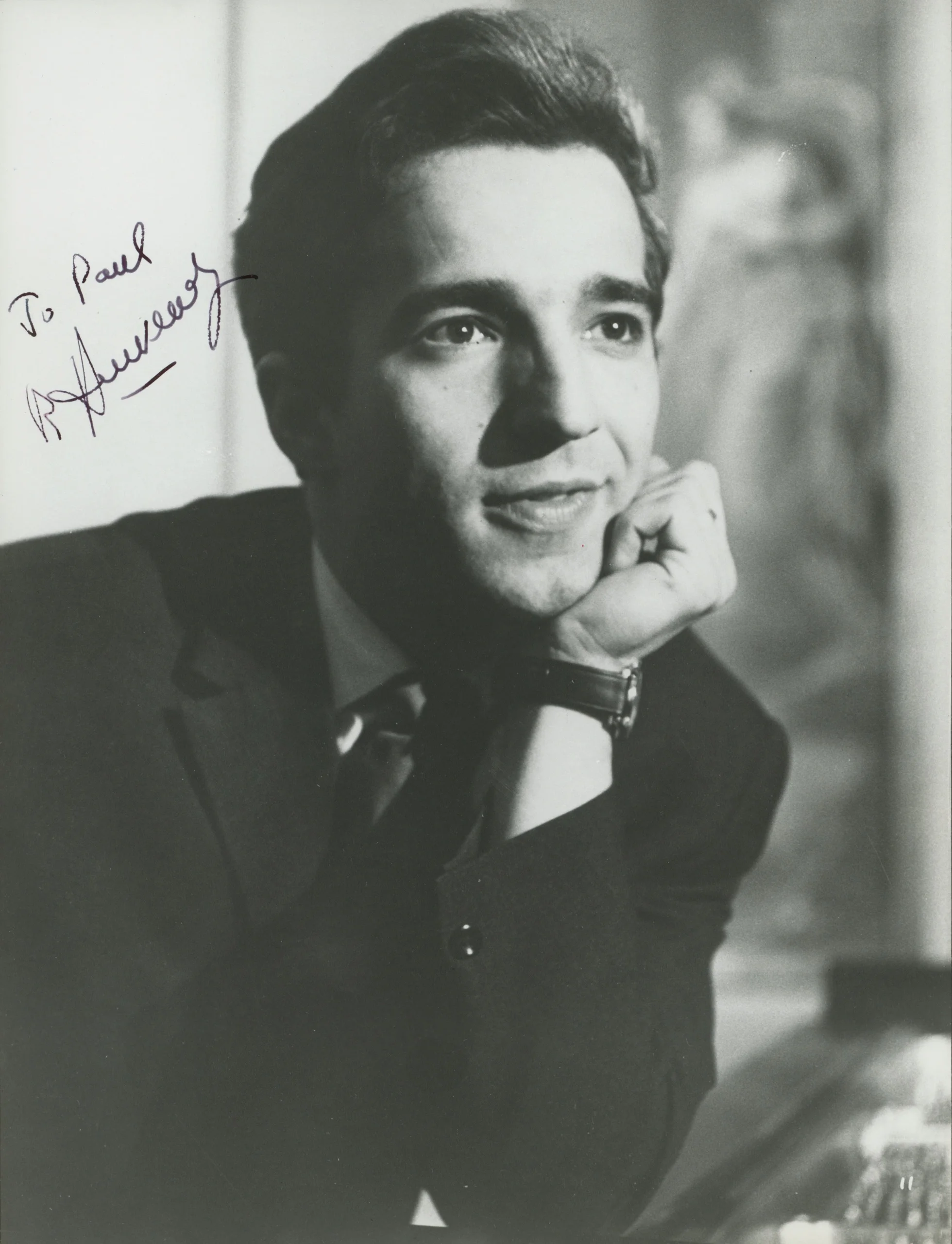
Vladimir Ashkenazy
 Switzerland
classical pianist•conductor•composer
Also known as: Vladimir Davidovich Ashkenazy, Wladimir Aschkenasi
Birthday
July 6, 1937
Birth Sign
Cancer
Birthplace
Nizhny Novgorod, Russia
Age
89 years old
About
Vladimir Ashkenazy is a Soviet-born Icelandic pianist, conductor, and composer. Born in Gorky, Soviet Union, on July 6, 1937, he rose to prominence as one of the 20th century's most celebrated classical pianists, renowned for his technical mastery and deep musicality. His interpretations of Beethoven, Rachmaninoff, and Prokofiev set a benchmark for generations. Ashkenazy's career spans over six decades, marked by a vast discography with Decca Classics that includes complete cycles of Chopin, Liszt, and Beethoven sonatas.
In addition to his solo work, Ashkenazy has conducted major orchestras worldwide, serving as Chief Conductor of the Oslo Philharmonic and holding posts with the London Symphony and Philharmonia. He has won seven Grammy Awards and numerous other honors. As of 2026, he is retired from public performance but remains active in the recording studio, continuing to influence the classical world. Fans admire his artistic integrity and the profound emotional connection he brings to every piece.
Early Life & Background
Vladimir Ashkenazy's musical journey began at age six, when he started piano lessons in his hometown of Gorky. His talent was evident immediately, and at eight he was accepted into the prestigious Central Music School in Moscow. Under the Soviet system, he was groomed as a prodigy, studying with renowned teachers and performing publicly from a young age. His first major public debut came at eight, and by his teens he was already a standout in Soviet musical circles.
In 1955, Ashkenazy gained international attention by tying for first prize at the Tchaikovsky Competition in Moscow, sharing the honor with American pianist Van Cliburn. The following year, he won the coveted Queen Elisabeth Competition in Brussels, solidifying his reputation as one of the most promising pianists of his generation. These victories opened doors to international tours, but his life was still constrained by Soviet restrictions. In 1963, he made the difficult decision to emigrate with his family to England, seeking artistic freedom. This move proved pivotal, allowing him to perform freely in the West and eventually leading him to Iceland, where he would later settle and become a citizen.
Career Growth
Ashkenazy's post-emigration career flourished rapidly. After moving to England in 1963, he signed with Decca Classics and began recording extensively, producing a catalog that would become legendary. His 1974 recording of Prokofiev's Piano Concertos Nos. 2 & 3 earned him his first Grammy, and he went on to win six more over the next two decades. His complete cycles of Chopin, Liszt, and Beethoven sonatas are considered definitive, and his recordings of Rachmaninoff's concertos remain bestsellers.
In 1969, Ashkenazy relocated to Iceland, where he embraced his new home and became an Icelandic citizen in 1972. He transitioned into conducting, taking on the role of Chief Conductor of the Oslo Philharmonic in 1979, a position he held for nearly a decade. He also led the Royal Philharmonic, London Symphony, and Philharmonia orchestras, earning acclaim for his interpretations of the Romantic repertoire. Notable collaborations include partnerships with soprano Elisabeth Schwarzkopf and violinist Itzhak Perlman. Ashkenazy continued recording into the 2000s, releasing acclaimed sets of Rachmaninoff symphonies. In January 2020, he announced his retirement from public performances, but he has remained active in the studio, with new archival releases and remastered editions appearing regularly.
Career Timeline
Public Image & Style
Ashkenazy is widely regarded as a gentle giant of classical music, known for his humility and profound musical insight. His public persona is one of quiet intensity, letting his performances speak for themselves. He has a reputation for being approachable and generous with young musicians, often mentoring them during masterclasses. Fans admire his ability to convey deep emotion without showmanship, and his recordings are treasured for their clarity and warmth. Ashkenazy's image has evolved from a Soviet prodigy to a global statesman of music, embodying cultural diplomacy during the Cold War. His retirement from performance in 2020 was met with an outpouring of affection from the classical community, and his legacy continues to inspire new generations of pianists.
Fame & Fandom (iFAMOUS Rankings)
Vladimir Ashkenazy commands a devoted audience of classical music enthusiasts who value technical precision and emotional depth over celebrity spectacle. Unlike modern pop stars, he never cultivated a formal fanbase with organized rituals or branded hashtags; his supporters are listeners drawn to the integrity of his interpretations rather than a mobilized community seeking personal access. His legacy is defined by the quiet intensity of his performances and the historic drama of his 1968 defection from the Soviet Union, stories that resonate deeply within the concert hall culture. While the fanbase has no formal name, his reputation as a mentor and a gentle giant ensures a steady stream of admirers across generations. This enduring influence places him firmly within the global hierarchy of musical icons. According to the latest data from the iFANN Global Fame Rankings, Vladimir Ashkenazy is currently the 71st most famous person in Classical, a position he has held steady through cycles of shifting public attention. These rankings reflect his sustained presence in media coverage, streaming consumption, and archival interest worldwide.
Interesting Facts and Legends
Vladimir Ashkenazy's name translates to 'ruler of the world' in Russian, a fitting title for a pianist who once commanded every major stage on Earth. He speaks five languages fluently: Russian, English, French, German, and Icelandic. In 1972, he delivered a unique televised performance inside a swimming pool, filmed by director Christopher Nupen. A dedicated line of educational instruments bears his name, designed specifically to aid young students in their early training. His family remains active in the arts; his daughter Margrét works in the cultural sector while his son Arnar has pursued a professional career in music. Ashkenazy is renowned for his rigorous preparation habits, often memorizing entire scores before entering the studio. Beyond these facts, a persistent legend surrounds his early career struggles with having relatively small hands for a virtuoso. Despite this physical limitation, he developed a technique so powerful it became an inspirational story for aspiring musicians. Another iconic moment involves his fiery rendition of Beethoven's "Pathétique" Sonata, which showcased an intense emotional power that defied his reserved public persona. These narratives, combined with his dignified retirement announcement in January 2020 after six decades of service, form the core of his cultural mythology.
Notable Quotes
“To my knowledge, I never made a less than exemplary recording.”
“The most important phone call I've ever received.”
“Music is not about notes; it's about the spaces between them.”
Family & Personal Life
Ashkenazy married Þórunn Jóhannsdóttir in 1972, the same year he became an Icelandic citizen. The couple met after his move to Iceland, and their marriage has lasted over five decades. They have three children: daughters Margrét and Hrafnhildur, and son Arnar. While Ashkenazy resides primarily in Switzerland, Þórunn often stays in Iceland, yet they remain legally married and share a strong bond. Family has always been central to Ashkenazy's life; he has mentioned that his wife's support was crucial during his transition to the West. In interviews, he has spoken fondly of his children's musical interests, though he never pushed them into careers in classical music.
Notable Connections
Vladimir Ashkenazy has collaborated with many of the 20th century's finest musicians. His wife, Þórunn Jóhannsdóttir, has been a constant support. He shared a famous rivalry and friendship with Van Cliburn after their 1955 Tchaikovsky Competition tie. He worked closely with soprano Elisabeth Schwarzkopf and violinist Itzhak Perlman. Filmmaker Christopher Nupen captured his 1972 performance, and he has been a mentor to younger pianists like Martha Argerich, who considers him a friend.
Relationships & Dating History
Vladimir Ashkenazy has been married only once, to Icelandic pianist Þórunn Jóhannsdóttir. They met after his move to Iceland in 1969, and their relationship blossomed into a deep partnership. The couple married in 1972, coinciding with his acquisition of Icelandic citizenship. Their marriage has lasted over five decades, a rare longevity in the demanding world of classical music. Ashkenazy has credited Þórunn's support as vital to his career, especially during the challenging transition from Soviet emigrant to international star. They have three children together, and despite living in different countries at times, they remain devoted to each other. As of 2026, Ashkenazy is still married to Þórunn, and there are no public records of any other significant relationships.
- MarriedÞórunn Jóhannsdóttir1972 - presentCurrentMet after his move to Iceland; married in the same year he became an Icelandic citizen.
Salary, Net Worth In 2026
$18 Million
iFANN Editorial Team estimate
iFANN currently estimates Vladimir Ashkenazy's net worth at $18 million as of 2026. This figure accumulates from a lifetime of recording royalties, conducting fees, and strategic investments. His extensive discography with Decca Classics, comprising over 100 albums, continues to generate substantial income, particularly as streaming platforms expand. Conducting engagements with major orchestras like the London Symphony and Oslo Philharmonic provided significant earnings throughout his career. Additional revenue streams include licensing his recordings for films, television, and documentaries. He holds properties in Switzerland and Iceland, and his involvement with the Ashkenazy Piano brand further diversifies his portfolio. Over the years, his wealth has grown steadily, reflecting the enduring value of his artistic output. While not among the wealthiest classical musicians, his financial standing remains solid, built on artistic excellence rather than commercial hype.
Awards Won (12)
Vladimir Ashkenazy has won seven Grammy Awards, including Best Classical Performance for his Prokofiev concertos and Best Classical Album for his Chopin Nocturnes. He also received the prestigious Polar Music Prize in 1994 and has been honored with Iceland's Order of the Falcon three times. His recordings have earned numerous Gramophone and Deutsche Schallplattenpreis awards, and he holds honorary doctorates from institutions like Cambridge and Helsinki.
1996 · Best Classical Contemporary Composition
Britten: War Requiem
1993 · Best Classical Vocal Performance
Schubert: Winterreise
1980 · Best Classical Album
Chopin: Nocturnes
1978 · Best Classical Performance – Instrumental Soloist
Rachmaninoff: Piano Concerto No. 2
1976 · Best Classical Album
The Ashkenazy Collection
1974 · Best Classical Performance – Orchestral
Beethoven: Symphonies Nos. 5 & 6
1974 · Best Classical Performance – Soloist with Orchestra
Prokofiev: Piano Concertos Nos. 2 & 3
1956 · First Prize
Piano
Known For
Rachmaninoff Piano Concertos
1970 · Pianist
Beethoven Piano Sonatas
1971 · Pianist
Chopin Nocturnes
1980 · Pianist
Prokofiev Piano Concertos
1974 · Pianist
Keywords
Sources
Quick Facts
- Profession
- classical pianist, conductor, composer
- Born
- +1937-07-06
- Birthplace
- Nizhny Novgorod
- Gender
- Male
- Spouse
- Þórunn Jóhannsdóttir
- Birth Sign
- Cancer
- Residence
- Switzerland
- Citizenship
- Icelandic
Personal Details
- Full Name
- Vladimir Davidovich Ashkenazy
- Spouse
- Þórunn Jóhannsdóttir
- Children
- Margrét Ashkenazy, Hrafnhildur Ashkenazy, Arnar Ashkenazy
- Education
- Central Music School, Moscow
Frequently Asked Questions
How old is Vladimir Ashkenazy?
What is Vladimir Ashkenazy's net worth in 2026?
Why did Vladimir Ashkenazy retire?
Is Vladimir Ashkenazy still alive?
What nationality is Vladimir Ashkenazy?
Similar People
Join the community
fans discussing