“It is a movie that works on a level of pure sensation, a visual and auditory assault that leaves you reeling. Cronenberg has created a nightmare that feels terrifyingly plausible.”
Roger Ebert
Chicago Sun-Times
 Canada
"First it controls your mind. Then it destroys your body."
User Score
140000 votes
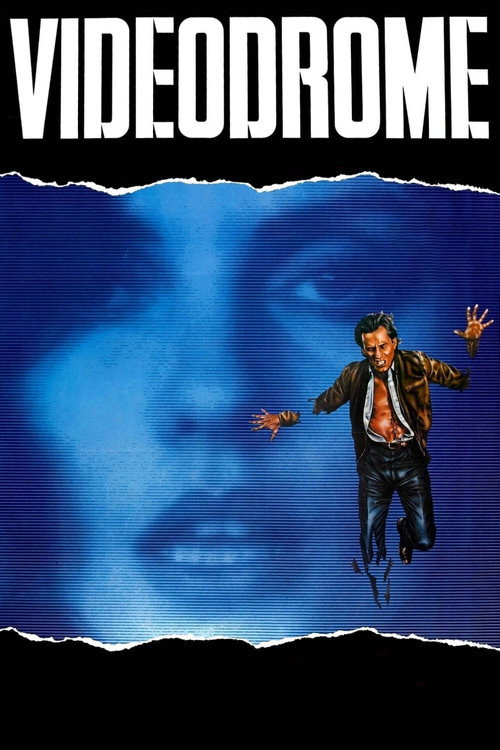
Max Renn runs a struggling Toronto cable station called Suck City, where he constantly fights for ratings against larger networks. His search for fresh content leads him to a pirate broadcast signal labeled Videodrome, a program featuring graphic scenes of torture and mutilation that appear so visceral they blur the line between performance and reality. Despite legal warnings, Max airs the show, triggering an immediate ratings explosion but also initiating a terrifying physical and psychological transformation within himself.
The film explores the disturbing intersection of media consumption and biological evolution as Max encounters hallucinations, fleshy growths on his body, and mysterious figures like Nicki Brand and Bianca O'Blivion. These characters guide him toward the revelation that Videodrome is not merely entertainment but a technological weapon designed to alter human consciousness through pain and saturation. As Max descends further into paranoia, he must navigate a surreal landscape where the boundaries between the viewer and the viewed dissolve completely.
Availability and pricing can change. Confirm on the provider's site before purchasing.
Max Renn operates out of a cramped office at Suck City, a low-budget television station in Toronto that struggles to compete with established networks. Desperate to boost declining viewership numbers, he tasks his assistant Barry Convex with finding edgy new programming from underground markets. Their investigation leads them to a mysterious VHS tape labeled "Videodrome," which arrives via a pirate broadcast signal. The footage is unlike anything seen before; it depicts raw, unfiltered scenes of torture, sadomasochistic violence, and mutilation that feel so real they challenge the viewer's perception of what is staged versus what is actual suffering.
Ignoring the advice of his legal department and personal conscience, Max decides to air the program. The response is immediate and explosive, propelling Suck City to the top of the ratings charts overnight. However, this success comes with a disturbing cost. Max begins experiencing vivid hallucinations and strange physical anomalies. He notices fleshy growths appearing on his body, and his grip on reality starts to fracture. He encounters a seductive performer named Nicki Brand, who appears both on the broadcasts and in the streets, seemingly guiding him deeper into a conspiracy involving a shadowy organization known as the "New Flesh." Nicki introduces Max to Bianca O'Blivion, the daughter of Brian O'Blivion, a legendary radical media theorist who disappeared years ago after broadcasting messages about the transformative power of television.
Through Bianca, Max learns that Videodrome is not just a show but a sophisticated technological weapon designed to alter human consciousness and evolve the species through pain and media saturation. The narrative spirals into a surreal nightmare where Max cannot distinguish between the world outside his apartment and the twisted reality projected by the television screen. His relationship with his girlfriend Masha deteriorates as she notices his erratic behavior and the grotesque changes in his physique. Simultaneously, Max finds himself hunted by a group of vigilantes led by Harlan, who believe Videodrome is a tool of control used by a powerful cabal to manipulate society.
The tension builds as Max becomes increasingly isolated and paranoid. He is forced to confront the question of whether he is a victim of a sinister plot or the architect of his own descent into madness. As the boundaries between the viewer and the viewed dissolve completely, Max must decide if he can escape the grip of the signal or if he has already become part of the "New Flesh" he once sought to exploit. The narrative moves toward a climax where the distinction between the broadcast and Max's life ceases to exist entirely, leaving the audience to wonder if any of what happens is truly real or merely another layer of the illusion.
Original Trailer
Trailer
Critical Consensus
David Cronenberg's Videodrome stands as a landmark of body horror and cyberpunk cinema, masterfully blending visceral special effects with a haunting exploration of media manipulation and psychological decay. James Woods delivers a career-defining performance as a man whose descent into madness mirrors the film's surreal, nightmarish logic. Though divisive upon release, its prescient themes regarding the saturation of technology and the erosion of reality have cemented its status as a cult classic and a profound cautionary tale.
“It is a movie that works on a level of pure sensation, a visual and auditory assault that leaves you reeling. Cronenberg has created a nightmare that feels terrifyingly plausible.”
Roger Ebert
Chicago Sun-Times
“A dazzling, disturbing vision of the future where the medium is not just the message, but the monster. Cronenberg's direction is bold and uncompromising.”
Todd McCarthy
Variety
“A masterpiece of paranoia and body horror that anticipates the digital age with startling accuracy. It remains one of the most unsettling films ever made.”
Mark Kermode
The Guardian
James Woods
Max Renn
Debbie Harry
Nicki Brand
Sonja Smits
Bianca O'Blivion
Peter Dvorsky
Harlan
Leslie Carlson
Barry Convex
Jack Creley
Brian O'Blivion
Lynne Gorman
Masha
Julie Khaner
Bridey
Director
David Cronenberg
Writer
David Cronenberg
Composer
Howard Shore
Cinematographer
Mark Irwin
Producer
Claude Héroux
Saturn Awards (1984)
Best Horror Film: Won
Saturn Awards (1984)
Best Writing: Nominated
Saturn Awards (1984)
Best Actress: Nominated
Genie Awards (1983)
Best Motion Picture: Nominated
Genie Awards (1983)
Best Direction: Nominated
Genie Awards (1983)
Best Actor: Nominated
Fright Meter Awards (1983)
Best Director: Won
Join the community
fans discussing