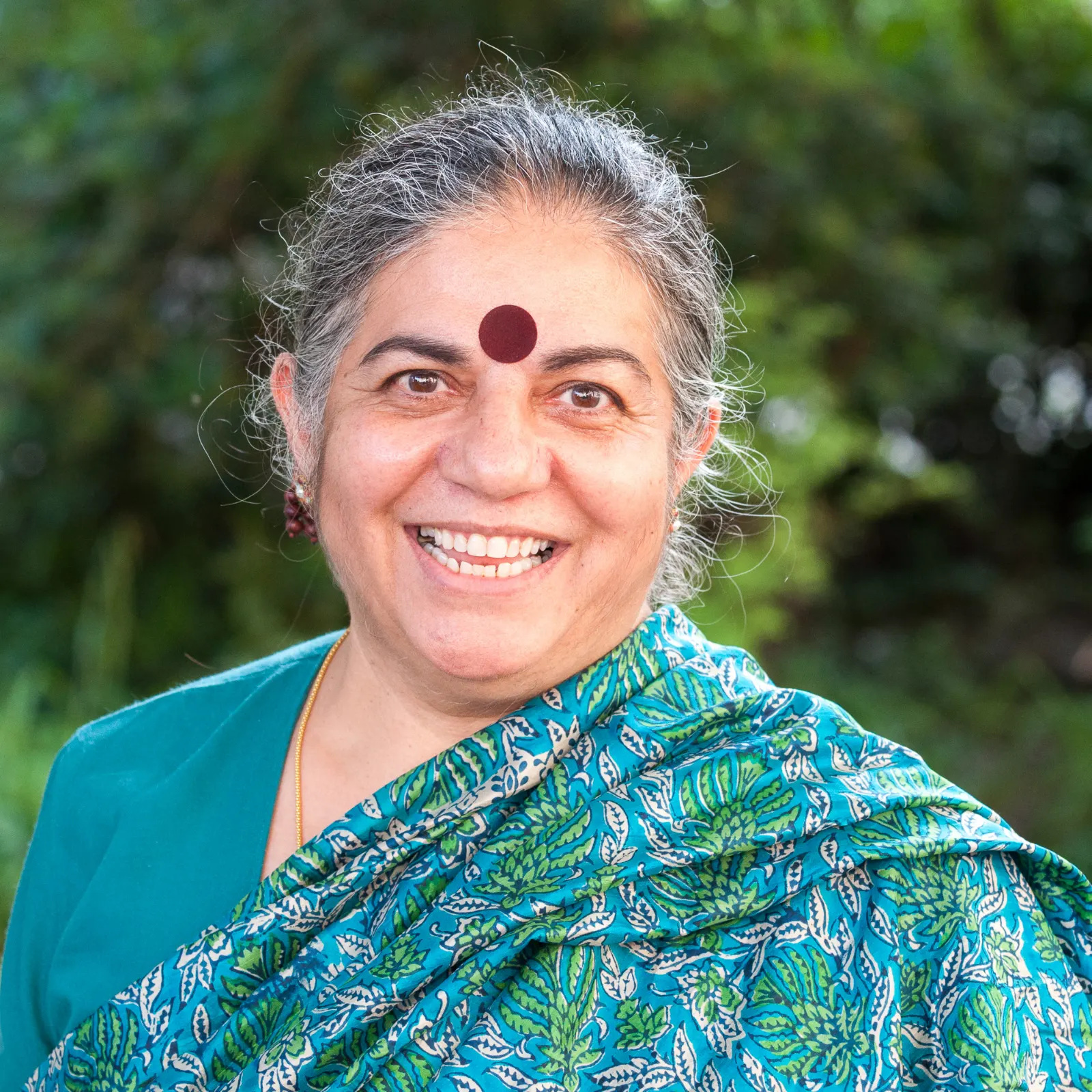
Vandana Shiva
 India
IndiaScholar•environmental activist•author
Also known as: Gandhi of grain
Birthday
November 5, 1952
Birth Sign
Scorpio
Birthplace
Dehradun, India
Age
73 years old
About
Vandana Shiva is an Indian scholar, environmental activist, and author who has spent four decades challenging industrial agriculture, genetic engineering, and the corporate control of food systems. She is the founder of Navdanya, a movement that has built over 150 community seed banks across 22 Indian states, preserving native crop varieties and promoting organic farming. Her 1993 Right Livelihood Award, often called the Alternative Nobel, recognized her work on biodiversity and farmers' rights.
Today Shiva remains one of the most visible voices in the global food sovereignty movement. Her books, including Staying Alive and Who Really Feeds the World?, have been translated into dozens of languages. She lectures worldwide, leads Navdanya's ongoing projects, and in March 2026 published Slow Living, a call for a deliberate slowdown in response to the climate crisis. Critics and supporters alike describe her as a polarizing figure, but her influence on how we think about seeds, soil, and sustainability is hard to overstate.
Early Life & Background
Shiva grew up in Dehradun, tucked into the Himalayan foothills, where her father worked as a forest conservator and her mother farmed and taught. That childhood, surrounded by forests and agriculture, planted the seeds of her lifelong connection to the land. She earned a BSc in physics from Panjab University, then moved to Canada for graduate work, completing a master's and PhD in the philosophy of science at the University of Western Ontario. Her dissertation explored the foundations of quantum theory.
Back in India, she did research at the Indian Institute of Science and the Indian Institute of Management in Bangalore. But the academic path shifted when she joined the Chipko movement, the famous tree-hugging protests where villagers, mostly women, physically blocked loggers from cutting forests. That experience transformed her. She saw environmental destruction up close and watched rural communities, especially women, fight for their livelihoods. It redirected her from theoretical physics to environmental activism and ecofeminism, setting the stage for everything that followed.
Career Growth
Shiva's breakthrough came in 1987 with Staying Alive: Women, Ecology and Development, a book that became a cornerstone of ecofeminism. She argued that Western development models had systematically marginalized women and wrecked ecosystems. Five years later, in 1991, she founded Navdanya, which grew into a nationwide network of seed banks and organic farms. In 1993 she won the Right Livelihood Award, cementing her international standing.
Through the 1990s and 2000s, Shiva became a leading critic of genetically modified crops and seed patents, targeting corporations like Monsanto. Her campaigns made her a hero to anti-GMO activists and a target for scientists who accused her of overstating risks. She kept publishing, with titles like Biopiracy, Earth Democracy, and Soil Not Oil. In 2010 she received the Sydney Peace Prize, and in 2012 the Fukuoka Asian Culture Prize. Her most recent project, Slow Living, co-authored with Shreya Jani, came out in March 2026, urging a more unhurried, restorative approach to climate action.
Career Timeline
Public Image & Style
Shiva cuts a distinctive figure: handwoven cotton saris or kurtas, often white or natural-colored, with a shawl draped over her shoulder. That style mirrors her message of simplicity and sustainability. In media coverage, she comes across as a fearless, tireless defender of farmers and indigenous knowledge, nonviolent in method but uncompromising in tone. Supporters see a moral clarity that cuts through corporate spin; critics see a tendency to oversimplify complex science.
Her fandom is less about celebrity and more about movement building. Environmental activists, academics, and food sovereignty advocates treat her as a touchstone. Her lectures draw packed halls, and her interviews go viral in activist circles. She doesn't have an official fan name, but her influence shows up in the countless seed-saving projects and organic farms that cite her as their inspiration.
Fame & Fandom
Vandana Shiva commands a global following that defies the usual metrics of celebrity. Her audience is not a collection of fans chasing autographs or chart positions, but a dispersed network of activists, farmers, scholars, and students united by a shared commitment to seed sovereignty and food justice. There is no formal fan club, her fanbase has no documented name, and no organized birthday campaigns; instead, her supporters are defined by their participation in movements like Navdanya and their adherence to her philosophy of Earth Democracy. This distinction shapes how her influence is measured: through policy shifts, educational initiatives, and the mobilization of rural communities rather than viral moments or merchandise sales. While pop icons rely on media saturation, Shiva's reach grows organically through lectures, books, and grassroots organizing across 22 Indian states and beyond. She remains a polarizing yet indispensable figure, revered for her moral clarity by allies and scrutinized for her scientific interpretations by critics. Despite her immense impact on global environmental discourse, she does not currently hold a placement in the published iFANN Global Top 1,000 rankings. The iFANN Global Fame Engine has evaluated her profile, but she is not listed in any scope list as of August 2026. This absence from the ranked charts reflects the unique nature of her fame, which operates outside the commercial entertainment ecosystem where traditional ranking algorithms thrive.
Interesting Facts and Legends
Vandana Shiva holds a PhD in the philosophy of quantum physics, a background she frequently references in interviews to frame her ecological arguments. In February 2026, she discussed "The Power of Quantum Thinking" during a notable conversation. Her activism roots trace back to the Chipko movement, the tree-hugging protests that deeply influenced her ecofeminist worldview. Often called the "Gandhi of grain," she champions nonviolent resistance to secure seed sovereignty for farmers. She serves on the board of the International Forum on Globalization alongside figures like Ralph Nader. Her appearance in the 2018 documentary *Roshni* further cemented her public profile. A defining legend of her career is the founding of Navdanya in 1987, translating to "nine seeds." This initiative established over 150 community seed banks to protect native crop varieties from corporate erosion. Another iconic chapter involves her fierce battle against biopiracy and genetically modified crops, notably challenging multinational giants like Monsanto. Her work culminated in influential texts such as *Biopiracy: The Plunder of Nature and Knowledge*, which exposed corporate exploitation of indigenous knowledge. In 2014, a major New Yorker article titled "Seeds of Doubt" highlighted her role in sparking a global movement regarding the dangers of GMOs. More recently, her co-authored book *Slow Living* continues to generate discussion on sustainable alternatives to industrial life.
Notable Quotes
“Diversity without unity becomes the source of conflict and contest. Unity without diversity becomes the ground for external control.”
“Even if you keep telling/calling us uncivilized, primitive, backward or whatever for humiliating us, we're not going to hand over our remaining natural resources to fulfill your greed.”
“The future of the planet depends on the fight of the Indigenous Peoples.”
Family & Personal Life
Shiva's father was a forest conservator in Dehradun, and her mother was a farmer and educator. That combination shaped her worldview, giving her firsthand experience of both forestry and agriculture. She has spoken about how her parents' work influenced her commitment to environmental and food justice. Details about siblings, her own household, or pets have not been made public. She has not publicly discussed having a spouse or children, and no credible sources confirm any family of her own.
Notable Connections
Shiva's close collaborators include Shreya Jani, her co-author on Slow Living (2026). She has served on the board of the International Forum on Globalization alongside Jerry Mander and Ralph Nader. Geneticist Alison Van Eenenmaan has publicly fact-checked and criticized Shiva's anti-GMO claims, representing the scientific opposition she often faces.
Relationships & Dating History
Vandana Shiva keeps her personal life private. There are no public records of romantic relationships, marriages, or partnerships. She has never discussed a spouse or partner in interviews, and no credible media outlet has reported on her dating history. As of 2026, her relationship status remains unknown, and she appears to be single, though this is not confirmed.
Salary, Net Worth In 2026
$5 Million
iFANN Editorial Team estimate
As a scholar and activist rather than a commercial figure, Shiva's net worth is modest compared to celebrities. Her income comes from book royalties, speaking fees, and her leadership role at Navdanya, which operates as a nonprofit. No major financial disclosures have been made, but per iFANN's editorial analysis, her net worth is around $5 million as of 2026, accumulated over decades of publishing and lecturing. She lives simply, in keeping with her advocacy for sustainable living, and much of her work is donated or reinvested into Navdanya's projects.
Awards Won (5)
Shiva has won several prestigious awards for her environmental and social justice work. These include the Right Livelihood Award (1993), the Sydney Peace Prize (2010), and the Fukuoka Asian Culture Prize (2012), along with the UNEP Global 500 Roll of Honour and the LennonOno Grant for Peace.
1993 · Environmental Conservation
Lifetime achievement
2010 · Peace
Lifetime achievement
Known For
Navdanya
1991 · Founder
Staying Alive
1987 · Author
Anti-GMO activism
2000 · Activist
Keywords
Sources
Quick Facts
- Profession
- Scholar, environmental activist, author
- Born
- November 5, 1952
- Birthplace
- Dehradun, India
- Gender
- Female
- Birth Sign
- Scorpio
- Education
- PhD in Philosophy of Science, University of Western Ontario
Personal Details
- Full Name
- Vandana Shiva
- Education
- BSc in Physics, Panjab University; MSc and PhD in Philosophy of Science, University of Western Ontario
Filmography
1
Total
1
Film
0
TV
Frequently Asked Questions
How old is Vandana Shiva?
What is Vandana Shiva famous for?
Is Vandana Shiva married?
What is Vandana Shiva's net worth?
Does Vandana Shiva have children?
Similar People
Join the community
fans discussing