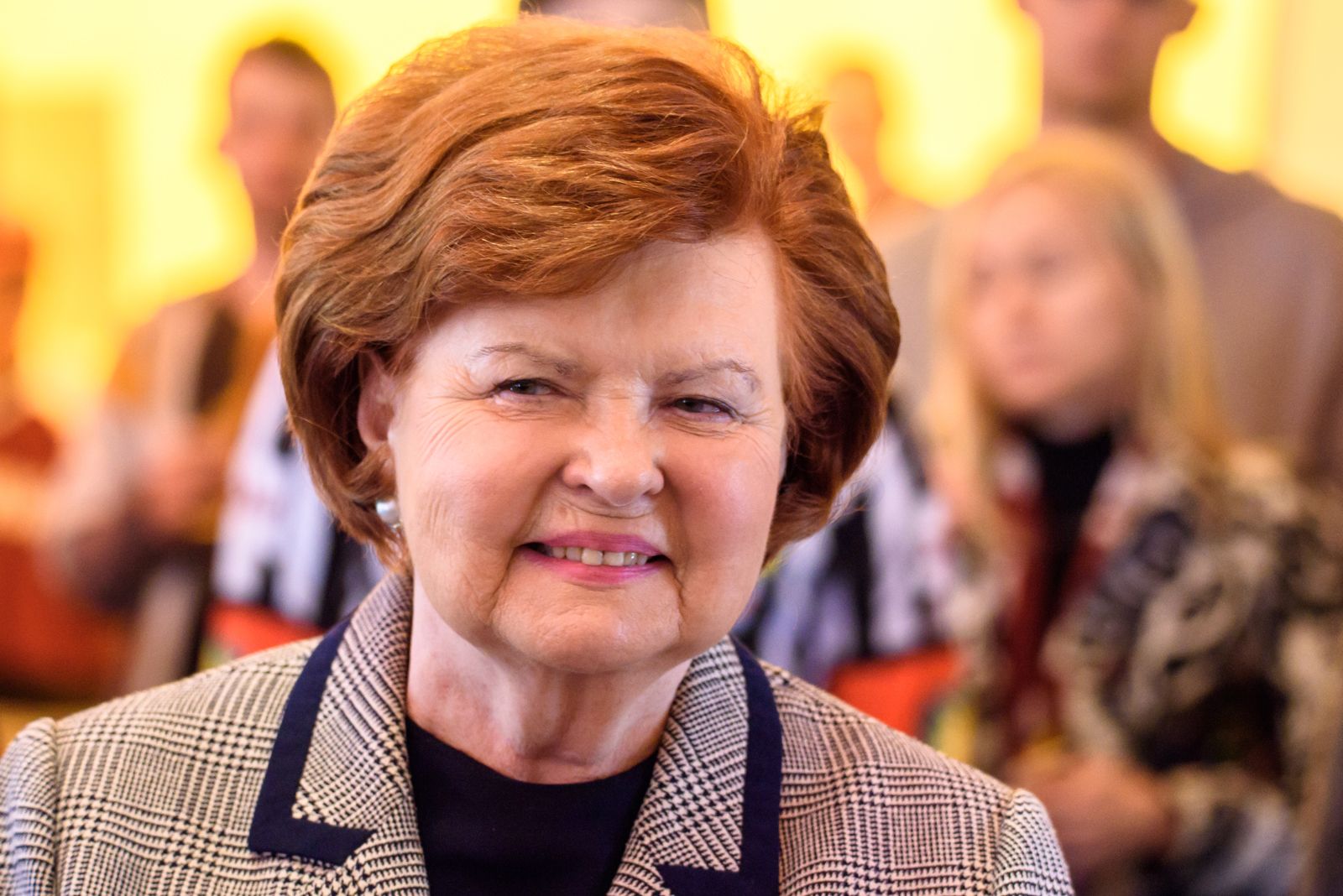
Vaira Vīķe-Freiberga
 Canada
politician•psychologist•university teacher
Also known as: Vaira Vike-Freiberga, Vaira Vīķe
Birthday
December 1, 1937
Birth Sign
Sagittarius
Birthplace
Riga, Latvia
Age
88 years old
About
Vaira Vīķe-Freiberga is a Latvian politician, psychologist, and former university professor who made history as the first woman to serve as President of Latvia, holding office from 1999 to 2007. She remains the only woman to have held the position and the most recent president to be re-elected for a second term. Her presidency was defined by her successful drive to bring Latvia into both the European Union and NATO, cementing the country's place in the Western alliance after decades of Soviet occupation.
Before politics, Vīķe-Freiberga built a distinguished academic career in Canada, earning a PhD in psychology from McGill University and later becoming a professor at the Université de Montréal. Her research in psycholinguistics and semiotics produced eleven books and numerous articles, establishing her as a respected intellectual. After leaving the presidency, she co-founded the Nizami Ganjavi International Center and led the Club of Madrid, the world's largest forum of former heads of state, from 2014 to 2020. As of 2026, she remains an active voice in global debates on democracy, human rights, and historical accountability, frequently speaking at international forums.
Early Life & Background
Vaira Vīķe was born on December 1, 1937, in Riga, Latvia, into a family that would soon be torn apart by war. When the Soviet Union occupied Latvia in 1940, her father, a naval officer, was arrested and deported to Siberia; the family never saw him again. In 1944, as the front lines shifted, Vaira, her mother, and her sister fled westward, joining a wave of refugees. They spent several years in displaced persons camps in Germany before emigrating to Morocco in 1949, where they lived until 1954.
In Morocco, Vaira attended a French-language school, which laid the foundation for her multilingual abilities. The family then moved to Canada, where she enrolled at the University of Toronto, earning a bachelor's degree in English and French literature and a master's in psychology. She went on to McGill University for her PhD, completing her dissertation on the structure of Latvian folk songs. Her academic path was unconventional, but it gave her a deep understanding of language, culture, and identity that would later inform her political vision.
Career Growth
Vaira Vīķe-Freiberga's political career began almost by accident. In 1998, she was approached by a group of Latvian intellectuals who urged her to run for president, despite her having lived abroad for most of her adult life. She agreed, and in June 1999, the Saeima elected her as the first female president of Latvia. She took office on July 8, 1999, and quickly became a symbol of Latvia's return to the European fold.
Her first term was marked by intense diplomatic efforts to secure NATO and EU membership. She personally lobbied Western leaders, including U.S. President George W. Bush, and her efforts paid off in 2004 when Latvia joined both organizations. She was re-elected in 2003 for a second term, serving until 2007. After leaving office, she ran as a candidate for UN Secretary General in 2006, receiving significant support but ultimately losing to Ban Ki-moon. She later served as a Special Envoy for UN reform. In 2014, she became president of the Club de Madrid, a position she held until 2020, and she continues to speak at events like the Global Baku Forum.
Career Timeline
Public Image & Style
Vaira Vīķe-Freiberga is widely admired in Latvia as a national figure who restored the country's international standing. She is known for her elegant, often colorful attire and her articulate, passionate speeches. In the media, she is portrayed as a strong, principled leader who never shied away from controversial topics, such as the need to confront the legacy of communism. Internationally, she is respected as a voice for democracy and human rights, frequently invited to speak at forums like the NATO Through Time podcast and the Global Baku Forum. Her fandom, if it can be called that, consists of Latvians who see her as a symbol of independence, as well as global policy enthusiasts who follow her commentary on geopolitics. She maintains an active presence on X (Twitter) and Facebook, where she shares her views on current events.
Fame & Fandom
Vaira Vīķe-Freiberga occupies a distinct space in global history as the first woman to lead a post-communist Eastern European state, a status that commands respect rather than the fervent adoration typical of entertainment figures. Her public profile is anchored in political achievement and diplomatic service rather than celebrity culture. According to the iFANN Global Fame Engine evaluation conducted in August 2026, she is currently evaluated but holds no placement within the published rankings for the Global Top 1,000 or any Top-100 scope list. This absence of a numeric rank reflects her standing as a dignified head of state whose influence is measured in policy and historical legacy rather than commercial metrics or viral engagement. The data confirms that while she enjoys high popularity among the Latvian people, this sentiment manifests as general public respect for a national leader rather than an organized fanbase. There is no documented formal name for any potential following, nor are there records of fan campaigns, birthday billboards, subway advertisements, or ritualized gatherings associated with her appearances. Unlike pop icons who inspire crowds to shut down streets or engage in specific online movements, her interactions remain strictly within the bounds of political channels, state functions, and formal forums. Her legacy is defined by verified historical milestones, such as her 1999 inauguration and subsequent re-election, alongside her instrumental role in securing Latvia's entry into NATO and the European Union. Recent activities, including receiving the GIWPS Trailblazer Award in September 2025 and speaking at the Global Baku Forum in 2026, further cement her reputation as a pioneering female leader without generating the chaotic energy often seen in modern fandoms. The narrative surrounding her life, from child refugee to president, serves as a story of resilience rather than a vehicle for fan fiction or internet lore.
Interesting Facts and Legends
Vaira Vīķe-Freiberga speaks four languages fluently: Latvian, French, English, and German, a skill set developed during her early years in refugee camps and Morocco. An accomplished folk singer, she has recorded traditional Latvian songs based on her academic research and has also published her own collections of poetry. In 2019, the BBC produced a feature titled "From child refugee to president: Latvia's Vike-Freiberga," highlighting her unique biography. She holds honorary doctorates from institutions including the University of Toronto and the University of Latvia. Her husband, Imants Freibergs, was a computer science professor, and they shared a marriage lasting over sixty years until his death in January 2026. The defining legend of her life is her journey from a child fleeing war-torn Latvia to becoming the sixth President of the nation, a transition symbolizing national rebirth. This narrative is widely retold as a reflection of resilience. A pivotal moment occurred on July 8, 1999, when she took the oath of office, marking the first time a woman led a post-communist Eastern European state. Her tenure saw significant international milestones, including a meeting with U.S. President George W. Bush at Riga Castle on May 7, 2005, which underscored her diplomatic strength. In recent years, her influence remains visible, such as her criticism of the United Nations' effectiveness in March 2026 and her receipt of the GIWPS Trailblazer Award in September 2025.
Notable Quotes
“Separation of church and state is a fundamental requirement.”
“Global Baku Forum can give world new ideas.”
“Those who are in the boat and are entrusted with leading our country have a heavy responsibility.”
Family & Personal Life
Vaira Vīķe-Freiberga was born to a family that was shattered by war. Her father, a naval officer, was deported to Siberia by the Soviets in 1940 and died there. She was raised by her mother, who managed to keep the family together through years of displacement. Vaira has a sister, whose name is not widely publicized. In 1960, she married Imants Freibergs, a Latvian computer scientist and professor. They had two children together, a son and a daughter, whose names are kept private. The couple lived in Canada for many years before returning to Latvia. Imants Freibergs passed away on January 1, 2026, at the age of 91, leaving Vaira a widow. She has often spoken about the importance of family and the support she received from her husband throughout her career.
Notable Connections
Relationships & Dating History
Vaira Vīķe-Freiberga married Imants Freibergs in 1960, a computer scientist she met while studying in Canada. Their marriage lasted over six decades, a remarkable partnership that supported her academic and political careers. They had two children together. Imants passed away on January 1, 2026, at the age of 91. As of 2026, Vaira is a widow. There are no other public relationships in her life; her marriage was a central and enduring part of her personal story.
- MarriedImants Freibergs1960 - 2026Husband for over 60 years; he passed away in 2026.
Salary, Net Worth In 2026
$5 Million
iFANN Editorial Team estimate
Per iFANN's editorial analysis, Vaira Vīķe-Freiberga's net worth is estimated at $5 Million as of 2026. Her financial portfolio reflects a long career spanning academia and politics. As a university professor for more than three decades, she accumulated a substantial salary, which is now supplemented by her presidential pension. Additional income derives from speaking fees garnered through numerous appearances at international forums and conferences. While she has authored books and articles, these works do not constitute a primary revenue stream. Her economic situation remains modest relative to many other world leaders, yet she has maintained a comfortable lifestyle throughout her life. Public records contain no information regarding significant real estate holdings or major investment portfolios. Following the death of her husband in 2026, she may have inherited assets from him, a factor that could potentially increase her total wealth, though specific details remain undisclosed.
Awards Won (2)
Vaira Vīķe-Freiberga has received numerous honours for her service, including the Grand Cross of the Order of the Three Stars, Latvia's highest state decoration, and the Order of Canada. She has also been recognized by the Victims of Communism Memorial Foundation for her advocacy against totalitarianism.
1999 · National Honour
Service to Latvia
2005 · National Honour
International service
Known For
President of Latvia
1999-2007 · President
NATO and EU accession
2004 · Advocate
Club de Madrid
2014-2020 · President
Keywords
Sources
Quick Facts
- Profession
- politician, psychologist, university teacher
- Born
- December 1, 1937
- Birthplace
- Riga, Latvia
- Gender
- Female
- Spouse
- Imants Freibergs (deceased)
- Children
- Two
- Education
- PhD in Psychology, McGill University
- Presidency
- 1999-2007
Personal Details
- Full Name
- Vaira Vīķe
- Spouse
- Imants Freibergs (deceased)
- Children
- Two children (names not publicly disclosed)
- Education
- PhD in Psychology, McGill University; BA and MA from University of Toronto
Frequently Asked Questions
Who is Vaira Vīķe-Freiberga?
How old is Vaira Vīķe-Freiberga?
What is Vaira Vīķe-Freiberga's net worth?
Is Vaira Vīķe-Freiberga still alive?
What did Vaira Vīķe-Freiberga do as president?
Social Media
Similar People
Join the community
fans discussing