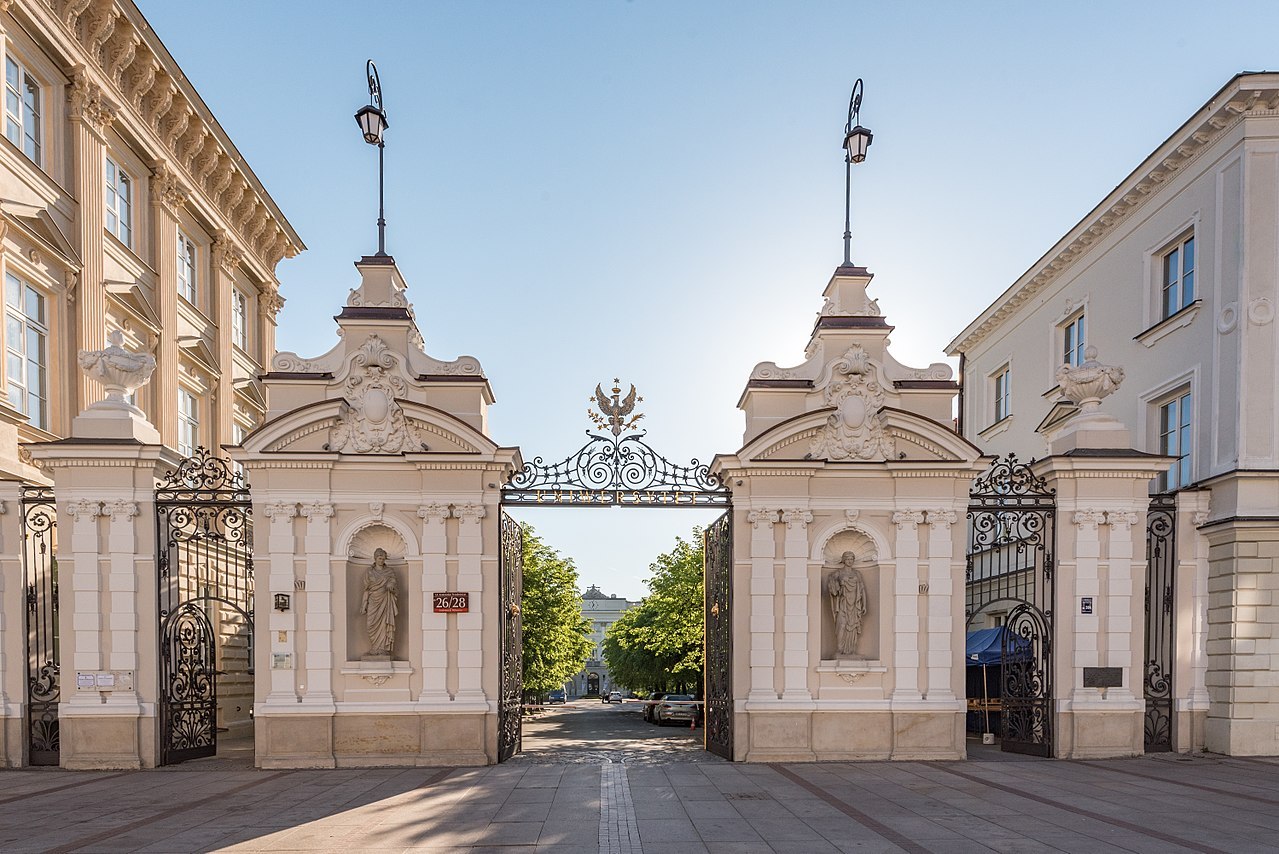
University of Warsaw
 Poland
"Poland's largest and most prestigious public research university"
About
The University of Warsaw, known in Polish as Uniwersytet Warszawski, is Poland's largest and most prominent institution of higher learning. Founded on November 19, 1816, it has grown into a sprawling academic hub that spans 126 buildings and educational complexes across the capital. With over 18 faculties, it offers 37 fields of study and 100 specializations, covering everything from the humanities to technical and natural sciences. The university's scale and reputation make it a cornerstone of Polish education and research.
While not a film or television production, the university has a rich history that has shaped its identity. It has weathered partitions, wars, and political upheavals, emerging as a resilient symbol of intellectual pursuit. Its alumni include Nobel laureates, prominent politicians, and cultural figures, reflecting its enduring impact on Polish society. Today, it continues to attract students from across the globe, fostering a vibrant academic community that balances tradition with innovation.
Mission
The University of Warsaw operates on the principles of unity of teaching and research, and the harmonious development of all branches of knowledge. It aims to provide high-quality education across humanities, social sciences, and natural sciences, while fostering critical thinking and academic freedom. The university is committed to advancing knowledge through research, promoting international collaboration, and serving as a cultural and intellectual center for Poland and Europe.
History
The University of Warsaw was founded on November 19, 1816, during the Congress Kingdom of Poland, when Warsaw was emerging as a major intellectual center. Its establishment followed the partition of Poland, and the university quickly became a symbol of Polish scholarly ambition. The institution was closed following the November Uprising of 1830, but reopened in 1857 under Russian rule, only to be closed again after the January Uprising of 1863. It operated as a Polish-language institution during the interwar period, but suffered heavy losses during World War II, with many faculty and students killed or imprisoned.
After the war, the university was rebuilt and expanded, becoming a state institution under the communist regime. It regained full autonomy after 1989, and in the following decades it modernized its curriculum and facilities. Today, the University of Warsaw is a leading research university in Central Europe, participating in international consortia such as the 4EU+ European University Alliance. It continues to honor its long tradition of academic excellence while adapting to the challenges of the 21st century.
Subdivisions
Faculty of Biology
Conducts research and teaching in biological sciences, including molecular biology, ecology, and genetics.
Faculty of Chemistry
Focuses on chemical research and education, with laboratories for organic, inorganic, and physical chemistry.
Faculty of Physics
Known for its research in quantum physics, optics, and condensed matter, with several Nobel laureates among its alumni.
Faculty of Mathematics, Informatics and Mechanics
A leading center for mathematical and computational sciences, offering programs in pure and applied mathematics, computer science, and mechanics.
Faculty of History
Covers a wide range of historical periods and regions, with strong archival and museum partnerships.
Faculty of Modern Languages
Offers instruction in numerous languages and literatures, from European to non-European languages.
Faculty of Economics
Provides education in economics, finance, and management, with research centers on global economic issues.
Faculty of Philosophy and Sociology
Examines philosophical and sociological questions, with a strong tradition in analytic philosophy and social theory.
Faculty of Geography and Regional Studies
Studies physical and human geography, regional development, and environmental management.
Faculty of Geology
Focuses on earth sciences, including geology, mineralogy, and paleontology.
Faculty of Applied Linguistics
Specializes in applied linguistics, translation studies, and language teaching methodologies.
Faculty of Journalism, Information and Book Studies
Educates future media professionals, information scientists, and librarians.
Faculty of "Artes Liberales"
Offers interdisciplinary humanities programs, blending classical and modern approaches.
Institute of Oriental Studies
Covers Asian and African languages, cultures, and religions, with specialized research units.
Notable People
Maria Curie-Skłodowska
Alumna · 1891-1893
Nobel laureate in Physics and Chemistry, pioneer in radioactivity research.
Czesław Miłosz
Alumnus · 1930s
Nobel laureate in Literature, poet and essayist.
Lech Kaczyński
Alumnus · 1970s
President of Poland from 2005 to 2010.
Alfred Tarski
Alumnus and professor · 1920s-1930s
Mathematician and logician, known for Tarski's undefinability theorem.
Joseph Rotblat
Alumnus · 1930s
Nobel Peace Prize laureate for nuclear disarmament efforts.
Milestones
1816
University of Warsaw founded on November 19.
1830
Closed after the November Uprising; reopened in 1857.
1863
Closed again after the January Uprising.
1915
Reopened as a Polish university during World War I.
1939
Closed during the Nazi occupation; underground education continued.
1945
Reopened after World War II.
1989
Regained autonomy after the fall of communism.
2019
Joined the 4EU+ European University Alliance.
Sources
Organization Info
- Founded
- November 19, 1816
- Headquarters
- Warsaw
- Country
- Poland
- Rector
- Prof. Alojzy Z. Nowak
- Type
- University
- Students
- 36,000
- Academic staff
- 3,500
- Buildings
- 126
Financials
- Employees
- 6300
Official Website
www.uw.edu.pl/
Join the community
fans discussing