University of Vienna
 Austria
"Oldest university in the German-speaking world"
About
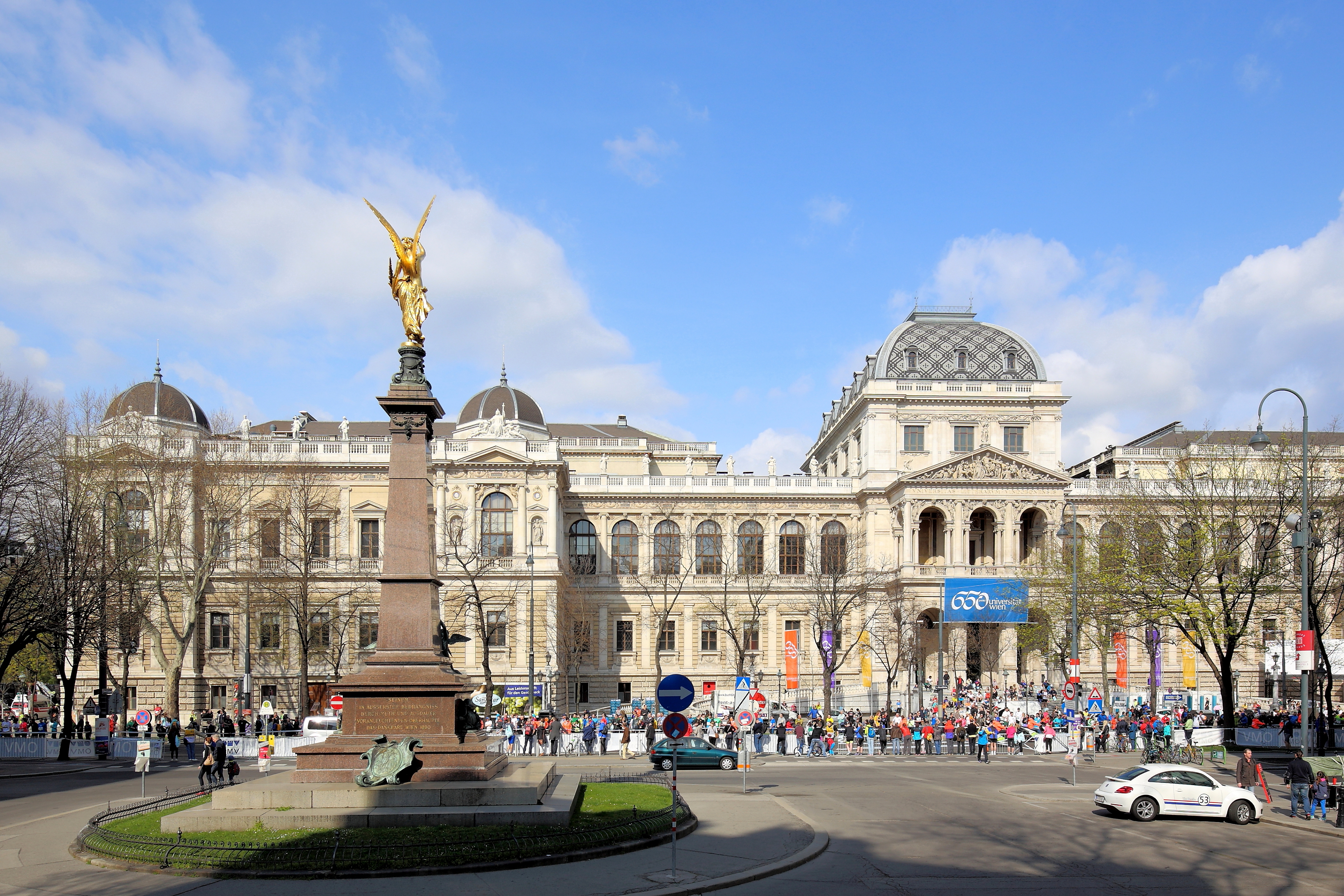
The University of Vienna, known in German as Universität Wien, stands as a venerable institution of higher learning and a cornerstone of academic life in Austria. Founded on March 12, 1365, by Duke Rudolph IV, it holds the distinction of being the oldest university in the German-speaking world and one of the oldest continuously operating universities in Europe. For over six and a half centuries, it has been a hub for intellectual inquiry, attracting students and fostering research from across the globe. Its main building, an imposing neo-Renaissance structure on the Ringstrasse completed in 1884, serves as both an architectural landmark and a symbol of the university's deep roots in Vienna's cultural landscape.
Today, the University of Vienna is one of Europe's largest universities, enrolling approximately 90,000 students and employing around 11,000 individuals, including a substantial academic staff. This vast community engages in a wide spectrum of academic pursuits across its numerous faculties and centers. The university's influence extends far beyond its campus walls, thanks to its rich history of producing world-renowned scholars and groundbreaking research. It has been home to numerous Nobel laureates, pivotal figures in psychoanalysis like Sigmund Freud, and influential philosophers such as Karl Popper, cementing its place as a significant contributor to global intellectual heritage.
Mission
The University of Vienna is committed to the pursuit of knowledge and the advancement of research across a wide array of disciplines. Its core mission involves providing high-quality education, fostering interdisciplinary collaboration, and contributing to societal progress through academic inquiry and innovation. The university strives to create an environment that encourages critical thinking, academic freedom, and the development of well-rounded individuals prepared to meet the challenges of a globalized world. It aims to uphold its historical legacy while embracing new challenges and opportunities in research and teaching, serving as a vital hub for intellectual exchange and discovery.
History
Duke Rudolph IV established the University of Vienna on March 12, 1365, modeling it after the University of Paris with faculties for theology, law, arts, and medicine. While the charter was issued in 1365, theological instruction did not begin until 1384 under Duke Albert III. The institution underwent significant reorganization in 1554 during the Counter-Reformation under Jesuit influence. Major modernization efforts occurred in the 18th century under Empress Maria Theresa and Emperor Joseph II, which updated curricula and administrative structures. The 19th century brought demands for academic freedom following the 1848 revolutions and the completion of the iconic neo-Renaissance main building on the Ringstrasse in 1884.
In 1897, the university became more inclusive by admitting women to its philosophical faculty, with full admission following shortly after. A dark chapter occurred between 1938 and 1945 during Nazi rule, marked by the dismissal of numerous faculty members and ideological alignment with the regime. Post-World War II, the university focused on rebuilding its international standing. A pivotal structural change occurred in 2004 when the medical faculty separated to form the independent Medical University of Vienna.
Subdivisions
Faculty of Catholic Theology
Focuses on religious studies, theology, and church history.
Faculty of Protestant Theology
Dedicated to Protestant theological studies and related disciplines.
Faculty of Law
Provides legal education and research in national and international law.
Faculty of Business, Economics and Statistics
Covers economics, business administration, and statistical methods.
Faculty of Computer Science
Advances research and teaching in computer science and information technology.
Faculty of Historical and Cultural Studies
Explores history, archaeology, and cultural heritage.
Faculty of Philological and Cultural Studies
Studies languages, literature, and cultural contexts.
Faculty of Philosophy and Education
Engages with philosophical thought and educational theory.
Faculty of Psychology
Conducts research and training in psychological sciences.
Faculty of Social Sciences
Investigates social structures, politics, and human behavior.
Faculty of Mathematics
Pursues advanced mathematical theory and application.
Faculty of Physics
Researches fundamental physical laws and quantum technologies.
Faculty of Chemistry
Focuses on chemical processes and material science.
Faculty of Earth Sciences, Geography and Astronomy
Studies the Earth's systems, geography, and celestial bodies.
Faculty of Life Sciences
Explores biology, genetics, and environmental science.
Faculty of Translation Studies
Specializes in language translation and intercultural communication.
Notable People
Erwin Schrödinger
Alumnus and Professor · 1920s-1930s
Nobel Prize in Physics (1933)
Victor Franz Hess
Alumnus and Professor · Early 20th Century
Nobel Prize in Physics (1936)
Konrad Lorenz
Alumnus and Professor · Mid-20th Century
Nobel Prize in Physiology or Medicine (1973)
Sigmund Freud
Alumnus and Lecturer · Late 19th - Early 20th Century
Founder of Psychoanalysis
Karl Popper
Alumnus · Early 20th Century
Influential Philosopher of Science
Lise Meitner
Researcher · Early 20th Century
Pioneering Nuclear Physicist
Ludwig Wittgenstein
Alumnus · Early 20th Century
Influential Philosopher
Gustav Mahler
Alumnus · Late 19th Century
Renowned Composer and Conductor
Milestones
1365
Founded by Duke Rudolph IV.
1384
Theological instruction begins.
1554
Reorganized under Jesuit administration.
1749
Reforms initiated by Maria Theresa.
1884
Main building on the Ringstrasse completed.
1897
Women first admitted to study.
1938-1945
Period of Nazi rule and significant faculty dismissals.
2004
Medical faculty separated to form the Medical University of Vienna.
2015
Celebrated its 650th anniversary.
Sources
Organization Info
- Founded
- 1365-03-12
- Headquarters
- Vienna
- Country
- Austria
- Rector
- Heinz W. Engl
- Type
- University
- Oldest university in the German-speaking world
- Number of students
- Approx. 90,000
- Number of employees
- Approx. 11,000
- Annual Budget
- Approx. €569 million (2022)
Financials
- Budget
- €569 million (2022)
- Employees
- 11,000
Official Website
www.univie.ac.at/en/
Join the community
fans discussing