University of Chicago
 United States
"Crescat scientia; vita excolatur, Let knowledge grow; let life be enriched."
About
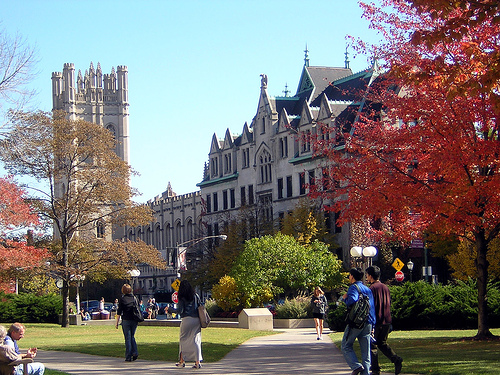
The University of Chicago is a private research university tucked into the Hyde Park neighborhood, right along Lake Michigan. Its Gothic quadrangles and modern labs house a community that takes ideas seriously, maybe more seriously than anywhere else. The culture here prizes rigorous debate, free expression, and the kind of questioning that makes you rethink what you thought you knew. That ethos has earned it a reputation as a place where the life of the mind isn't just encouraged; it's the whole point.
Founded in 1890 by John D. Rockefeller with support from the American Baptist Education Society, the university quickly became a powerhouse. It's organized into an undergraduate College and four graduate divisions: Arts & Humanities, Biological Sciences, Physical Sciences, and Social Sciences. Alongside those sit professional schools like the Booth School of Business, the Pritzker School of Medicine, and the Law School, plus research institutes such as the Oriental Institute. The university also co-manages Argonne National Laboratory, and its medical arm, UChicago Medicine, serves patients across Illinois.
With an endowment over $10 billion, UChicago ranks among the wealthiest universities globally. Its faculty and alumni have racked up Nobel Prizes, especially in economics, the Chicago School of Economics reshaped policy worldwide. The university's motto, 'Crescat scientia; vita excolatur' ('Let knowledge grow; let life be enriched'), sums up its mission: push boundaries, yes, but also make the world better.
Mission
UChicago's mission is to produce knowledge that stands up to scrutiny. The university describes itself as one of the world's leading research institutions, dedicated to free expression and the open exchange of ideas. Its goal is to inspire scholars to ask hard questions, challenge assumptions, and pursue truth, no matter where it leads. The motto 'Crescat scientia; vita excolatur', 'Let knowledge grow; let life be enriched', reflects that dual commitment to advancing understanding and improving human life.
History
John D. Rockefeller's gift of $600,000, matched by the American Baptist Education Society, launched the University of Chicago in 1890. William Rainey Harper, the first president, recruited a stellar faculty and opened the university in 1892 with 594 students. The university was coeducational from the start, and its early faculty included philosopher John Dewey, who helped shape its pragmatic approach to learning.
During World War II, UChicago played a pivotal role in the Manhattan Project. In 1942, Enrico Fermi and his team achieved the first controlled nuclear chain reaction in a squash court under Stagg Field, a moment that changed the course of history. After the war, the university continued to expand, opening the Oriental Institute and growing its medical enterprise.
The postwar era saw the rise of the Chicago School of Economics, with figures like Milton Friedman and George Stigler reshaping economic thought. The university also became a leader in sociology, law, and political science. In the 21st century, UChicago has focused on interdisciplinary research, urban engagement, and initiatives like the Crime Lab and quantum computing partnerships.
Subdivisions
College of the University of Chicago
The undergraduate division, known for its rigorous core curriculum and emphasis on critical thinking.
Booth School of Business
Graduate business school, famous for the Chicago approach to economics and finance.
Pritzker School of Medicine
Medical school that trains physicians and researchers, affiliated with UChicago Medicine.
Law School
Professional law school known for law and economics scholarship.
Harris School of Public Policy
Graduate school focused on public policy analysis and leadership.
Divinity School
Graduate school for religious studies and theology.
School of Social Service Administration
Graduate school for social work and social welfare research.
Graham School of Continuing Liberal and Professional Studies
Offers continuing education and professional development programs.
Graduate Library School
Trains librarians and information scientists.
Institute of Politics
Nonpartisan institute fostering political engagement and civic discourse.
Notable People
John Dewey
Founder, philosopher · 1894-1904
Pragmatist philosopher who shaped the university's early academic philosophy and influenced American education.
Robert Zimmer
President (2006-2021), Chairman · 2006-2023
Led the university for 15 years, championing free expression and academic freedom.
Milton Friedman
Professor of Economics · 1946-1977
Nobel laureate and leader of the Chicago School of Economics, influencing monetary policy worldwide.
Jens Ludwig
Director, Crime Lab · 2000s-present
Leading scholar on gun violence prevention, using data to inform policy.
Enrico Fermi
Professor of Physics · 1942-1954
Led the team that achieved the first controlled nuclear chain reaction at Chicago Pile-1.
Milestones
1890
University founded by John D. Rockefeller and the American Baptist Education Society.
1942
First controlled nuclear chain reaction achieved at Chicago Pile-1.
1969
Student protests over the Vietnam War and the university's ties to the military.
2006
Robert Zimmer becomes president, emphasizing free expression.
2023
Robert Zimmer passes away in May.
2026
IBM and the University of Chicago demonstrate quantum advantage on logical circuits.
Departments
Sources
Organization Info
- Founded
- 1890
- Headquarters
- 5801 South Ellis Avenue, Chicago, Illinois 60637
- Country
- United States
- Chairman
- Robert Zimmer
- Type
- University
- Employees
- 2350
- Founder
- John D. Rockefeller, American Baptist Education Society, Silas B. Cobb, Charles L. Hutchinson, Martin A. Ryerson, John Dewey
Financials
- Revenue
- $2.3 billion
- Endowment
- $10 billion
- Employees
- 2350
Official Website
uchicago.edu/
Join the community
fans discussing