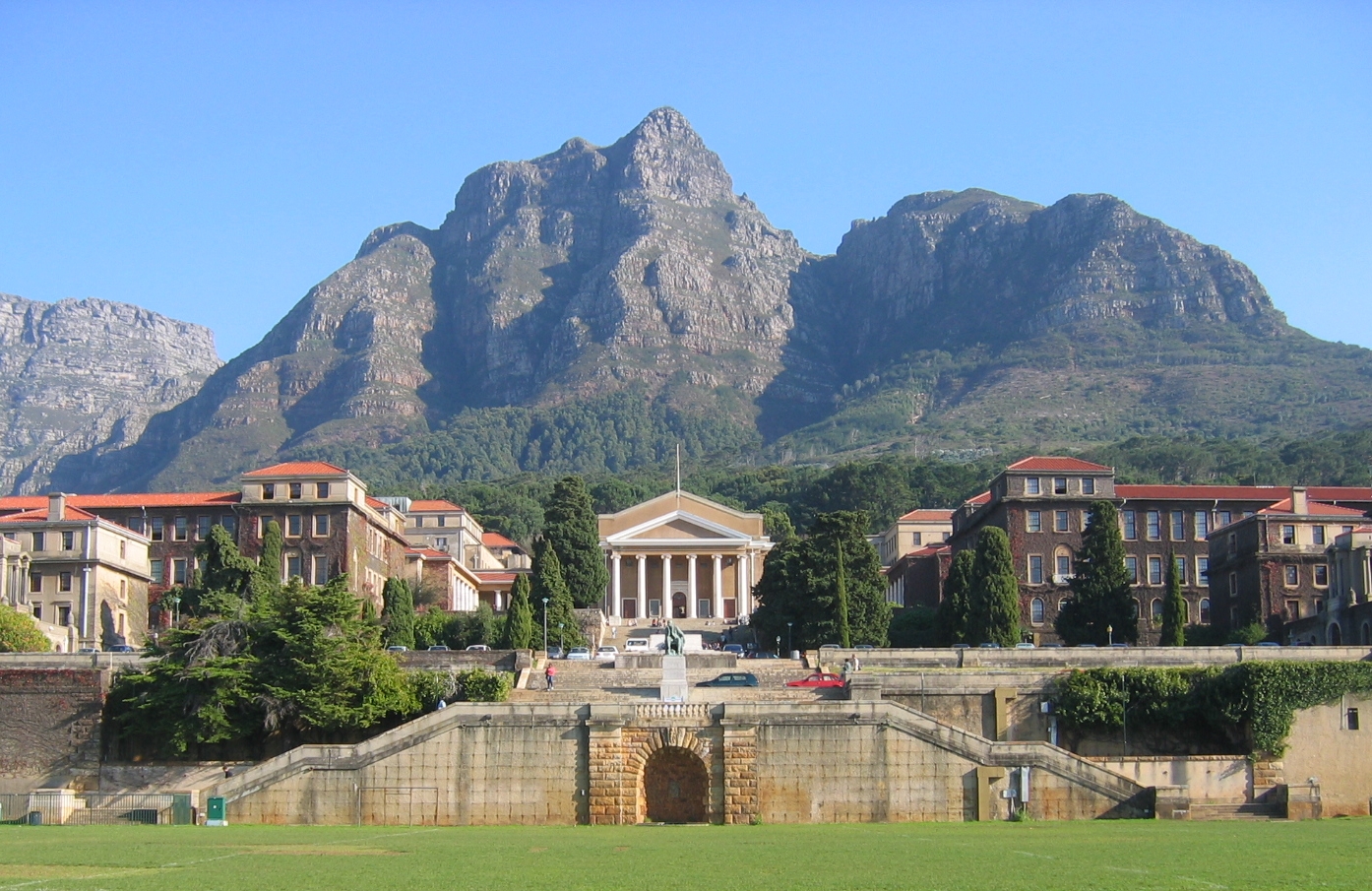
University of Cape Town
 South Africa
"Africa's leading research university"
About
The University of Cape Town (UCT) is the oldest university in South Africa, founded in 1829 as the South African College. It gained full university status in 1918, making it a pioneer in higher education across sub-Saharan Africa. As a public research institution, UCT has consistently ranked as the top university on the continent, currently holding the 184th spot globally in the QS World University Rankings 2027.
Set on the slopes of Devil's Peak in Cape Town, UCT's main campus in Rondebosch is a striking blend of historic architecture and modern research facilities. The university operates six faculties: Commerce, Engineering and the Built Environment, Health Sciences, Humanities, Law, and Science. With 57 academic departments, it offers programs from undergraduate to doctoral level, spanning NQF levels 7 through 10.
UCT is a hub for research that addresses pressing African and global challenges. Its numerous institutes and units, such as the newly launched SAMRC-UCT AI for African Population Health Unit, apply cutting-edge technology to improve health outcomes across the continent. The university's commitment to social justice and decolonization has made it a focal point for debates on higher education's role in shaping a more equitable society.
Mission
UCT's mission is to be a leading research university that contributes to the advancement of knowledge and the betterment of society. It aims to foster critical thinking, promote social justice, and address the complex challenges facing Africa and the world. The university is dedicated to academic excellence, innovation, and the development of leaders who will make a positive impact.
History
UCT's story begins on October 1, 1829, when the South African College opened its doors in Cape Town as a small secondary school for boys. It was a modest start, but the institution quickly grew in ambition. In 1874, it moved to its current location on the slopes of Devil's Peak, and in 1880 it began offering university-level courses. The college received full university status in 1918, becoming the University of Cape Town and one of the first universities in sub-Saharan Africa.
The early decades of the 20th century saw UCT establish itself as a serious research institution. It expanded its faculties, attracted international scholars, and built a reputation for academic rigor. During the apartheid era, UCT was a rare space of relative openness, admitting students of all races despite the government's policies. The university became a site of resistance, with students and faculty actively opposing the regime.
In recent years, UCT has faced new challenges. The #FeesMustFall protests in 2015 and 2016 highlighted issues of access and affordability. The university has also grappled with questions of decolonization, including the removal of the Rhodes statue in 2015. Most recently, UCT has been navigating a leadership crisis and financial pressures, including the loss of donor funding over its stance on the Gaza conflict. Despite these hurdles, UCT remains a beacon of higher learning in Africa.
Subdivisions
Faculty of Commerce
Offers programs in business, economics, accounting, and related fields.
Faculty of Engineering and the Built Environment
Covers engineering disciplines, architecture, and construction management.
Faculty of Health Sciences
Includes medicine, nursing, and allied health programs.
Faculty of Humanities
Spans arts, social sciences, languages, and philosophy.
Faculty of Law
Provides legal education and research.
Faculty of Science
Focuses on natural sciences, mathematics, and computer science.
Notable People
Desmond Tutu
Alumnus, Archbishop · 1954-1958
Nobel Peace Prize laureate for his anti-apartheid activism
J.M. Coetzee
Alumnus, Writer · 1960-1963
Nobel Prize in Literature
Aaron Klug
Alumnus, Scientist · 1945-1949
Nobel Prize in Chemistry
Allan Cormack
Alumnus, Physicist · 1944-1945
Nobel Prize in Physiology or Medicine for CT scanning
Max Theiler
Alumnus, Virologist · 1916-1918
Nobel Prize in Physiology or Medicine for yellow fever vaccine
Milestones
1829
Founded as the South African College
1918
Received full university status
2015
Rhodes statue removed after student protests
2026
Launched the All-Africa Rankings Initiative with AppliedHE
2026
Established the SAMRC-UCT AI for African Population Health Unit
Departments
Sources
Organization Info
- Founded
- October 1, 1829
- Headquarters
- Cape Town, South Africa
- Country
- South Africa
- Vice-Chancellor
- Professor Mosa Moshabela
- Type
- University
- Employees
- 5442
- Faculties
- 6
- Academic Departments
- 57
- Nobel Laureates
- 5
Financials
- Employees
- 5442
Official Website
www.uct.ac.za/
Join the community
fans discussing