University of Bonn
 Germany
"Rhenish Friedrich Wilhelm University of Bonn"
About
The University of Bonn, officially the Rhenish Friedrich Wilhelm University of Bonn, is a public research university in Bonn, North Rhine-Westphalia, Germany. Founded on 18 October 1818 by Frederick William III of Prussia, it traces its roots to the Academy of the Prince-elector of Cologne, established in 1777. Today, the university enrolls more than 35,000 students and employs around 4,500 academic staff, making it one of the largest and most prominent institutions of higher education in the country.
The university is organized into seven faculties: Catholic Theology, Protestant Theology, Law and Economics, Medicine, Arts, Mathematics and Natural Sciences, and Agriculture. It has earned particular distinction in mathematics, physics, economics, and the humanities, and its research output consistently ranks among the best in Europe. The institution holds the University of Excellence designation under Germany's Excellence Strategy, a status that reflects its standing among the nation's elite research universities.
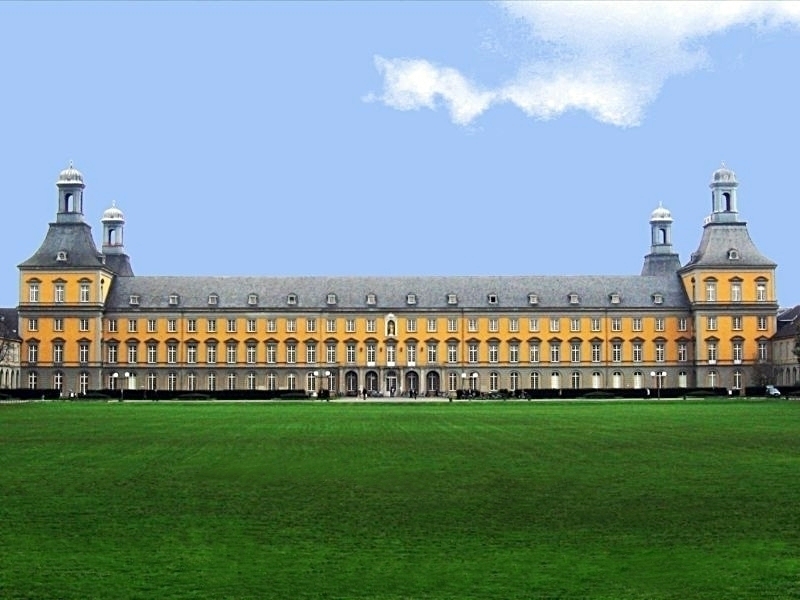
Bonn's campus is spread across the city, with the historic main building serving as a visual anchor. The university maintains a strong international profile, offering joint degree programs such as the German and Comparative Literature master's with the University of St Andrews, and it participates in major research collaborations, including the German eROSITA consortium for X-ray sky surveys. Its alumni and faculty include Nobel laureates, philosophers, and scientists who have shaped modern thought.
Mission
The University of Bonn is dedicated to research-led teaching and the advancement of fundamental knowledge across all disciplines. It aims to foster critical thinking, international collaboration, and societal engagement, preparing students to address complex global challenges. The university is committed to excellence in research, as evidenced by its participation in the Excellence Strategy and its support for early-career researchers.
History
The origins of the University of Bonn lie in the Academy of the Prince-elector of Cologne, founded in 1777. That institution was dissolved during the French occupation of the Rhineland, but the territory passed to Prussia in 1815. Frederick William III of Prussia then established the Rhine University on 18 October 1818, deliberately linking it to the earlier academy. The new university quickly attracted prominent scholars and became a center of intellectual life in the Rhineland.
During the Nazi era, the university suffered severe disruption; many faculty members were dismissed for racial or political reasons, and research in certain fields was curtailed. After the Second World War, the university reopened and gradually rebuilt its reputation. In 2012, it was awarded the title of University of Excellence under Germany's Excellence Initiative, a status it retains.
In recent years, Bonn has expanded its international collaborations and launched innovative programs. For example, a joint master's in German and Comparative Literature with the University of St Andrews received renewed DAAD funding for four more years in 2026. The university also introduced a professional degree in Protection Against Sexualized Violence and Abuse of Power in Organizations for the 2026/27 winter semester. Its cultural footprint includes participation in the Bonn Carnival, where professors have delivered humorous political speeches for generations.
Subdivisions
Faculty of Catholic Theology
Focuses on theological studies, including biblical research and church history.
Faculty of Protestant Theology
Covers Protestant theology, ethics, and church history.
Faculty of Law and Economics
Offers programs in law, economics, and business administration.
Faculty of Medicine
Provides medical education and conducts biomedical research.
Faculty of Arts
Encompasses humanities disciplines such as philosophy, history, and languages.
Faculty of Mathematics and Natural Sciences
Includes mathematics, physics, chemistry, biology, and earth sciences.
Faculty of Agriculture
Focuses on agricultural sciences, food technology, and nutrition.
Notable People
Friedrich Nietzsche
Faculty (Classical Philology) · 1869-1879
Philosopher and philologist, developed influential philosophical works.
Wolfgang Pauli
Faculty (Physics) · 1923-1928
Nobel Prize in Physics 1945 for the exclusion principle.
Konrad Adenauer
Alumnus (Law) · 1894-1897
First Chancellor of the Federal Republic of Germany.
Harald zur Hausen
Alumnus (Medicine) · 1960s
Nobel Prize in Physiology or Medicine 2008 for discovering HPV causes cervical cancer.
Heinrich Hertz
Faculty (Physics) · 1883-1885
Confirmed electromagnetic waves, leading to radio technology.
Karl Barth
Alumnus (Theology) · 1904-1908
Influential Protestant theologian, author of Church Dogmatics.
August Kekulé
Faculty (Chemistry) · 1867-1896
Discovered the ring structure of benzene.
University and State Library Bonn
Affiliated institution
Central library serving the university and the region.
BASA-Museum
Affiliated museum
Museum of antiquities and casts of classical sculptures.
Milestones
1777
Academy of the Prince-elector of Cologne founded.
1818-10-18
University of Bonn founded by Frederick William III of Prussia.
1933-1945
Nazi era; many faculty dismissed, research disrupted.
1946
University reopened after World War II.
2012
Awarded University of Excellence status.
2026
New professional degree in Protection Against Sexualized Violence launched.
Departments
Sources
Organization Info
- Founded
- October 18, 1818
- Headquarters
- Bonn
- Country
- Germany
- Type
- University
- Employees
- 4,500
- Founder
- Frederick William III of Prussia
- Students
- 35,000+
- Faculties
- 7
Financials
- Employees
- 4500
Official Website
www.uni-bonn.de/en
Join the community
fans discussing