 Canada
“A loose, good-natured spoof that is less a coherent movie than a series of sketches, some of which are very funny.”
A.O. Scott
The New York Times
Part of a Collection
Undercover Brother Collection
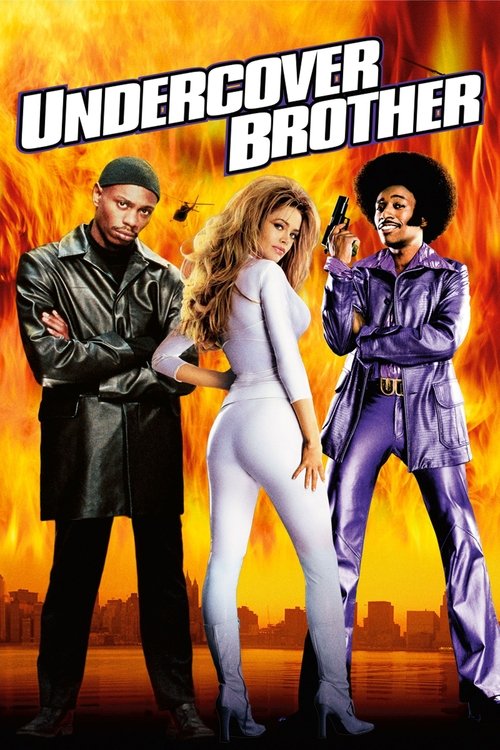
In 2002, director Malcolm D. Lee took a sharp turn from his debut feature, the romantic comedy The Best Man, to deliver a broad, affectionate spoof of 1970s blaxploitation cinema. The film arrived at a moment when the spy parody genre was riding high on the Austin Powers franchise, but Undercover Brother carved its own lane by targeting racial stereotypes and assimilationist pressures rather than just groovy costumes. At its center is Eddie Griffin as the afro-sporting, velvet-suited secret agent who works for the B.R.O.T.H.E.R.H.O.O.D., a clandestine organization whose absurdly long acronym barely conceals its mission: protect Black culture from covert white-supremacist plots.
The film was shot on a $25 million budget across Toronto and Los Angeles, with custom-made afro wigs that took over an hour each to style for Griffin. The supporting cast is a who's-who of early-2000s comedy talent: Dave Chappelle as a paranoid tech guru, Neil Patrick Harris as a suburban dweeb desperate to be down, and Denise Richards as the White She Devil, a villainess whose name leaves no ambiguity about her allegiances. James Brown even shows up as himself, reportedly so delighted by the script that he took a pay cut to appear. The soundtrack, composed by jazz-fusion legend Stanley Clarke and featuring tracks from Curtis Mayfield and Isaac Hayes, gives the whole thing a funky, period-authentic pulse.
Undercover Brother opened on May 31, 2002, and grossed $41.6 million worldwide. Critical reception was mixed, it currently holds a 67% on Rotten Tomatoes and a 56 on Metacritic, but the film found a devoted audience on home video and streaming. It's often compared to Austin Powers for its affectionate genre parody, but its satire of systemic racism gives it a sharper edge. The film's legacy includes a 2019 direct-to-video sequel and a lasting reputation as a cult comedy that celebrates Black culture while poking fun at the very idea of a monolithic Black identity.
Availability and pricing can change. Confirm on the provider's site before purchasing.
Undercover Brother opens with a montage of 1970s blaxploitation heroics before introducing its protagonist, a charismatic secret agent with a towering afro and a wardrobe full of velvet suits. By day he's a smooth-talking man about town; by night he works for the B.R.O.T.H.E.R.H.O.O.D., an underground organization dedicated to protecting Black culture and advancing the interests of Black Americans. The agency is led by the stern but loving Chief, who keeps a close eye on threats both obvious and insidious.
The central conflict emerges when a shadowy white-supremacist organization called The Man launches a scheme to sabotage the presidential campaign of General Warren Boutwell, the first viable Black candidate for the White House. The Man's primary weapon is a hypnotic device called the Colonizer, which can turn Black people into obedient, assimilationist drones. To execute this plot, The Man deploys his top operative, the seductive and ruthless White She Devil, who uses her wiles and a series of elaborate traps to neutralize Boutwell's campaign.
Undercover Brother is assigned to infiltrate The Man's operation. He is paired with Sistah Girl, a sharp, no-nonsense B.R.O.T.H.E.R.H.O.O.D. agent who initially clashes with his flamboyant, retro style. Together they assemble a team that includes Conspiracy Brother, a paranoid tech expert who lives in a van and believes everything is a plot; Smart Brother, a brainy but nerdy analyst; and Lance, a white suburban dweeb who idolizes Black culture and serves as comic relief. The team must stop The Man's plot while dealing with internal friction, particularly Undercover Brother's resistance to updating his 1970s fashion sense and Sistah Girl's insistence on modern, professional tactics.
The story proceeds through a series of comedic set pieces: Undercover Brother infiltrates a suburban country club, a fashion show, and a high-tech villain lair. The Man's plan escalates when he kidnaps General Boutwell and replaces him with a doppelgänger programmed to lose the election. As the team races against time, Undercover Brother must confront his own outdated methods and learn to work as part of a modern team. The plot builds toward a final confrontation at The Man's secret headquarters, where the team must disable the Colonizer device, rescue the real general, and expose the conspiracy to the public, all while maintaining their cover and their dignity.
Undercover Brother trailer
Critical Consensus
Undercover Brother is a sporadically funny spoof that leans heavily on blaxploitation nostalgia and Eddie Griffin's charisma. While its satire of racial stereotypes is clever in spots, the humor is uneven and the plot feels stretched. It's an amiable, low-stakes comedy that succeeds as a lighthearted homage but doesn't fully land its punches.
“A loose, good-natured spoof that is less a coherent movie than a series of sketches, some of which are very funny.”
A.O. Scott
The New York Times
“Griffin is a charismatic comic lead, but the film too often settles for broad, obvious gags when it could have been sharper.”
David Rooney
Variety
“A silly, affectionate parody that works best when it's not trying too hard. The cast is game, but the script lacks the bite of the best blaxploitation satires.”
Michael Wilmington
Chicago Tribune
“The movie is a lot of fun in a goofy, low-ambition way. Eddie Griffin has the right swagger, and the supporting cast is full of welcome faces.”
Roger Ebert
Chicago Sun-Times
“A hit-and-miss affair that coasts on its retro vibe and Griffin's energy, but never quite becomes the smart, subversive comedy it aspires to be.”
Owen Gleiberman
Entertainment Weekly
Eddie Griffin
Undercover Brother
Chris Kattan
Mr. Feather
Denise Richards
White She Devil
Aunjanue Ellis-Taylor
Sistah Girl
Chi McBride
The Chief
Neil Patrick Harris
Lance
Dave Chappelle
Conspiracy Brother
Gary Anthony Williams
Smart Brother
Billy Dee Williams
Gen. Warren Boutwell
Robert Trumbull
The Man
Robert Townsend
Mr. UB
James Brown
Himself
Director
Malcolm D. Lee
Writers
Michael McCullers, John Ridley
Composer
Stanley Clarke
Cinematographer
Tom Priestley Jr.
Producers
Brian Grazer, Michael Jenkinson, Damon Lee, Greg McKay
BET Comedy Awards (2003)
Outstanding Directing for a Theatrical Film: Nominated
Black Reel Awards (2003)
Best Actor: Nominated
Black Reel Awards (2003)
Best Actress: Nominated
NAACP Image Awards (2003)
Outstanding Supporting Actress in a Motion Picture: Nominated
Join the community
fans discussing