 United States
“John Candy gives a performance that is warm, funny, and surprisingly touching. He makes Buck into a real person, not just a cartoon.”
Roger Ebert
Chicago Sun-Times
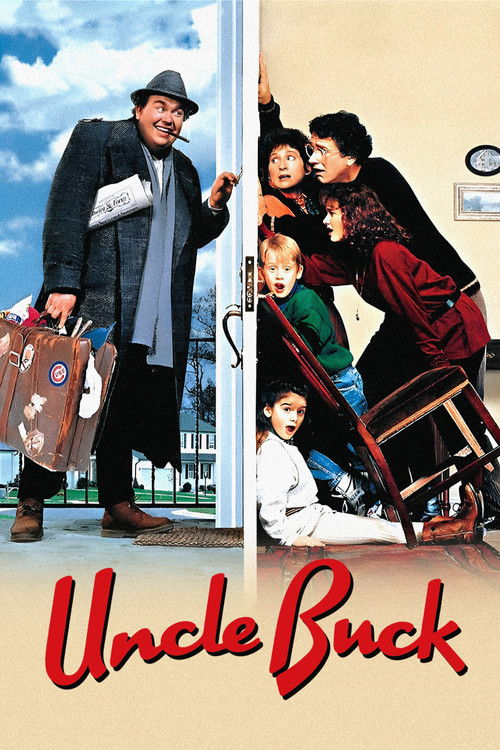
In the summer of 1989, John Hughes delivered a family comedy that would become a defining vehicle for John Candy's talents. The film centers on Buck Russell, a perpetually unemployed bachelor in his late thirties whose life of junk food and avoidance suddenly collides with responsibility when he is asked to watch his brother's three children for several days. What follows is a story that balances broad physical comedy with genuine emotional stakes, as Buck's unorthodox methods clash with the expectations of his teenage niece, the skepticism of his girlfriend, and the judgment of the neighbors.
Hughes, fresh off his successful run of teen dramas like The Breakfast Club and Ferris Bueller's Day Off, turned his attention to family dynamics with this film. Shot on location in Chicago and its suburbs over 42 days, the production marked a return to the writer-director's Midwestern roots. The cast included relative newcomers like Macaulay Culkin, whose performance as the precocious Miles would help launch his career, and stage veteran Laurie Metcalf, who turned a minor role into one of the film's most memorable characters.
At a budget of $15 million, the film grossed over $79 million domestically, making it one of the year's most profitable comedies. Its enduring popularity has kept it in circulation on cable television and streaming platforms, where it continues to find new audiences. The film's central performance remains its strongest asset: Candy brings a warmth and vulnerability to Buck that elevates the material beyond simple slapstick.
Stream
Rent
Buy
Availability and pricing can change. Confirm on the provider's site before purchasing.
Buck Russell lives a life free of obligation. He spends his days in a Chicago apartment cluttered with sports memorabilia and empty pizza boxes, working odd jobs that never last, and maintaining a relationship with his girlfriend Chanice that is held together by her patience and his charm. Chanice works at a tire shop and has been pushing Buck to find direction, but he deflects every serious conversation with a joke or a promise he never keeps.
That equilibrium shatters when Buck's brother Bob calls with a crisis. Bob's father-in-law has been hospitalized, and he and his wife Cindy need to leave town immediately. They have three children: fifteen-year-old Tia, eight-year-old Miles, and six-year-old Maizy. With no other options, they ask Buck to move into their suburban home and watch the kids for a few days. Buck agrees reluctantly, and the arrangement begins with immediate friction.
Tia is the primary source of conflict. She is in full rebellion mode, wearing dark makeup, listening to moody music, and treating Buck with open contempt. She resents being left with a man she considers a loser and tests every boundary he sets. Miles, by contrast, is a curious boy who carries a toolbox everywhere and wants to fix anything that seems broken. He takes an immediate liking to Buck's chaotic energy. Maizy is sweet and trusting, and she bonds with her uncle over his oversized pancakes and his willingness to read her stories at bedtime.
Buck's approach to parenting is improvisational. When Miles gets into trouble at school for hitting a classmate, Buck does not punish him but instead takes him to see a grimy auto repair shop, explaining that this is where people end up if they cannot control their temper. When Maizy is afraid of the dark, Buck tells her there is nothing under the bed except the floor. These moments work, but they do not sit well with Marcie Dahlgren-Frost, the neighbor who watches the Russell house with suspicion and reports every infraction to Bob and Cindy by phone.
The deeper problem is Tia. She sneaks out of the house at night to see her boyfriend Bug, a high school student whose reputation precedes him. Buck tracks her down at Bug's house, where he finds the two alone. He does not yell or threaten. He simply tells Bug that he will be watching, and he takes Tia home. The confrontation does not win her over, but it establishes that Buck will not back down. Meanwhile, Chanice grows frustrated with Buck's absence and his refusal to take their relationship seriously. She gives him an ultimatum, and Buck must decide whether he can commit to anything at all.
The tension between Buck and Tia escalates when she sneaks out again, this time to a party at Bug's house while his parents are away. Buck discovers her missing and drives through the night to find her. What he finds will force both of them to see each other differently.
Uncle Buck (1989) Original Trailer [FHD]
Critical Consensus
John Candy's charismatic performance and John Hughes's signature blend of humor and heart elevate Uncle Buck above its formulaic plot. The film remains a beloved family comedy despite mixed critical reviews upon release.
“John Candy gives a performance that is warm, funny, and surprisingly touching. He makes Buck into a real person, not just a cartoon.”
Roger Ebert
Chicago Sun-Times
“Mr. Candy is a wonderfully engaging comic actor, and he gives the film a warmth that its predictable plot doesn't deserve.”
Janet Maslin
The New York Times
“John Hughes delivers a crowd-pleasing family comedy that showcases John Candy's considerable talents as both a comedian and a dramatic actor.”
Variety Staff
Variety
“Hughes has crafted a film that is both hilarious and heartfelt, anchored by Candy's larger-than-life performance that never loses its humanity.”
Peter Travers
Rolling Stone
“Candy is a gentle giant of comedy, and Uncle Buck gives him room to be both funny and touching, even when the script veers into predictability.”
Richard Corliss
Time Magazine
John Candy
Buck Russell
Jean Louisa Kelly
Tia Russell
Gaby Hoffmann
Maizy Russell
Macaulay Culkin
Miles Russell
Amy Madigan
Chanice Kobolowski
Elaine Bromka
Cindy Russell
Garrett M. Brown
Bob Russell
Laurie Metcalf
Marcie Dahlgren-Frost
Jay Underwood
Bug
Brian Tarantina
E. Roger Coswell
Mike Starr
Pooter-the-Clown
Suzanne Shepherd
Mrs. Hogarth
Director
John Hughes
Writer
John Hughes
Composer
Ira Newborn
Cinematographer
Ralf D. Bode
Producers
John Hughes, Tom Jacobson
Young Artist Awards (1990)
Best Young Actress in a Motion Picture: Nominated
Young Artist Awards (1990)
Best Young Actor in a Motion Picture: Nominated
Golden Screen Awards (1990)
Golden Screen: Won
American Comedy Awards (1990)
Funniest Actor in a Motion Picture: Nominated
Join the community
fans discussing