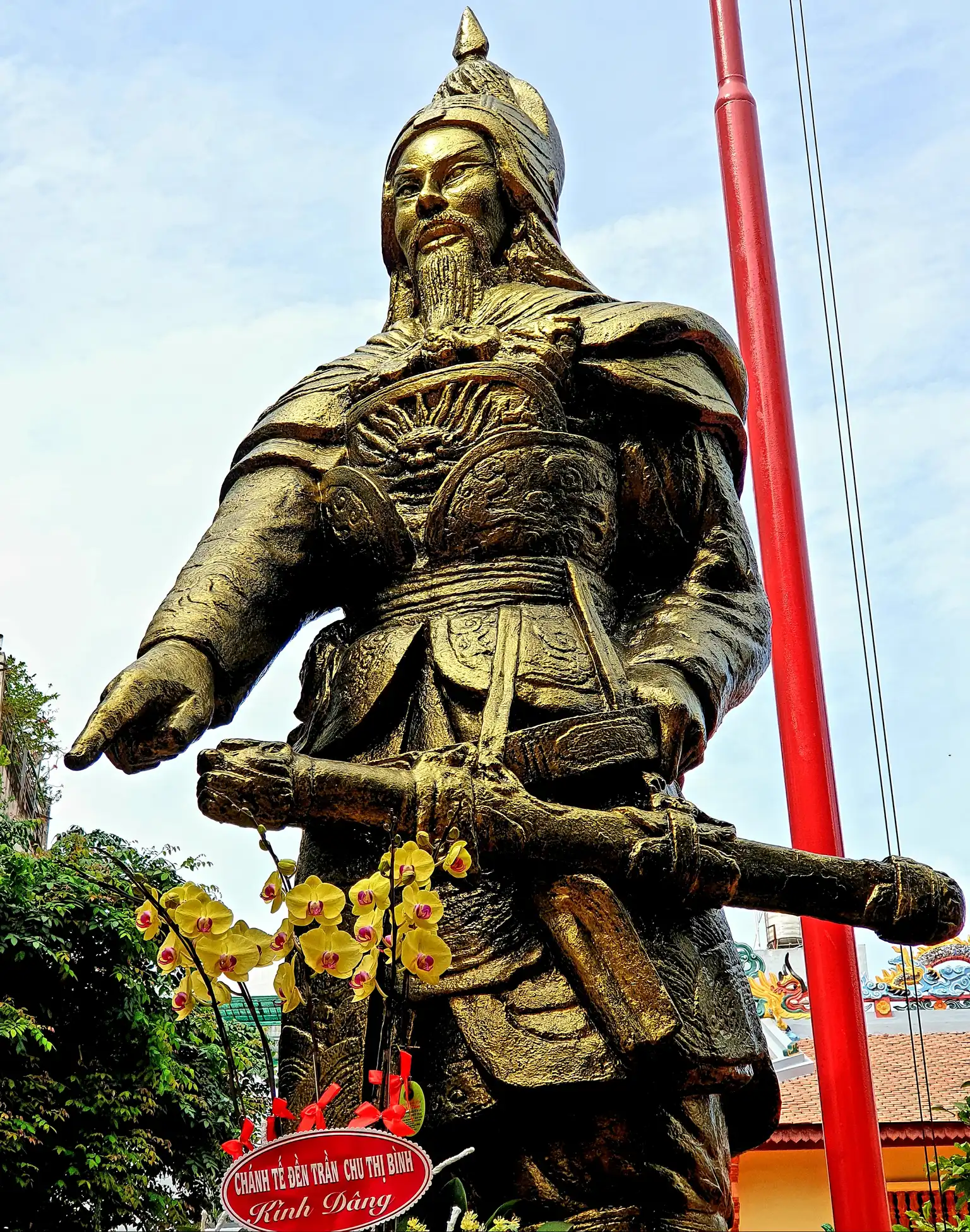
Trần Hưng Đạo
Also known as: Trần Quốc Tuấn, Hưng Đạo Đại Vương, Đức Thánh Trần
Birthday
1228
Birth Sign
Capricorn
Birthplace
Thái Bình
Age
Died at 72
About
Trần Hưng Đạo (1228–1300), born Trần Quốc Tuấn, was a Vietnamese royal prince, statesman, and supreme military commander who led the Đại Việt armed forces during the Trần dynasty. He is revered as one of Vietnam's greatest national heroes for successfully repelling two out of three major invasions by the Mongol Empire under Kublai Khan in the late 13th century.
Posthumously deified as Đức Thánh Trần, his legacy extends far beyond his battlefield victories into the realm of spiritual veneration. He is widely worshipped as a deity in Vietnamese folk religion, often invoked during times of national crisis. Countless institutions, from schools to military units, bear his name, cementing his status as an enduring symbol of Vietnamese resistance and patriotism.
Early Life & Background
Trần Quốc Tuấn entered the world in 1228 within the territory of modern-day Thái Bình province, though some accounts suggest his family seat lay closer to Hanoi. He was born into the imperial Trần clan as the son of Prince Trần Liễu, the elder brother of Emperor Trần Thái Tông. His early years were defined by complex political tensions; his father had been forced to cede his claim to the throne to his younger brother, creating a strained relationship between the uncle and nephew that lingered until Trần Quốc Tuấn matured. Despite this familial friction and the shadow of his father's earlier disgraces, the young prince received an elite education focused on Confucian classics, military strategy, and statecraft.
By his youth, he had already distinguished himself through sharp intellect and strategic acumen, earning the respect of the court despite the lingering stigma attached to his lineage. He prepared for high office not through birthright alone but by demonstrating a profound understanding of governance and warfare. His formative experiences were marked by the need to navigate a volatile court while mastering the arts of leadership. These early years laid the groundwork for his future role, transforming a prince with a complicated family background into a disciplined leader ready to face the existential threats looming over Đại Việt.
Career Growth
Trần Quốc Tuấn's rise to power began with appointments to high-ranking government positions before he ascended to the role of Grand General. His pivotal moment arrived in 1258 during the first Mongol invasion, where he played a crucial role in organizing the defense of Thăng Long and executing the scorched earth policy that would become his signature tactic. His career reached its zenith during the second and third Mongol invasions when he served as Supreme Commander.
In 1285, facing a massive army led by Prince Toghan, he unified disparate Vietnamese forces and employed guerrilla warfare to harass overextended supply lines. Despite initial setbacks including the loss of the capital, his leadership culminated in a decisive victory that drove the Yuan forces back to China. Three years later, during the third invasion, he orchestrated the famous ambush on the Bạch Đằng River in April 1288. By planting iron-tipped stakes underwater and timing the attack with the tide, his forces destroyed the majority of the Yuan fleet, capturing Prince Toghan and ending the Mongol threat permanently. Following these victories, he retired from active command but remained a key advisor, writing influential military treatises like Hịch tướng sĩ and Bình Ngô sách that remain foundational texts in Vietnamese military history.
Career Timeline
Public Image & Style
Trần Quốc Tuấn is remembered as the archetype of the loyal and strategic leader. His public persona was built on unwavering dedication to the state and a mastery of psychological warfare. Media and historical texts portray him as a man who prioritized the survival of his people over personal glory, often sacrificing comfort and safety to lead from the front. His writings reveal a deep emotional connection to his soldiers, describing nights spent awake in anguish over the fate of the nation.
Today, his image is one of sanctity and strength. Statues and temples depict him as a dignified figure clad in armor, representing the unbreakable spirit of Vietnam. He is viewed not merely as a conqueror of armies but as a guardian of culture and identity, a figure whose wisdom transcends the centuries.
Fame & Fandom
iFANN has not yet collected fame data for this person. As a historical figure from the 13th century, he does not appear in modern global fame rankings or social media metrics. The concept of a modern fandom does not apply to him in the traditional sense.
However, his "fanbase" is the entire nation of Vietnam and the global community of Sinologists and historians. Devotees identify simply as followers of Đức Thánh Trần. Their engagement takes the form of annual festivals held at his temples, offering incense, and reciting his poems. Notable campaigns include the preservation of his temples and the continued study of his military strategies. He is a central figure in Vietnamese identity, often invoked during times of national crisis, serving as a spiritual anchor for the country's cultural heritage.
Interesting Facts and Legends
Trần Quốc Tuấn pioneered the systematic use of scorched earth tactics against the Mongols, ordering the evacuation of civilians and the destruction of crops to starve the invading army. This strategy proved devastatingly effective and is still studied in military academies today. The battle of Bạch Đằng is considered one of the most significant naval battles in history, showcasing his ability to utilize tides and hidden stakes to destroy a vastly superior fleet.
He is one of the few figures in Vietnamese history to be worshipped as both a historical general and a deity in the Taoist-Buddhist-Folk syncretic tradition. Born as Trần Quốc Tuấn, he adopted the title "Hưng Đạo" (Glory and Way) later in life, which became his primary moniker. His writings, particularly Hịch tướng sĩ, are mandatory reading in Vietnamese schools and serve as a model of patriotic literature, inspiring generations of students with their call to defend the nation.
Notable Quotes
“Military orders must be strictly enforced, and military laws must be carried out.”
“I often forget to eat at mealtime and slap my knees at midnight; my intestines feel as if they are being cut, and my eyes are filled with tears; I only hate that I cannot tear open your flesh, strip your skin, swallow your liver, and drink your blood [the enemy's].”
Family & Personal Life
Trần Quốc Tuấn was married to Princess Thiên Thành, a daughter of Emperor Trần Thái Tông. This marriage solidified his position within the royal family, bridging the gap between his lineage and the reigning emperor. Historical records indicate they had children who continued the Trần line, though specific details regarding their names and birthdates are less documented than his public deeds. Unlike modern celebrities, there is no record of dating history, engagements, or divorces in the modern sense; his marital status was defined by dynastic alliance, and he remained married to Princess Thiên Thành until his death.
Notable Connections
Relationships & Dating History
Trần Quốc Tuấn's personal life was defined by a single, politically significant marriage rather than a series of romantic relationships. He wed Princess Thiên Thành, the daughter of Emperor Trần Thái Tông, a union that served to strengthen the bonds between different branches of the royal family. This marriage solidified his standing within the court and helped heal the rift caused by his father's earlier succession dispute. Historical records confirm they had children together, ensuring the continuation of his lineage, though the specific names of his offspring are not well-documented compared to his public achievements.
Unlike modern figures, there is no record of engagements, divorces, or other partnerships. His relationship with Princess Thiên Thành lasted until his death in 1300. At the time of his passing, he was widowed by her prior death or simply survived by her, depending on the exact timeline of her passing, but the marriage remained his sole domestic bond throughout his life. The focus of his existence was entirely on the state and the military, leaving little room for the private dramas that characterize modern celebrity relationships.
Death & Aftermath
Died
1300-10-03 (aged 72)
Death Place
Hải Dương
Cause of Death
Natural causes
Trần Quốc Tuấn passed away on October 3, 1300, at the age of 72 in Hải Dương. His death was not a sudden tragedy but the peaceful conclusion of a long life dedicated to the defense of Đại Việt. Authorities and historians record his passing as natural, consistent with his advanced age for the era. There were no legal investigations or disputes following his death, as he was a revered figure whose end was expected by the court and the people.
The reaction to his death transcended mourning and immediately shifted into veneration. The Trần dynasty and subsequent Vietnamese rulers elevated him to the status of a deity, establishing the cult known as Đức Thánh Trần. This spiritual transformation meant he was no longer just a historical general but a divine protector capable of intervening in both military affairs and daily life. Temples dedicated to his worship sprang up across the country, with the most significant located at Vạn Kiếp in Chí Linh, where his remains were originally interred before being moved to a mausoleum.
His legacy was cemented through state-sponsored rituals and the construction of shrines that continue to serve as pilgrimage sites today. The annual festivals held in his honor involve incense offerings and recitations of his military treatises, ensuring his teachings remain part of the national consciousness. While there were no estate disputes or financial settlements recorded in the modern sense, his cultural wealth became a permanent asset of the Vietnamese identity. The posthumous honors included the naming of countless schools, streets, and military units after him, transforming his personal history into a foundational element of the nation's collective memory.
Net Worth (Estate Value)
$0
iFANN Editorial Team estimate
Awards & Accolades
View 6 records, honours and achievementsKnown For
Battle of Bạch Đằng
1288 · Commander
Repelling Mongol Invasions
1285 · Supreme Commander
Hịch tướng sĩ
1285 · Author
Keywords
Sources
Quick Facts
- Profession
- military leader, military officer
- Born
- +1228
- Birthplace
- Thái Bình
- Died
- +1300-10-03
- Death Place
- Hải Dương
- Gender
- Male
- Spouse
- Công chúa Thiên Thành
Personal Details
- Full Name
- Trần Quốc Tuấn
- Spouse
- Công chúa Thiên Thành
- Education
- Confucian classics, military strategy, statecraft
Frequently Asked Questions
Who was Trần Hưng Đạo?
When did Trần Hưng Đạo die?
What is the Battle of Bạch Đằng?
Why is Trần Hưng Đạo worshipped?
Did Trần Hưng Đạo write any books?
Similar People
Join the community
fans discussing