 United Kingdom
“This is a movie that grabs you by the throat and doesn't let go.”
Roger Ebert
Chicago Sun-Times
Part of a Collection
Trainspotting Collection
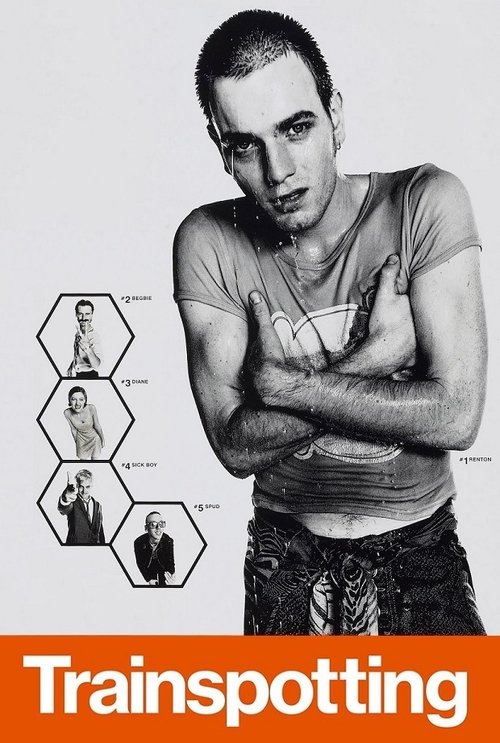
In 1996, a low-budget Scottish film about heroin addicts became an international sensation. Trainspotting, directed by Danny Boyle, cost just $4 million to make and grossed over $71 million worldwide. It turned Ewan McGregor into a star and made its soundtrack, featuring Iggy Pop's "Lust for Life" and Underworld's "Born Slippy .NUXX", a cultural touchstone for a generation.
The film follows Mark Renton, a young Edinburgh addict who wants to quit but can't escape the gravitational pull of his friends: the charismatic schemer Sick Boy, the psychotic Begbie, the lovable loser Spud, and the tragic Tommy. Kelly Macdonald, in her debut, plays Diane, a sharp-tongued schoolgirl who sees through Renton's bullshit. Based on Irvine Welsh's 1993 novel, the movie uses jump cuts, surreal hallucinations, and a blistering energy to plunge viewers into the highs and hellish lows of addiction.
Boyle and screenwriter John Hodge transformed Welsh's dialect-heavy book into a visual assault that's both hilarious and harrowing. The infamous "Worst Toilet in Scotland" scene, the dead baby hallucination, the cold-turkey withdrawal sequence, these images became instantly iconic. The film earned an Academy Award nomination for Best Adapted Screenplay and won the BAFTA for the same category. It remains one of the most influential British films of the 1990s, a raw, funny, and unflinching look at a world most people would rather ignore.
Availability and pricing can change. Confirm on the provider's site before purchasing.
Mark Renton is a young man living in the housing schemes of Edinburgh, deep in the grip of heroin addiction. He and his friends, the cunning Sick Boy, the violent Begbie, the dim-witted Spud, and the athletic Tommy, spend their days scoring drugs, stealing to fund their habits, and hanging out in squalid flats. Renton occasionally tries to quit, delivering a famous monologue about choosing life, a career, a mortgage, a family, but the pull of the needle always wins.
The group's dynamics are volatile. Begbie doesn't use heroin; he prefers alcohol and violence, and his unpredictable rage keeps everyone on edge. Sick Boy is a manipulative narcissist who uses his charm to get what he wants. Spud is good-natured but hopelessly incompetent, often the fall guy for their schemes. Tommy, meanwhile, is the only one with a stable relationship and a job, until his girlfriend leaves him after Renton's interference, sending him spiraling into addiction.
Renton's life takes a turn when he meets Diane, a confident underage girl who quickly becomes his lover. She brings a strange stability to his chaos, but even she can't stop his relapses. After a particularly harrowing overdose, during which Renton nearly dies and is wheeled into a hospital, he is sent to live with his parents in the suburbs. There, he goes through cold turkey, hallucinating and screaming in a room that feels like a prison. He emerges clean, and for a while, he moves to London, gets a job as a real estate agent, and tries to live a straight life.
But his past won't let him go. Begbie, on the run after a botched robbery, shows up at Renton's London flat. Soon Sick Boy and Spud follow, and the four are reunited. Sick Boy has a plan: buy a large quantity of high-grade heroin from a gangster in Edinburgh, then sell it in London for a huge profit. Renton, despite his clean life, is drawn back in. The deal goes down, but Begbie's paranoia and violence threaten to unravel everything. Renton sees his chance to escape, but only if he's willing to leave his friends behind for good.
The film builds to a tense, chaotic climax in a London hotel room, where the money and the drugs are all on the table. Renton must make a choice that will define the rest of his life.
Official 30th Anniversary 4K Restoration Trailer
Official UK Re-release Trailer
Official Trailer
Critical Consensus
A visceral, darkly funny, and stylishly directed look at heroin addiction, Trainspotting is a landmark of 1990s British cinema that balances its gritty subject matter with kinetic energy and dark humor.
“This is a movie that grabs you by the throat and doesn't let go.”
Roger Ebert
Chicago Sun-Times
“Danny Boyle's audacious and energetic film is a raw, unflinching, and surprisingly empathetic portrayal of addiction.”
David Stratton
Variety
“A bold, exhilarating, and often shocking journey into the underbelly of addiction, Trainspotting is unforgettable.”
Peter Travers
Rolling Stone
“Trainspotting is a film that is both outrageously funny and deeply disturbing, a testament to the power of its subject matter and its filmmakers.”
Janet Maslin
The New York Times
Ewan McGregor
Renton
Ewen Bremner
Spud
Jonny Lee Miller
Sick Boy
Kevin McKidd
Tommy
Robert Carlyle
Begbie
Kelly Macdonald
Diane
Peter Mullan
Swanney
James Cosmo
Renton's Father
Eileen Nicholas
Renton's Mother
Susan Vidler
Allison
Pauline Lynch
Lizzy
Shirley Henderson
Gail
Director
Danny Boyle
Writers
John Hodge, Irvine Welsh
Cinematographer
Brian Tufano
Producer
Andrew Macdonald
Academy Awards (1997)
Best Adapted Screenplay: Nominated
BAFTA Awards (1997)
Best Adapted Screenplay: Won
BAFTA Awards (1997)
Best Film: Nominated
BAFTA Awards (1997)
Best Director: Nominated
BAFTA Awards (1997)
Best Actor in a Supporting Role: Nominated
BAFTA Awards (1997)
Best Editing: Nominated
British Independent Film Awards (1996)
Best Film: Won
Empire Awards (1997)
Best British Film: Won
London Critics Circle Film Awards (1997)
British Film of the Year: Won
Join the community
fans discussing