“Comparisons to TV's 'Miami Vice' are probably inevitable because of the picture's look and sound track. But 'To Live and Die in L.A.' is hotter, faster, kinkier, and has better music.”
Niall Browne
Movies in Focus
 United States
"Revenge fuels a descent into L.A.'s deadly counterfeiting underworld."
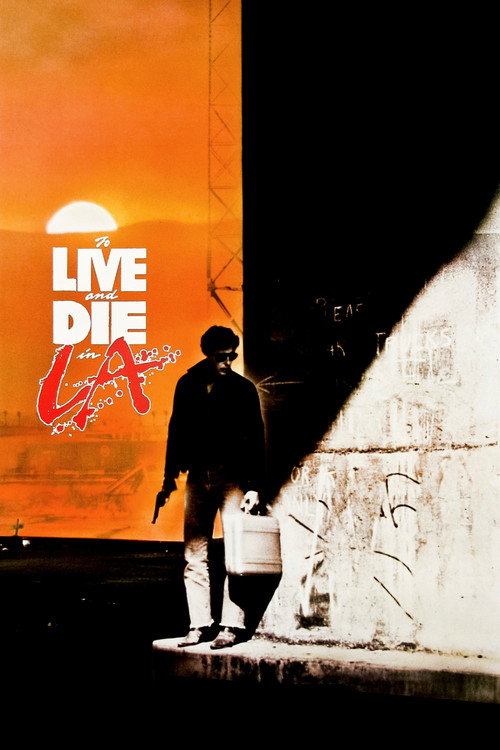
William Friedkin's 1985 crime thriller To Live and Die in L.A. drops viewers into a Los Angeles where the line between lawman and outlaw blurs beyond recognition. The film opens with Secret Service agent Richard Chance (William L. Petersen) and his partner Jim Hart (Michael Greene) thwarting an assassination attempt on President Reagan. Days before Hart's retirement, he is killed while investigating counterfeiter Rick Masters (Willem Dafoe), a gifted artist who has turned his talents to printing flawless fake bills. Chance, reckless and consumed by revenge, vows to bring Masters down, dragging his new by-the-book partner John Vukovich (John Pankow) into a scheme that spirals into robbery and murder.
Friedkin, fresh off the failure of Deal of the Century, worked from a script he co-wrote with Gerald Petievich, adapting Petievich's 1984 novel. The film was shot on location across Los Angeles, capturing the city's gritty underbelly with cinematographer Robby Müller's unflinching lens. Made on a budget of $6 million, it grossed $17.3 million domestically. The production faced challenges, including a lawsuit from Michael Mann over alleged similarities to Miami Vice, which was dismissed. The film's synth-heavy score by Wang Chung, including the hit title track, became as iconic as the visuals, helping cement its cult status.
Critically, the film was a slow burn. Initial reviews were mixed, but over the decades it has been reevaluated as a neo-noir landmark. Its brutal car chase, shot without permits on real freeways, is routinely ranked among cinema's greatest. The shocking mid-film death of its apparent protagonist defied genre conventions and left audiences stunned. Friedkin himself called it one of his favorite films, and it now holds an 87% Rotten Tomatoes score, with many praising its moral complexity and raw energy.
Availability and pricing can change. Confirm on the provider's site before purchasing.
Richard Chance and Jim Hart are Secret Service agents who start the film by stopping a would-be assassin targeting the President. Hart is weeks from retirement, but he takes one last assignment: watching a remote desert warehouse where Eric 'Rick' Masters runs a counterfeiting operation. Masters, a painter who burns his own canvases, treats his illegal work as an art form. When Hart gets too close, Masters and his bodyguard Jack murder him. Chance, known for his reckless tactics, is devastated and vows to avenge his partner.
Chance is paired with John Vukovich, a stickler for procedure. The two begin investigating Masters by leaning on informants, including Ruth Lanier, a woman with underworld ties whom Chance uses coldly. They also pressure Masters' imprisoned associate Carl Cody, who is serving time in a federal penitentiary. The investigation reveals the scale of Masters' operation, which includes a plan to distribute a large batch of counterfeit bills.
To lure Masters into a transaction, Chance needs $30,000 in buy money, three times the authorized limit. When the agency refuses, Chance persuades a reluctant Vukovich to help him rob Thomas Ling, a man Ruth says is carrying $50,000 to purchase stolen diamonds. The robbery at Union Station triggers a spectacular chase through Los Angeles streets and freeways, culminating in a wrong-way pursuit on the 110. During the chaos, Ling's cover people open fire and accidentally kill him. It turns out Ling was an FBI undercover agent.
Chance and Vukovich now have the cash and a body count. They proceed with the plan, setting up a meeting with Masters. Chance's obsession grows, and Vukovich, initially the voice of caution, finds himself drawn into his partner's orbit, compromising his own ethics. The two men close in on Masters, but the counterfeiter is always one step ahead. The narrative builds to a confrontation that will test both agents' loyalties and their definitions of justice.
Original Trailers
Official Trailer
Critical Consensus
A gritty neo-noir that pulls no punches, To Live and Die in L.A. is a visceral thriller with a legendary car chase and a shocking twist. While its dated elements and tonal shifts may divide some, Friedkin's bold direction and a committed cast make it a cult classic worth revisiting.
“Comparisons to TV's 'Miami Vice' are probably inevitable because of the picture's look and sound track. But 'To Live and Die in L.A.' is hotter, faster, kinkier, and has better music.”
Niall Browne
Movies in Focus
“Friedkin's modern noir is a cinematic shot to the face, a bold and brash thriller that grabs your expectations, shakes them to oblivion and then scatters them to the wind.”
Ian Thomas Malone
ianthomasmalone.com
“Friedkin's triumph comes from an extended car chase, one of the best in film history. To Live and Die in L.A. is a rare case of style mattering more than substance.”
Nick Rogers
Midwest Film Journal
“The climax is something worth waiting for, as it hits the viewer unexpectedly and suddenly.”
Fertile Celluloid
IMDb
“One of the very best films of the 1980s this was shamefully neglected and misunderstood by the critics. The problem is: on the surface it's just like an ordinary action crime thriller (and thus won't appeal to the arthouse crowd), except that it makes it difficult to identify yourself with any of the characters. In other words: it violates its genre rules.”
SMK-410
IMDb
William L. Petersen
Richard Chance
Willem Dafoe
Rick Masters
John Pankow
John Vukovich
Debra Feuer
Bianca Torres
John Turturro
Carl Cody
Dean Stockwell
Bob Grimes
Darlanne Fluegel
Ruth Lanier
Michael Greene
Jim Hart
Steve James
Jeff Rice
Robert Downey Sr.
Thomas Bateman
Christopher Allport
Max Waxman
Valentin de Vargas
Judge Filo Cedillo
Director
William Friedkin
Writers
Gerald Petievich, William Friedkin
Composers
Nick Feldman, Jack Hues
Cinematographer
Robby Müller
Producers
Irving H. Levin, Bud S. Smith
Los Angeles Times 'Best Films Set in L.A.' (2008)
Recognition: Selected
Join the community
fans discussing