“Garfield gives a performance of such raw, unvarnished intensity that it feels less like acting and more like a public confession.”
A.O. Scott
The New York Times
 United States
"Don't let your time run out before you sing your song"
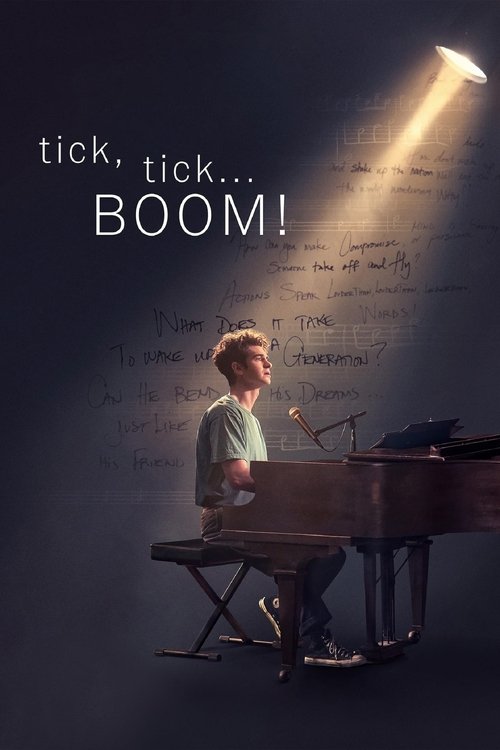
Lin-Manuel Miranda makes his feature film directorial debut with this vibrant adaptation of Jonathan Larson's semi-autobiographical musical. The story tracks the final three weeks in the life of a talented but struggling composer racing to finish his magnum opus while navigating love and friendship in early 1990s New York City. Andrew Garfield anchors the project as Larson, delivering a performance that balances manic creativity with deep-seated anxiety about mortality and artistic failure.
The film captures the specific energy of downtown Manhattan during the winter of 1990, a time when the city felt both electric and dangerous due to the ongoing HIV/AIDS crisis. Larson works as a waiter at a diner while trying to secure funding for Superbia, a futuristic rock opera satirizing media saturation. His personal life remains fraught with tension as he balances his single-minded dedication to art against the practical desires of his girlfriend Susan and the stability offered by his best friend Michael.
Stream
Availability and pricing can change. Confirm on the provider's site before purchasing.
New York City breathes differently in the winter of 1990. The air is cold, the streets are gritty, and the clock on the wall seems louder than usual. Jonathan Larson sits in a diner booth, staring at a napkin covered in musical notation. He is twenty-nine years old and terrified. Every day brings him closer to thirty, a milestone he views not as an achievement but as a deadline. If he has not made it by then, he believes his career will never take off. The pressure is physical, manifesting as a constant tremor in his hands and a tightness in his chest that no amount of coffee can fix.
Jonathan's life revolves around a precarious balance between survival and creation. By day, he waits tables at a local eatery, serving customers who have no idea that the man taking their orders is one of the most gifted composers in the city. By night, he scrambles to find money for his dream project, Superbia. This musical is a wild ride through a dystopian future where people are controlled by screens and advertising. It is ambitious, loud, and deeply personal, yet the producers seem uninterested in hearing more than a few bars of the score. Jonathan feels invisible, trapped in a cycle of rejection and doubt that threatens to swallow him whole.
His relationship with Susan Wilson adds another layer of complexity to his already chaotic existence. Susan wants to be a dancer, and she loves Jonathan, but she also fears what his obsession means for their future. She sees the toll his anxiety takes on his body and spirit. When she suggests marriage or a more stable path, Jonathan hesitates. He cannot imagine settling down when the music inside him demands everything he has. Their conversations often end in silence, heavy with unspoken fears about whether they can survive the next year, let alone a lifetime together.
Michael, Jonathan's best friend, offers a different perspective. Michael has found a semblance of happiness with Carolyn, an actress who is just as driven as Jonathan but willing to compromise to get there. Through Michael, the audience sees the cost of artistic purity versus the rewards of compromise. Carolyn herself is a force of nature, ambitious and sharp-tongued, often clashing with Susan over their respective roles in Jonathan's life. These dynamics create a web of tension that pulls everyone tighter as the days count down.
The backdrop of the story is the looming shadow of the AIDS epidemic. Friends die, neighbors disappear, and the community shrinks. Jonathan remembers David, a mentor whose death haunts every scene. This fear of loss fuels his urgency. He knows time is short, not just for himself but for the world around him. The narrative weaves through flashbacks and fantasy sequences, showing Jonathan imagining his life if he succeeds or fails. These moments blur the line between reality and the heightened emotional state of a man running out of time.
As the deadline for a meeting with potential investors approaches, Jonathan faces writer's block and financial ruin. He argues with his father, who represents traditional values of hard work and stability, contrasting sharply with Jonathan's chaotic vision. The rehearsals for Superbia become battlegrounds where the cast struggles to understand the material. Jonathan pushes them harder, desperate to prove the show is worth producing. The film builds toward a pivotal moment where Jonathan must decide whether to finish the piece or give up. The ticking clock continues to beat, relentless and unforgiving, forcing him to confront the possibility that his dream might remain just that, a dream.
The journey is not linear. There are moments of joy, like a late-night jam session with friends, and crushing lows, like a rejected proposal or a failed audition. Each scene adds weight to the central question: Can Jonathan find the courage to finish his work and embrace the uncertainty of his future? Or will the pressure of time and expectation crush him before he ever gets to sing his song? The story leaves the audience waiting for the final note, wondering if the composer will break through or succumb to the noise.
Official Trailer
Critical Consensus
Critics widely praised Andrew Garfield's transformative performance and Lin-Manuel Miranda's confident directorial debut, noting the film's emotional resonance and vibrant musical numbers. While some reviews felt the pacing occasionally lagged in the second act, the consensus highlighted the movie's ability to capture the urgency of the 1990s theater scene and the universal theme of artistic struggle. The production design and cinematography were frequently lauded for their authenticity, successfully transporting audiences back to a specific era of New York City history.
“Garfield gives a performance of such raw, unvarnished intensity that it feels less like acting and more like a public confession.”
A.O. Scott
The New York Times
“Miranda proves himself a masterful filmmaker, crafting a visual language that matches the kinetic energy of the music.”
Peter Travers
Rolling Stone
“A triumph of heart and hustle, 'Tick, Tick... Boom!' is a love letter to the artists who refuse to give up, even when the clock is ticking.”
David Ehrlich
IndieWire
“Garfield is electric, channeling the manic energy of a man racing against time, while Miranda directs with a warmth that makes every note count.”
Owen Gleiberman
Variety
“A deeply moving and musically dazzling tribute to Jonathan Larson that captures the spirit of the 90s with stunning accuracy.”
Richard Roeper
Chicago Sun-Times
Andrew Garfield
Jonathan Larson
Alexandra Shipp
Susan Wilson
Robin de Jesús
Michael
Michaela Jaé Rodriguez
Carolyn
Ben Levi Ross
Freddy
Bradley Whitford
Stephen Sondheim
Judith Light
Rosa Stevens
Laura Benanti
Judy
Joshua Henry
Roger Bart
Director
Lin-Manuel Miranda
Writer
Steven Levenson
Composers
Jonathan Larson, Lin-Manuel Miranda
Cinematographer
Alice Brooks
Producers
Lin-Manuel Miranda, Brian Grazer, Ron Howard, Julie Oh
Academy Awards (2022)
Best Actor: Nominated
Golden Globe Awards (2022)
Best Actor – Motion Picture Musical or Comedy: Won
BAFTA Awards (2022)
Best Leading Actor: Nominated
Critics' Choice Movie Awards (2022)
Best Actor in a Comedy/Musical: Won
Screen Actors Guild Awards (2022)
Outstanding Performance by a Male Actor in a Leading Role: Nominated
Join the community
fans discussing