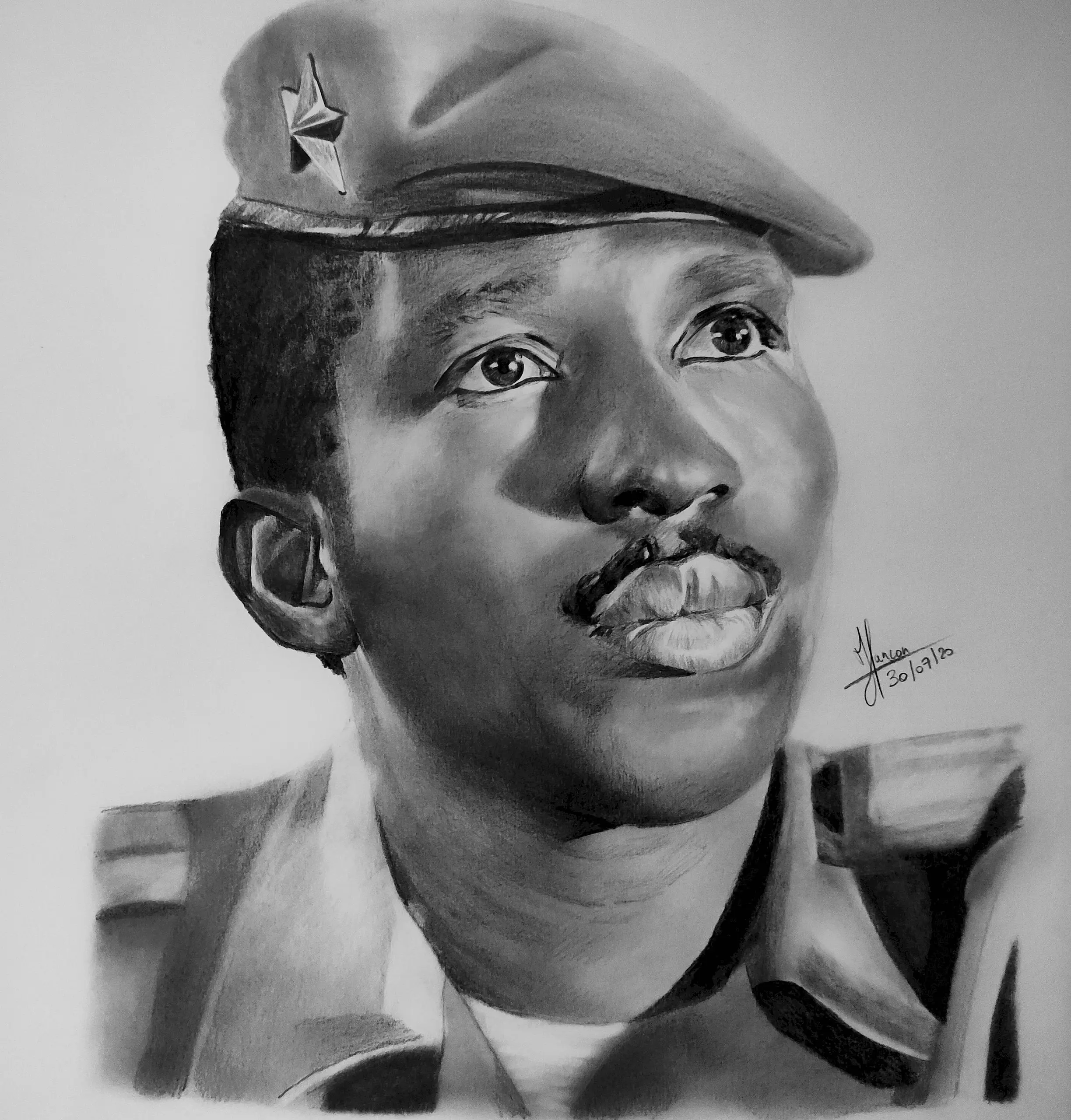
Thomas Sankara
politician•military officer•statesperson
Also known as: Thomas Isidore Noël Sankara
Birthday
December 21, 1949
Birth Sign
Sagittarius
Birthplace
Yako, French Upper Volta
Age
Died at 37
Height
5 ft 9 in (175 cm)
About
Thomas Sankara was a Burkinabé military officer, politician, Marxist and pan-Africanist revolutionary who served as the first president of Burkina Faso from 1983 until his assassination in 1987. He had previously served as the fifth prime minister of Upper Volta from January to May 1983.
A charismatic army captain, Sankara came to power in a popularly supported coup and launched the most ambitious development program in the region, one built on self-reliance, mass mobilization and a refusal of the conditions attached to Western aid. His program touched nearly every village: land reform, literacy drives, immunization, tree planting, railways and an assault on the rural taxes and chiefly tribute that had long weighed on peasants. What set him apart was the refusal to separate the personal from the political. He lived as plainly as he asked the country to live, and that consistency, more than any single policy, made him a symbol.
His enemies were correspondingly broad. Tribal leaders, the old ruling class, and the governments of France and Ivory Coast all read his popularity and his anti-imperialist line as a threat. His revolution lasted four years and ended in gunfire in Ouagadougou. Decades later, a tribunal in the capital formally established that his death was a deliberate plot, and the verdict turned him from a martyr into a legal finding. Today he is quoted by student movements, cited by pan-Africanist parties, and claimed by governments that did not exist in his lifetime.
Early Life & Background
Thomas Isidore Noël Sankara was born on December 21, 1949, in Yako, in what was then French Upper Volta. His father had served in the French army, and the household carried military connections. He was a Sagittarius by birth sign and was raised in a country still shaped by French colonial influence. He came of age in a military molded by that colonial legacy, but his politics developed in the opposite direction: Marxist, pan-Africanist, and fiercely opposed to the money and conditions attached to Western aid.
He entered the military as a young man and trained as an officer. He was sent to Madagascar for military academy training, where he witnessed popular uprisings against a neocolonial government, an experience widely credited with crystallizing his revolutionary politics. He also served in a paratrooper unit and fought in a border war between Upper Volta and Mali in 1974, where his conduct earned him notice.
Before fame, his pivotal moments were these formative military postings and his growing reputation as an austere, incorruptible officer who read widely and refused the perks of rank. He played guitar and led a government band, a detail often misread in search suggestions as a musical act named after him. His early career was that of a soldier who studied the politics of liberation, built a small circle of like-minded officers, and waited for his moment.
Career Growth
Sankara became president of Upper Volta in 1983 at age 33. In four years his government redistributed land to two million people. He renamed the country Burkina Faso, meaning land of the upright people, in 1984, and wrote its national anthem himself. His government ran nationwide literacy and vaccination campaigns, distributing millions of doses to children, built schools, health centers and water reservoirs, and planted more than 10 million trees to hold back the Sahel's desertification.
He outlawed tribute payments and obligatory labor to village chiefs, abolished rural poll taxes, instituted a massive immunization program and built railways. He pushed land reform and agrarian expansion, and moved to ban female circumcision, forced marriages and polygamy. He sold off government luxury cars and refused to run the air conditioning in his office, gestures that kept him popular with a large share of the public. His Committees for the Defense of the Revolution, modeled on Cuba's, and his Popular Revolutionary Tribunals went after officials accused of graft, though Amnesty International criticized the government over arbitrary detentions of political opponents.
Abroad, he rejected IMF loans and made self-sufficiency the center of his foreign policy, though he accepted some aid to diversify its sources. That stance, along with his popularity, alienated tribal leaders, the old ruling class, and the governments of France and Ivory Coast. His four-year revolution ended with his assassination in 1987.
Career Timeline
Public Image & Style
Sankara's public image was built on austerity and directness. He wore simple military fatigues, cycled to work, and spoke in plain, declarative sentences. Media perceived him as a charismatic army captain who rejected the perks of office, and the contrast between the modesty of his personal style and the scale of his development program is what makes his presence distinctive. His posthumous social media voice is carried by clips of his speeches and by merchandise sold by third parties. Statues, streets and squares named for him across Africa and beyond extend that image into public space.
Fame & Fandom (iFAMOUS Rankings)
iFANN has not yet collected fame data for Thomas Sankara, so no rank is stated here. He is not on the September 2026 iFAMOUS Rankings flagship list. His fame rests on his four years in power and on the posthumous circulation of his speeches and ideas. The fanbase has no formal name. His audience is informal: pan-Africanists, students, and political movements across West Africa and beyond who quote his lines on debt and women's emancipation. Annual commemorations every October 15 draw gatherings in Ouagadougou and elsewhere, and his frequent inclusion in lists of great African leaders and pan-African icons keeps him in circulation between them. In 2026 his legacy is a live political battleground, with Burkina Faso's junta under Ibrahim Traoré laying claim to it and commentators debating whether Traoré follows or tramples Sankara's model. Calls to keep Sankarist ideals alive were reported in September 2026.
Interesting Facts and Legends
Sankara was of average height for his era, roughly 1.75 m by most estimates, though no authoritative figure exists. A story fans still retell is his line that 'he who feeds you controls you,' a summary of his position on debt. Another is his declaration that 'the revolution cannot triumph without the emancipation of women.' He holds no Western entertainment-industry awards, since he was a head of state rather than a performer, and the honours attached to him are commemorative: statues, streets and squares named for him across Africa and beyond, annual memorial events, and his standing in lists of great African leaders. He would be 76 in 2026 if living.
Notable Quotes
“He who feeds you controls you.”
“The revolution cannot triumph without the emancipation of women.”
Family & Personal Life
Sankara married Mariam Sankara, who survives him and has been a prominent voice in the decades-long campaign for justice over his killing. The couple had two sons, Ismaël and Philippe. His family life was marked by the same austerity he asked of the country, and the household kept no display of office. Mariam Sankara has not remarried publicly and remains a widow as of 2026. She became the public face of the family's legal fight, attending the proceedings in Ouagadougou that ran for years before the 2021 verdict.
Notable Connections
Relationships & Dating History
Sankara married Mariam Sankara. The historical record documents no other public romantic relationships, no reported dating history, engagements, or high-profile flings beyond his marriage to Mariam. Any claim of additional partners is not supported by credible sources. At the time of his death in 1987, he was married to Mariam Sankara, and his latest reported status is deceased. She has not remarried publicly and remains a widow as of 2026.
- MarriedMariam Sankara? - 1987Married until his death in 1987; they had two sons, Ismaël and Philippe.
Death & Aftermath
Died
October 15, 1987 (aged 37)
Death Place
Ouagadougou, Burkina Faso
Cause of Death
Gunshot wounds
On the morning of October 15, 1987, soldiers loyal to Blaise Compaoré stormed the council building in Ouagadougou and shot Thomas Sankara dead. He was 37 years old. The official account described a 'regrettable' shootout, but the family and prosecutors maintained it was a deliberate assassination plot. Compaoré seized power and held it until the 2014 uprising.
In April 2021, a military tribunal in Ouagadougou convicted Compaoré in absentia and several co-defendants of complicity in Sankara's murder. The verdict followed a long campaign by the family and civil society. The trial established the legal finding of a deliberate plot, though the exact circumstances remain contested in some quarters.
Tributes and annual commemorations every October 15 keep his memory alive. Posthumous books, documentaries including Thomas Sankara: The Upright Man, and reissues of his speeches circulate widely. His legacy is a live political battleground in 2026. Burkina Faso's junta under Ibrahim Traoré has laid claim to Sankara's legacy, with Traoré marking four years in power explicitly following Sankara's model. Jacobin described Traoré as wanting to be 'Thomas Sankara's heir,' while other outlets argue Traoré 'tramples Sankara's legacy,' and Traoré himself has cautioned against comparisons as a 'new Thomas Sankara.' Commentators have analyzed the economics of Thomas Sankara and the Thomas Sankara model for Burkina Faso's political economy. In September 2026 there were calls to keep Sankarist ideals alive. A feminist-legacy retrospective was published in October 2026, and an exiled Burkinabé publisher spoke to RFI about repression and fear four years after the coup.
No conventional estate exists. Posthumous revenue flows mainly through book royalties, documentary licensing, and merchandise sold by third parties rather than an estate-managed enterprise.
Net Worth (Estate Value)
$1 Million
iFANN Editorial Team estimate
No reliable valuation of Sankara's estate exists. His known personal assets were minimal by design, consistent with his austere lifestyle. The iFANN Editorial Team's analysis of his known assets and posthumous revenue points to roughly $1 Million, a figure that reflects book royalties, documentary licensing, and merchandise sold by third parties rather than an estate-managed enterprise. He held no conventional celebrity fortune. His posthumous earnings flow mainly through book royalties, documentary licensing including Thomas Sankara: The Upright Man, and merchandise such as posters and shirts sold by third parties. The estate has no major financial events such as catalog sales or legal settlements. Its financial trajectory over the years has been modest and steady, tied to continuing interest in his speeches and legacy. As of 2026, the figure remains an estimate rather than a documented sum.
Awards & Accolades
View 2 records, honours and achievementsKnown For
President of Burkina Faso
1983-1987 · President
Renaming Upper Volta to Burkina Faso
1984 · Head of state
Nationwide literacy and vaccination campaigns
1980s · President
Planting 10 million trees
1980s · President
Keywords
Sources
Quick Facts
- Profession
- politician, military officer, statesperson
- Born
- +1949-12-21
- Birthplace
- Yako
- Died
- +1987-10-15
- Death Place
- Ouagadougou
- Gender
- Male
- Spouse
- Mariam Sankara
- Birth Sign
- Sagittarius
Personal Details
- Full Name
- Thomas Isidore Noël Sankara
- Height
- 5 ft 9 in (175 cm)
- Spouse
- Mariam Sankara
- Children
- Ismaël Sankara, Philippe Sankara
- Education
- Military academy training in Madagascar
Frequently Asked Questions
Why was Thomas Sankara assassinated?
What was Thomas Sankara famous for?
What was Thomas Sankara's ideology?
What was Thomas Sankara's cause of death?
Was Thomas Sankara married?
Similar People

Join the community
fans discussing