“There Will Be Blood is not just a great movie but a visionary one, a work of immense and awful power that leaves you shaken and awed.”
A.O. Scott
The New York Times
 United States
"There will be greed. There will be vengeance."
User Score
7,486 votes
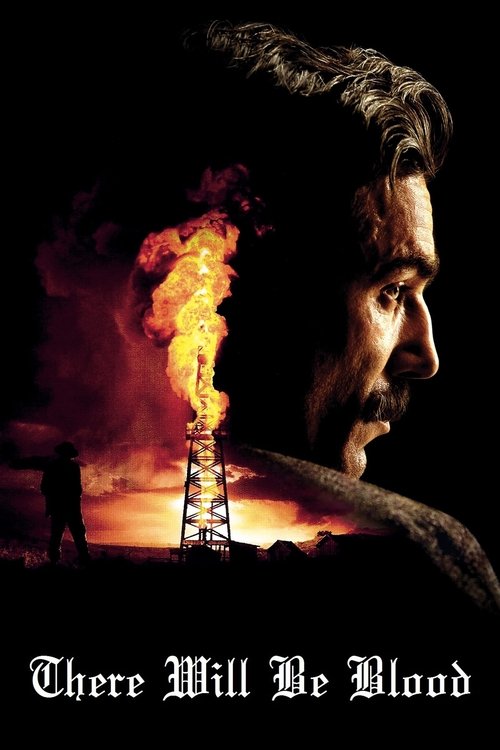
In 1898, a silver miner named Daniel Plainview breaks his leg in a shaft collapse and drags himself to town to file his claim. That opening scene, shot in a single take, sets the tone for a film about men who endure physical and moral ruin in pursuit of wealth. Paul Thomas Anderson's fifth feature, adapted from Upton Sinclair's 1927 novel Oil!, follows Plainview's transformation from a solitary prospector into a monopolistic oil tycoon whose hunger for control consumes everything around him.
Set across three decades in Southern California, the film charts the collision of two kinds of American ambition: Plainview's ruthless capitalism and Eli Sunday's evangelical fervor. Anderson shot in Marfa, Texas, standing in for the arid plains of Kern County, and the landscape itself becomes a character, dusty, vast, indifferent to the men who tear it open. Jonny Greenwood's atonal score, recorded with the BBC Concert Orchestra using scraped strings and prepared piano, underscores the unease that permeates every frame.
Daniel Day-Lewis, who stayed in character for the entire 90-day shoot, delivers a performance built on small gestures: the way Plainview wipes his mouth after a drink, the slight Southern drawl that hardens into a snarl. The film earned eight Academy Award nominations and won two, including Best Actor. It has been ranked by Sight & Sound as one of the greatest films of the 21st century.
Availability and pricing can change. Confirm on the provider's site before purchasing.
Daniel Plainview begins as a lone miner in 1898 New Mexico, digging silver by hand. After breaking his leg in a cave-in, he drags himself to town and files a claim, using the money to start an oil-drilling operation. By 1902 he works alongside a young boy he introduces as his son, H.W. Plainview. The two present a folksy, trustworthy front while Plainview negotiates leases and drills wells across California with brutal efficiency.
In 1911, a man named Paul Sunday approaches Plainview with information about oil-rich land in the remote town of Little Boston. Plainview travels there with H.W. and his foreman Fletcher Hamilton, posing as a family man to win over the Sunday family. The land belongs to Abel Sunday, but the real power in the household belongs to his son Eli, a charismatic preacher who leads the local Church of the Third Revelation. Plainview secures a lease from Abel, agreeing to a small payment and a promise to donate to Eli's church.
Drilling begins, but tensions rise immediately. Eli demands that Plainview allow him to bless the well before it is uncapped. Plainview refuses and instead gives a mocking blessing himself. When the well blows out in a catastrophic explosion, a worker is killed and H.W. is struck by a blast of natural gas, leaving him permanently deaf. Plainview sends the boy to a school for the deaf in San Francisco, though his motives seem as much about removing a liability as about seeking treatment.
A man named Henry arrives, claiming to be Plainview's long-lost half-brother. Plainview, lonely and paranoid, welcomes him and confides his misanthropic worldview. Meanwhile, Eli pressures Plainview to be baptized in his church as public penance. Plainview reluctantly agrees, enduring a humiliating ceremony in order to secure a pipeline easement from the Sunday family. The baptism is a raw, uncomfortable scene, Eli slaps Plainview and forces him to confess sins, while Plainview's eyes burn with suppressed fury.
Plainview discovers that Henry is not his brother but an impostor named Henry Brands. In a quiet, terrifying scene, Plainview shoots him dead and buries the body. The murder goes unnoticed, and Plainview's business empire expands. Years pass. H.W. returns from school, now a young man fluent in sign language. He confronts Plainview about the adoption, and Plainview coldly reveals that he never loved him, only used him as a business prop. H.W. leaves to start his own oil company in Mexico with Mary Sunday, Eli's sister.
By 1927, Plainview lives alone in a vast, dark mansion, a reclusive alcoholic. The Great Depression has devastated the economy, and Eli Sunday arrives at Plainview's door, a broken man. His church has failed, and he begs Plainview to sign a document allowing him to lease the old Sunday land for a new drilling venture. Plainview, drunk, agrees, but only if Eli humiliates himself by confessing that he is a false prophet and that God is a superstition. Eli complies, weeping.
There Will Be Blood (2007) Original Trailer [FHD]
Critical Consensus
A towering achievement in American cinema, There Will Be Blood features Daniel Day-Lewis's mesmerizing, Oscar-winning performance at its core, supported by Paul Thomas Anderson's masterful direction and Robert Elswit's stunning cinematography, creating an epic meditation on greed, religion, and the corruption of the American dream that remains as powerful today as upon release.
“There Will Be Blood is not just a great movie but a visionary one, a work of immense and awful power that leaves you shaken and awed.”
A.O. Scott
The New York Times
“A stunningly ambitious, brilliantly acted epic that ranks with the best films of the decade, driven by Daniel Day-Lewis's ferocious, career-best performance.”
Todd McCarthy
Variety
“Paul Thomas Anderson's 'There Will Be Blood' is a film of extraordinary power and resonance, a story of greed and religion that feels both timeless and urgently contemporary.”
Roger Ebert
Chicago Sun-Times
“Daniel Day-Lewis gives a titanic, extraordinary performance as a man who becomes a monster, in a film that is as brilliant as it is bleak.”
Peter Bradshaw
The Guardian
“A riveting, epic character study that transcends its period setting to become a timeless parable of American ambition and its dark consequences.”
Kirk Honeycutt
The Hollywood Reporter
Director
Paul Thomas Anderson
Writers
Upton Sinclair, Paul Thomas Anderson
Composer
Jonny Greenwood
Cinematographer
Robert Elswit
Producers
Daniel Lupi, Paul Thomas Anderson, JoAnne Sellar
Academy Award for Best Actor (2008)
Best Actor: Won
Academy Award for Best Cinematography (2008)
Best Cinematography: Won
Academy Award for Best Picture (2008)
Best Picture: Nominated
Academy Award for Best Director (2008)
Best Director: Nominated
Academy Award for Best Adapted Screenplay (2008)
Best Adapted Screenplay: Nominated
Academy Award for Best Film Editing (2008)
Best Film Editing: Nominated
Academy Award for Best Art Direction (2008)
Best Art Direction: Nominated
Academy Award for Best Sound Mixing (2008)
Best Sound Mixing: Nominated
Golden Globe Award for Best Actor – Motion Picture Drama (2008)
Best Actor – Motion Picture Drama: Won
Golden Globe Award for Best Motion Picture – Drama (2008)
Best Motion Picture – Drama: Nominated
Golden Globe Award for Best Director (2008)
Best Director: Nominated
Golden Globe Award for Best Screenplay (2008)
Best Screenplay: Nominated
BAFTA Award for Best Actor in a Leading Role (2008)
Best Actor in a Leading Role: Won
BAFTA Award for Best Cinematography (2008)
Best Cinematography: Won
BAFTA Award for Best Production Design (2008)
Best Production Design: Won
BAFTA Award for Best Sound (2008)
Best Sound: Won
BAFTA Award for Best Film (2008)
Best Film: Nominated
BAFTA Award for Best Director (2008)
Best Director: Nominated
BAFTA Award for Best Adapted Screenplay (2008)
Best Adapted Screenplay: Nominated
BAFTA Award for Best Film Music (2008)
Best Film Music: Nominated
BAFTA Award for Best Makeup & Hair (2008)
Best Makeup & Hair: Nominated
Screen Actors Guild Award for Outstanding Performance by a Male Actor in a Leading Role (2008)
Outstanding Performance by a Male Actor in a Leading Role: Won
Screen Actors Guild Award for Outstanding Performance by a Cast in a Motion Picture (2008)
Outstanding Performance by a Cast in a Motion Picture: Nominated
Join the community
fans discussing