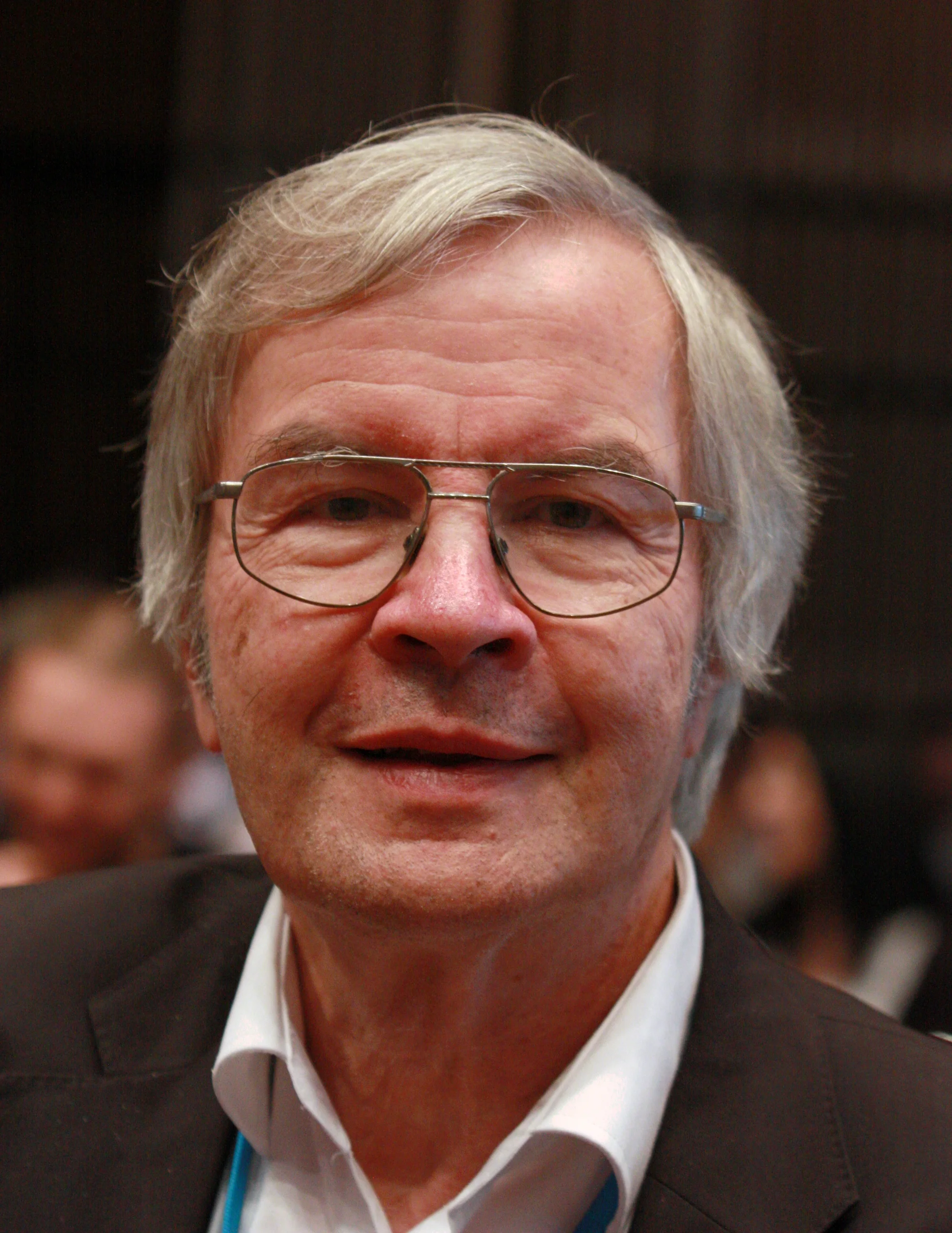
Theodor W. Hänsch
 Germany
Also known as: Theodor Wolfgang Hänsch
Birthday
October 30, 1941
Birth Sign
Sagittarius
Birthplace
Heidelberg, Germany
Age
84 years old
About
Theodor W. Hänsch is a German physicist whose pioneering work in laser-based precision spectroscopy earned him a share of the 2005 Nobel Prize in Physics. He is best known for developing the optical frequency comb technique, a method that allows measurement of optical frequencies with extraordinary precision. Hänsch currently serves as Director emeritus and Scientific Member at the Max Planck Institute for Quantum Optics and holds a professorship at Ludwig-Maximilians University in Munich.
With over 105,000 citations on Google Scholar, Hänsch is among the most influential physicists of his generation. His research has enabled countless applications in optical metrology and high-precision spectroscopy, and his legacy continues through the Theodor W. Hänsch Prize in Quantum Optics, established in his honor by Optica.
Early Life & Background
Born on October 30, 1941, in Heidelberg, Germany, Theodor W. Hänsch grew up amid the backdrop of post-war Germany. He pursued his academic career in physics in his hometown, receiving his Ph.D. from the University of Heidelberg in 1969. His early work included the development of the first narrowband tunable dye laser, a seminal contribution that laid the groundwork for his later achievements in laser spectroscopy.
In 1970, Hänsch moved to the United States to join the faculty at Stanford University. During this period, he devised a scheme for saturation spectroscopy outside the laser cavity that was highly immune to the intensity fluctuations of the still-primitive lasers of that era. This innovation proved crucial for high-resolution spectroscopy and set the stage for his future breakthroughs.
Career Growth
Hänsch's breakthrough came with the development of the optical frequency comb technique in the late 1990s. This revolutionary method uses a train of ultrashort laser pulses to create a spectrum of equally spaced frequencies, enabling precise measurement of optical frequencies. For this work, he was awarded the 2005 Nobel Prize in Physics, sharing the prize with John L. Hall and Roy J. Glauber. He received the prize from King Carl XVI Gustaf of Sweden on December 10, 2005.
Throughout his career, Hänsch has held prestigious positions, including a Chair at Stanford University and a professorship at LMU Munich, where he moved in 1986. He served as Director of the Max Planck Institute for Quantum Optics and continues as Director emeritus. His work has had a profound impact on optical metrology, enabling applications in timekeeping, GPS technology, and fundamental physics research.
Career Timeline
Public Image & Style
In the media, Theodor W. Hänsch is portrayed as a dedicated and pioneering physicist whose work fundamentally advanced laser spectroscopy and quantum optics. His public image is that of a rigorous researcher and educator who shaped the next generation of scientists through his roles at the Max Planck Institute and LMU Munich. There is no documented fandom culture or signature style associated with him, as his public presence is primarily academic and focused on scientific contributions.
Fame & Fandom (iFAMOUS Rankings)
Theodor W. Hänsch commands a quiet but profound reverence within the global scientific community, though he lacks the chaotic energy of pop culture fandoms or the organized rallies seen in entertainment sectors. There is no formal name for his supporters, nor are there subway ads, birthday billboards, or fan-funded projects dedicated to the Nobel laureate. His audience consists primarily of physicists, researchers, and students who revere his contributions to laser spectroscopy rather than any performative persona. The narrative surrounding him is built on peer-reviewed breakthroughs and the rigorous precision of his work, devoid of viral moments or crowd disruptions. Yet, this academic stature has translated into measurable digital prominence within specialized circles. His influence extends far beyond the laboratory, capturing attention across global media coverage and consumption signals worldwide. This reach places him firmly among the most recognized figures in his specific domain of artificial intelligence and advanced physics research. He is currently the 51st most famous person in AI, holding steady from the previous cycle according to the iFANN Global Fame Rankings.
Interesting Facts and Legends
Theodor W. Hänsch holds a seat on the Pontifical Academy of Sciences, an unusual distinction for a physicist that underscores his standing in the broader scientific world. His pioneering frequency comb technique measures optical frequencies with precision rivaling atomic clocks, revolutionizing how time and light are understood. He also created a saturation spectroscopy scheme outside the laser cavity that proved highly immune to intensity fluctuations in early, primitive lasers. His official website remains hosted at the Max Planck Institute for Quantum Optics. Beyond these technical feats, his legacy is anchored by the 2005 Nobel Prize in Physics, where he shared one-fourth of the award for his role in developing laser-based precision spectroscopy. A pivotal moment in his career occurred in the late 1970s when he devised a method to stabilize laser measurements against noise, allowing for unprecedented accuracy. Around the year 2000, working alongside John L. Hall, he developed the frequency comb, a tool using equidistant laser frequencies to unlock new frontiers in optical metrology. These achievements define his story: a rigorous scientist whose work fundamentally altered the landscape of quantum optics without ever seeking the spotlight.
Notable Quotes
“We devised a scheme for saturation spectroscopy outside the laser cavity that was highly immune to the intensity fluctuations of our still primitive lasers.”
“The frequency comb has opened up a new era in optical metrology, allowing measurements with unprecedented precision.”
Family & Personal Life
Details about Hänsch's family life remain largely private. He is married, but his spouse's name and background are not publicly documented. Similarly, no information is available about children or extended family. His dedication to physics research has kept his personal life out of the spotlight, and he has not shared family details in public forums.
Notable Connections
John L. Hall and Roy J. Glauber shared the 2005 Nobel Prize in Physics with Hänsch, recognizing their collective contributions to quantum optics and laser spectroscopy. Hall, a physicist at JILA, worked independently on similar frequency comb techniques, while Glauber's theoretical work laid the foundation for quantum optics. Hänsch has also collaborated with numerous researchers at the Max Planck Institute and LMU, contributing to a vibrant scientific community.
Relationships & Dating History
Public sources do not document any specific romantic relationships, dating history, or marriages for Theodor W. Hänsch beyond the fact that he is married. As a scientist whose life has been dedicated to physics research, his personal relationships have remained private and out of the public eye. There is no publicly available information about dating history, engagements, or divorces. As of 2026, his latest reported status is that he is married, though no details about his spouse are available.
Salary, Net Worth In 2026
$5 Million
iFANN Editorial Team estimate
Per iFANN's editorial analysis, Theodor W. Hänsch's net worth is estimated at $5 Million as of 2026. This figure is primarily derived from his academic salary as a professor and director emeritus, along with prize money from the Nobel Prize, which was approximately 10 million Swedish kronor shared among the three laureates. His financial standing reflects a career dedicated to research and education rather than commercial ventures, with no significant business interests or endorsements reported.
Awards Won (1)
Theodor W. Hänsch's most prestigious accolade is the 2005 Nobel Prize in Physics, which he received for his contributions to laser-based precision spectroscopy, including the optical frequency comb technique. This recognition places him among the most distinguished physicists of his time, and his work continues to influence the field.
2005 · Physics
Laser-based precision spectroscopy
Known For
Nobel Prize in Physics
2005 · Laureate
Optical Frequency Comb
1999 · Developer
Laser Spectroscopy
1970 · Pioneer
Keywords
Sources
Quick Facts
- Profession
- Physicist, University Teacher
- Born
- October 30, 1941
- Birthplace
- Heidelberg, Germany
- Gender
- Male
- Birth Sign
- Sagittarius
Personal Details
- Full Name
- Theodor Wolfgang Hänsch
- Education
- Ph.D. from University of Heidelberg, 1969
Frequently Asked Questions
What did Theodor W. Hänsch win the Nobel Prize for?
Where does Theodor W. Hänsch work?
How old is Theodor W. Hänsch?
Where was Theodor W. Hänsch born?
What is Theodor W. Hänsch known for?
Similar People
Join the community
fans discussing